
Replacing a Tired Foredeck Hatch on a Grand Banks 32
The forward hatch on Onne van der Wal’s 1986 Grand Banks 32, Snow Goose, had seen better days. The lens had become crazed and cloudy, and the hatch no longer held itself open. Rather than attempt repairs on the old unit, Onne decided the most reliable solution was to install a new hatch.
A prior owner had previously replaced the original Grand Banks fiberglass hatch with a Lewmar unit, likely in the 1990s. That aftermarket hatch was a slightly larger size than the factory opening, so the previous installation required modifying the deck’s original cutout. Fortunately, Lewmar still makes a hatch in that size, which simplified the selection process for a modern replacement.
Preparing for the Swap
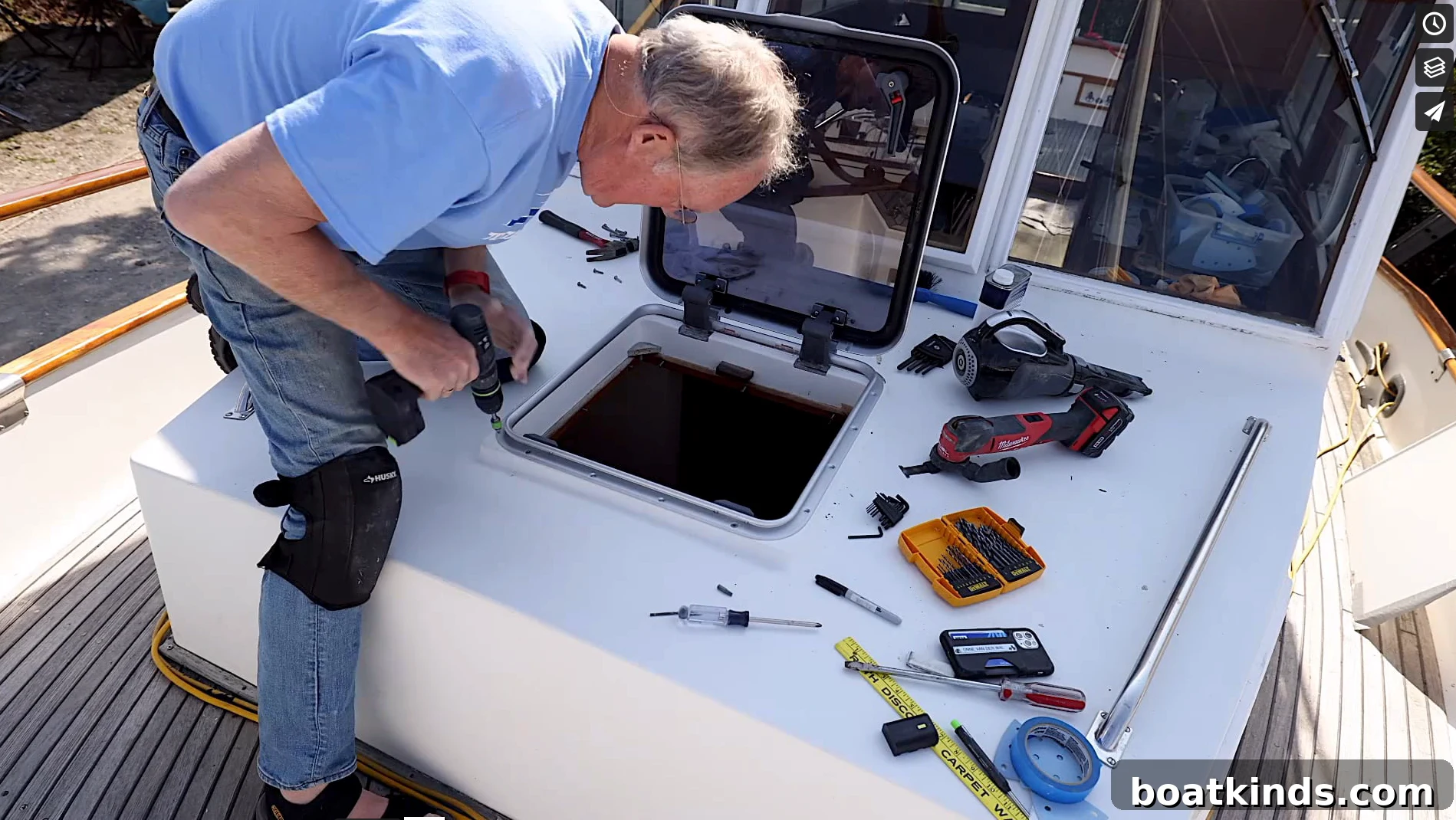
The project proved straightforward with careful planning and the right tools. After removing the fasteners around the old hatch, Onne pried the unit free using a crowbar, taking care not to damage the surrounding deck. The largest challenge wasn’t the removal itself but accommodating the new hatch’s slightly beefier hinges. Those needed small, precise cutouts in the fiberglass where the previous installation had not anticipated the larger hinge dimensions.
Onne made those trim adjustments using a Fein tool and a Milwaukee multitool, shaping the fiberglass to accept the new hinge plates. He worked methodically to avoid overcutting and to maintain the deck’s structural integrity. Once the mechanical fit was confirmed, he cleaned the modified areas thoroughly to prepare for sealing and finishing.
Sealing, Painting, and Dry-Fitting
Before final assembly, all exposed or altered fiberglass surfaces were sealed and painted to restore the deck’s appearance and protect against moisture intrusion. Onne scraped away any loose material from the earlier modification, applied appropriate primers and paints, and let each coat cure fully.
With the surface work complete, he dry-fit the new Lewmar hatch to ensure smooth operation. Checking the opening and closing action before applying any permanent sealant helps identify alignment issues and prevents having to remove a fully-bedded hatch later. Once satisfied with the fit and movement, he applied TotalBoat Seal sealant along the flange to create a watertight bond between the hatch and the deck.
Onne reused the existing stainless-steel screws from the earlier installation. “They were nice stainless-steel screws,” he explains. “There was nothing wrong with them.” Reusing sound fasteners can be both economical and practical when the hardware is in good condition, provided their threads and finishes remain intact.
Care for the New Hatch Seal
New hatch seals often need to adapt to the profile of their frames before they form a secure, weatherproof contact. To allow the rubber seal to “memorize” the hatch frame without being compressed prematurely, Onne deliberately avoided clamping down the dogs fully. “I won’t fully latch it until we get some nice warm weather so the rubber can mold itself into the shape of the frame,” he says. Allowing the seal to settle in warm conditions helps ensure a better long-term seal and reduces the risk of leaks from a seal that has been forced into shape too cold.
Practical Takeaways
This hatch replacement illustrates several useful points for owners tackling similar boat maintenance projects: choose replacement parts that match available sizes when possible; take time to modify and fit hinge areas carefully to avoid overcutting; dry-fit hardware before bedding with sealant; and give new rubber seals a chance to conform to their frames under appropriate temperature conditions. With patience and the right approach, a foredeck hatch replacement can be a manageable DIY task that restores weatherproofing and improves the vessel’s appearance.
You can watch a time-lapse video of the job with Onne’s commentary below.