
Coast Guard Response and Boating Safety Updates
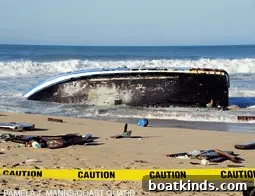
Washed Up
On Jan. 4, contractors began efforts to right a beached 65-foot commercial fishing vessel at Francis State Beach near Half Moon Bay, California. Coast Guard Sector San Francisco pollution investigators monitored the operation to prevent potential environmental impacts during the recovery process.
Responders Rescue Injured Tug Crewmember
Kingston, N.Y. — A coordinated response by the Coast Guard and local first responders rescued an injured engineer from a tugboat near Kingston.
The engineer aboard the tug Barbara McAllister sustained a leg injury and became trapped in the engine room while the tug was en route to Albany via the Hudson River. Coast Guard Sector New York’s search-and-rescue command dispatched the cutter Wire to Kingston. The cutter’s crew embarked members of the Kingston Fire Department and Emergency Medical Services to assist with the extraction.
After bringing the injured crewmember aboard the cutter, responders transported him to Kingston Point and transferred him to local EMS for further medical treatment. (Jan. 4)
Disabled Fishing Boat Assisted Off Long Island
Shinnecock, N.Y. — The Coast Guard deployed both a cutter and a rescue helicopter to assist the fishing vessel Neskone, which reported mechanical problems and was adrift about 50 miles south of Shinnecock on Dec. 20.
The Neskone, an 84-foot scallop boat homeported in New Bedford with an active EPIRB, had eight people aboard. A sister boat, the Polaris, attempted to reach the Neskone and tow it early the next morning, arriving around 2 a.m., but rough seas prevented a safe tow. Later, a Coast Guard helicopter delivered needed mechanical parts to the scene.
The Coast Guard cutter Harriet Lane arrived at about 3:30 p.m. with plans to establish a tow and escort the disabled vessel back to New Bedford, Mass. Despite challenging conditions — reported 30-knot winds and 15-foot seas — the Neskone retained a working generator and its crew was reported to be in good spirits. (Dec. 21)
Paddlers Urged to Label Gear for Safety
New York — Coast Guard Sector Long Island Sound is promoting a simple safety campaign: label kayaks, canoes, paddles and other paddlecraft equipment with the owner’s name and contact information. Proper identification helps responders quickly determine whether found gear represents a missing person or simply lost equipment.
Petty Officer First Class Anthony Kozak, a search-and-rescue controller at Sector Long Island Sound, explained the rationale: “If there is a chance that someone is out there and in danger, we’re launching. We want Coast Guard eyes on scene. We’re going to figure out what happened and look for people in the water. Unfortunately, this means that we often spend a lot of time searching the water for people who are safe at home. If we are able to contact the owner and verify the vessel was not in use when we found it, the case can be avoided completely, conserving our search and rescue assets.”
Sector Long Island Sound responded to 53 incidents in 2009 where recreational boats or kayaks were found empty and adrift. One example cited an hourlong small-boat search on Dec. 22 that cost about $400 after an empty kayak was discovered. Longer, multi-asset searches raise costs significantly and divert resources from true emergencies.
To help prevent unnecessary searches and to provide useful leads during real emergencies, the Coast Guard Auxiliary offers free identification stickers through safe boating classes and local events. Paddlers can also use permanent markers or paint to label their equipment and are encouraged to include multiple contact numbers.
Operation Sail Safe Helps Reduce Fatalities on the Hudson
New York, N.Y. — Operation Sail Safe, a multiagency safety and enforcement campaign launched in May 2010, focused efforts to improve recreational boating safety on the upper Hudson River. The operation emphasized vessel boardings by Coast Guard and state or local law enforcement teams to enforce safety regulations and educate boaters.
Coast Guard officials note a meaningful improvement: after fatalities involving recreational boaters in 2008 and 2009, there were no recreational boating fatalities on the upper Hudson in 2010. Lt. j.g. Dave Ruhlig, project officer for Operation Sail Safe, attributes that improvement to safer boating practices and sustained enforcement efforts.
“Many boaters see these boardings as anything from an unpleasant interruption of their day to heavy-handed harassment by the Coast Guard and law enforcement,” said Lt. Cmdr. Michael Batchelder, head of the law enforcement branch at Coast Guard Sector New York. “They are anything but — we’re out there to prevent tragedy.”
Data cited by the Coast Guard show additional progress in reducing unsafe conditions: vessel terminations due to unsafe conditions on the upper Hudson fell from 37 in 2009 to 12 in 2010. Minor violations that required correction also decreased, from 263 notices in 2009 to 75 in 2010.
Despite local improvements, national boating safety challenges remain. In 2009 the Coast Guard recorded 4,730 accidents nationwide, resulting in 736 deaths, more than 3,300 injuries and roughly $36 million in property damage. Common contributing factors include operator inattention and inexperience, excessive speed, poor lookouts and alcohol use. Alcohol accounted for 16 percent of boating deaths in 2009; 86 percent of operators involved in fatal accidents had not received safety instruction. Nearly 75 percent of the 736 victims drowned, and 84 percent of those who drowned were reportedly not wearing life jackets.
“When it comes to protecting our communities, to saving lives on the water and preventing injuries, it is imperative that we maintain our continued vigilance,” said Batchelder. (Dec. 30)