
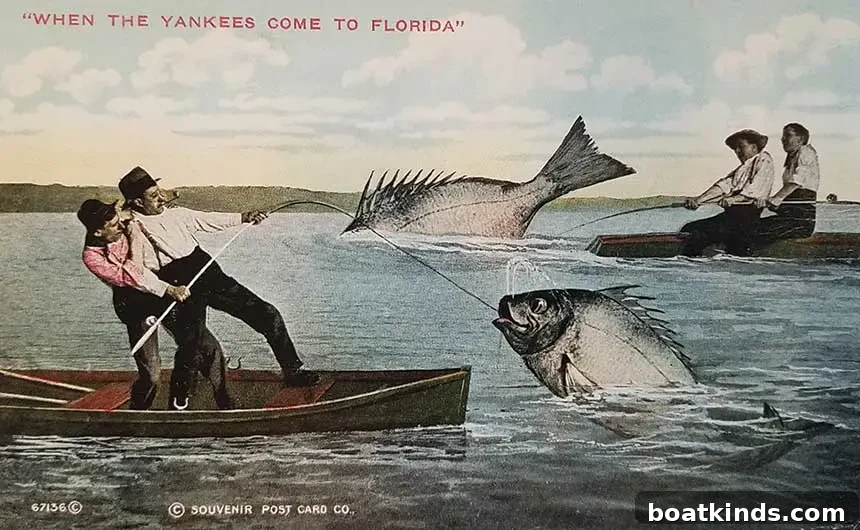
How a Mid-20th Century Postcard Helped Build Florida’s Fishing Legacy
A whimsical mid-20th century novelty postcard from Florida did more than amuse vacationers — it helped entice anglers to the Sunshine State and contributed to the growth of Florida’s world-class recreational fishing industry. These brightly colored cards captured the imagination of out-of-state fishermen and painted a picture of exciting “big catch” opportunities along Florida’s coast.
Postcards were an essential form of communication and promotion in the late 19th and early 20th centuries. When the federal government began issuing postcards in the late 1860s, rules were strict: only an address could appear on the front and a short message on the back. Even so, postcards were instantly popular. They were quicker to write than a full letter and inexpensive to mail — only a penny — making them the era’s equivalent of a short, personal text or a social media post.
The modern picture postcard emerged after 1898, when private production was permitted. Photographic and printing advances allowed vivid illustrations and photographs to fill the front of a card, with the message and address moved to the back. By 1908 the Post Office handled some 700 million postcards, and that same year printer Carl Teich produced the first of his iconic “Greetings from …” cards, featuring bold lettering and saturated colors designed to grab attention.
Civic boosters and tourism promoters embraced the picture postcard as a powerful marketing tool. They used visual exaggeration and playful imagery to advertise towns, attractions, and regional strengths. In Florida, promoters focused on one of the state’s greatest natural draws: its rich fishing opportunities. With more than 700 species of fish found along a pristine 1,350-mile coastline, Florida’s waters promised bonefish, tarpon, marlin, sailfish and many other prized targets — names that sparked images of sportfishing adventures in the minds of anglers across the country.
At the time these cards circulated, Florida’s population was far smaller and less developed than many American cities. The arrival of attractive, colorful postcards depicting trophy catches and sunny beach scenes helped create curiosity and desire to travel south. Improved road access, including the opening of the Keys Highway in 1938, made the state easier to reach and turned postcard-inspired interest into actual visits. As visitors arrived, demand for services followed: fishing camps, bait-and-tackle shops, boat charters and rentals, waterfront restaurants and family motels began to appear along popular stretches of coast and in the Keys.
The picture postcard was both advertisement and souvenir — a tiny portable image that encouraged travel and then gave visitors a keepsake to send home. For anglers, a postcard could promise a dream catch; for local entrepreneurs, it was an inexpensive and highly visible way to promote their businesses. Over time, these small cards helped knit together a growing tourist economy centered on sportfishing and related services, laying the groundwork for the large recreational angling industry Florida is known for today.
Beyond their marketing power, vintage postcards now serve as cultural artifacts. They document how Florida’s image was shaped and sold to the rest of the nation, showing both the hopes of local promoters and the tastes of travelers in past decades. Collectors and historians value them for the stories they tell about leisure, commerce, and the rise of tourism in the Sunshine State.
In short, a single novelty postcard may seem like a minor piece of ephemera, but when multiplied by millions and circulated widely, postcards became a potent force in persuading Americans to head south. Through bold graphics, playful exaggeration and a focus on prized local resources such as sportfishing, these cards played a meaningful role in building Florida’s reputation as a premier destination for anglers and vacationers alike.
This article originally appeared in the July 2020 issue.