
Chris-Craft’s Roamer Steel Boats: The 1959 Fleet and the Shift to Fiberglass
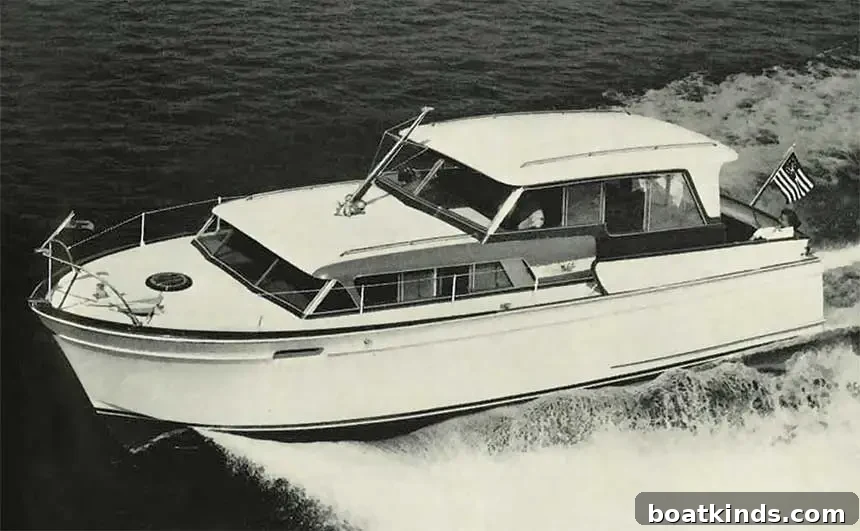
In the late 1950s, the American pleasure-boat market was at a crossroads. Larger builders such as Pacemaker, Owens and Trojan still favored traditional wooden construction for their big models, while a growing number of smaller firms were experimenting with alternative materials: plywood, aluminum and the young technology of fiberglass. Amid that transition, Chris-Craft—then the nation’s largest boatbuilder, producing 159 models at 11 different plants—began testing new approaches. The company’s first use of fiberglass appeared in 1955 on the fins of its 18- and 21-foot Cobra runabouts, but it also made a decisive move into steel construction a few years later.
In 1957 Chris-Craft acquired the Roamer Boat Co., a builder of steel boats based in Holland, Michigan, and organized the acquired operation as the Roamer Steel Boats Division in Pompano Beach, Florida. Roamer boats were notable for their robust, modified-V hulls, fabricated from electronic-resistance-welded steel plates. Those plates were paired with corrosion-resistant alloy and mounted on heavy steel frames, producing a hull structure that emphasized strength and longevity. The Roamer line of 1959 included about a dozen models, ranging from a 28-foot express to a fully appointed 52-foot cabin cruiser.
Design and Onboard Comfort
Roamer designs of that era were recognizable by their low silhouette and moderate, uninterrupted sheerline, which gave the boats a conservative, purposeful profile. Designers paid close attention to weight distribution; a relatively low center of gravity helped deliver a stable, comfortable ride in rough water—an important selling point for owners who planned extended cruising or offshore travel.
The 35-foot Regal, redesigned in 1959, illustrates how Chris-Craft and Roamer sought to blend seakeeping and comfort. The redesign widened the beam to create a more generous interior layout without compromising hull performance. The accommodation plan included an owner’s stateroom with a double berth and an adjacent head compartment, a salon lounge and dinette that converted into additional berths, and a practical galley equipped with an icebox, stovetop and sink. Cabin joinery favored blonde, satin-finished mahogany for a warm, traditional yacht-style interior.
Performance for Roamer boats typically relied on twin diesel powerplants. The 35-foot Regal could cruise at better-than-planing speeds, with combined diesel output for some installations reaching as much as 550 horsepower—sufficient to propel the hull to speeds in the 20-plus-knot range under favorable conditions.
The 52-Foot Flagship
The largest model in the 1959 Roamer fleet was the 52-foot cabin cruiser, the line’s flagship. Designed for extended family cruising or a small owner-operator program with crew, that model offered sleeping space for up to ten people, including crew quarters. The accommodation package featured two head compartments with the option of showers and a well-equipped galley with an icebox, stove and dinette—comforts that underscored the boat’s role as a long-range, liveaboard-capable cruiser.
Why Steel—and Why Fiberglass Took Over
Steel construction provided clear advantages: structural strength, impact resistance and long-term durability when properly protected from corrosion. Those qualities made steel attractive for larger, heavier displacement hulls and for buyers who prioritized toughness and seakeeping. At the same time, steel has inherent compromises—weight, susceptibility to rust without careful maintenance, and higher construction costs—that limited its appeal for certain recreational buyers.
By the 1960s and 1970s, advancements in fiberglass technology and composite construction transformed the industry. New resins, improved molding techniques, and the introduction of lightweight foam cores and sandwich construction produced strong, lighter hulls that required less maintenance than steel and wood. Fiberglass allowed builders to produce complex shapes and larger production runs more economically, and the material’s corrosion-resistant properties appealed to recreational boat buyers. Those factors steadily eroded the market for steel pleasure boats.
Chris-Craft ultimately responded to market realities. Despite the quality and capability of the Roamer steel designs, the company closed the Roamer Steel Boats Division in 1979 as fiberglass and other composite methods became dominant in production boating.
This article originally appeared in the June 2020 issue.