
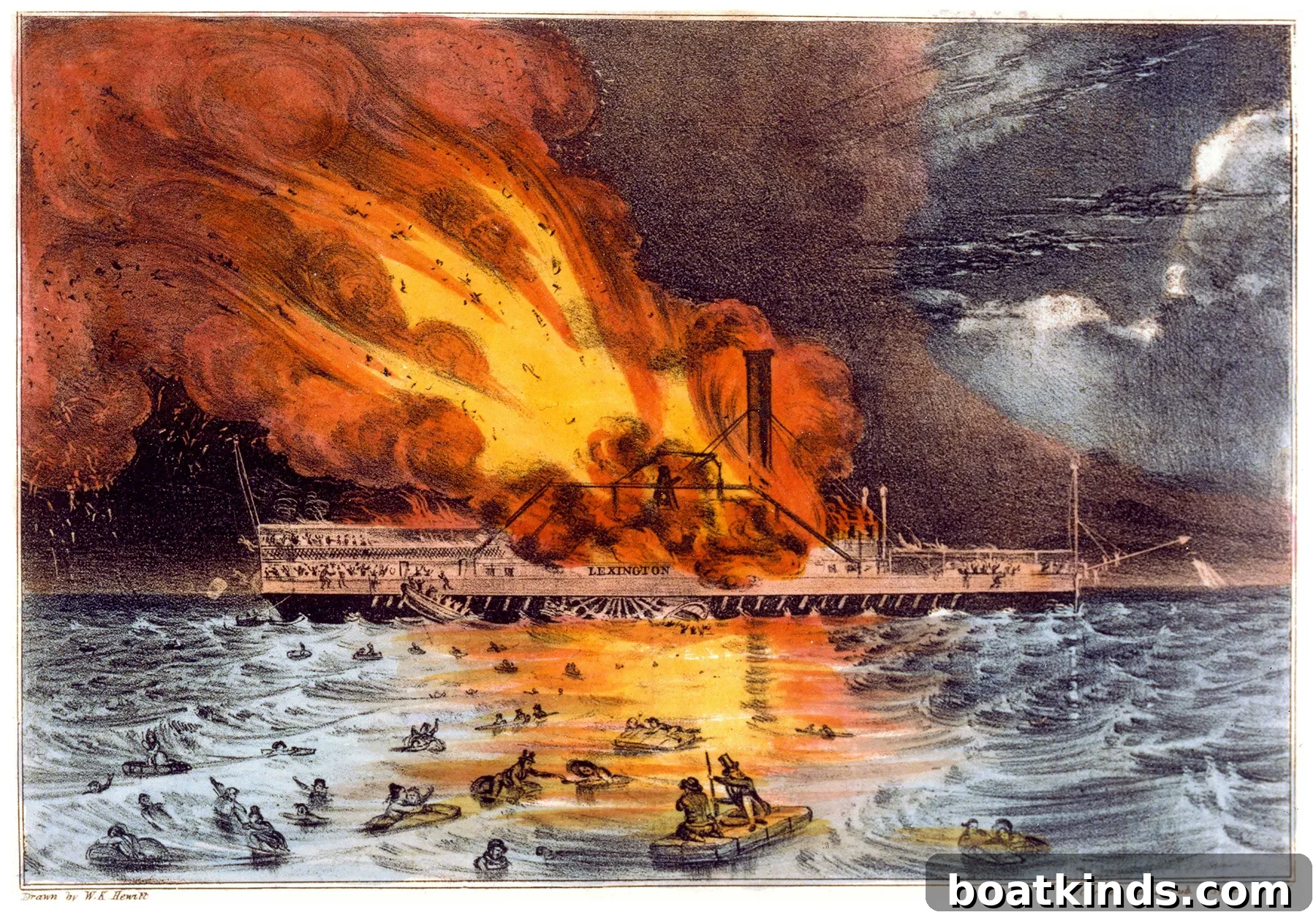
The steamboat Lexington departed its Manhattan pier on a bitterly cold afternoon, January 13, 1840, bound for Stonington, Connecticut. It never reached its destination. Before nightfall, a fire consumed the vessel and all but four of the roughly 150 people on board perished, making the disaster one of the deadliest maritime tragedies in Long Island Sound history.
At the time, the sinking of the Lexington commanded national attention. The steamboat had been launched in 1835 by “Commodore” Cornelius Vanderbilt and was widely promoted as the fastest, safest and most luxurious ship on the Sound. On its maiden voyage, June 1, 1835, the Lexington set a record average speed of 14.7 knots traveling to Providence. In 1838, Vanderbilt pressured the New Jersey Steam Navigation and Transportation Company to purchase the vessel to avoid destructive fare competition. After the sale, the company converted the engine to burn coal and installed blowers that increased furnace heat—changes that later drew scrutiny after the catastrophe.

Before the final voyage, the crew stowed nearly 150 bales of cotton on the main deck. That cargo later proved both a lifesaving buoy for a few survivors and a focal point of controversy about the cause and culpability surrounding the fire. Passengers ranged from businessmen, actors and a Harvard College professor to Mary Russell, who had married the day before. Several oceangoing captains were aboard as passengers, including 24-year-old Chester Hillard, who would play a critical role during the emergency.
The fire was first noticed around 7:30 p.m. as the ship passed north of Huntington, New York. Pilot Stephen Manchester, one of only three surviving crew members, testified at a Manhattan inquest that he saw “the upper deck burning all around the smoke pipe.” Attempts to steer for the nearest land at Eatons Neck were hampered when the tiller rope burned through. A portable pump proved ineffective because its hose ran into the blaze, many fire buckets were unreachable, and engineers were driven from the engine room before they could stop the machinery. Though the vessel continued to move at about 13 miles per hour, crew, officers and passengers worked desperately to launch three lifeboats; all were swamped and lost. Fireman Charles Smith survived by clinging to part of a paddlewheel guard.

Amid the chaos, Chester Hillard urged those about him amidships to remain on board until the ship stopped. He and fireman Benjamin Cox climbed onto a cotton bale and pushed it overboard; when the bale capsized around 4 a.m., both managed to get back aboard briefly, though Cox soon lost consciousness and fell into the water. Some 30 people who had gathered on the bow built a raft, but it proved unmanageable. Near midnight, convinced the vessel could not remain afloat, pilot Manchester went overboard and shared a cotton bale with passenger Patrick McKenna, who tragically soon succumbed.
Witnesses on both shores of the Sound saw the flames, but ice-bound harbors prevented many vessels from reaching the burning steamer. The following morning, Capt. Oliver Meeker of the sloop Merchant in Southport, Connecticut, was finally able to sail out and rescued Hillard around 11 a.m., later taking aboard pilot Manchester and fireman Smith.
The most remarkable survival story belonged to second mate David Crowley. He clung alone to a cotton bale until it washed ashore near Riverhead, New York—nearly 50 miles from where he had abandoned the Lexington some 48 hours earlier. Crowley walked about three-quarters of a mile to the home of Matthias and Mary Hutchinson, who treated his frostbitten hands and feet and retrieved the bale for him as a keepsake.
Newspaper coverage of the sinking provoked a national outcry and fierce criticism of the steamboat company and crew. Lithographer Nathaniel Currier produced a dramatic print titled “Awful Conflagration of the Steam Boat Lexington,” created in collaboration with the editors of the New York Sun for special “extra” editions—an image that helped shape the public’s perception of the disaster and may have been the first illustration run in a daily newspaper extra.
A “Jury of Inquest” convened in Manhattan on January 19. While testimony was often conflicting, investigators found the vessel to have been generally well maintained and that compacted cotton bales were not inherently unsafe. Still, after nine days the jurors issued a severe censure of the steamboat inspectors, the company and the officers of the Lexington. Newspapers demanded criminal indictments, but none were brought.
Civil litigation followed. The most consequential case reached the Supreme Court after the Merchants’ Bank in Boston sued for the loss of $25,000 in gold and silver. The court held the steamboat company liable, finding that placing cotton so near the steam chimney amounted to gross negligence.
Salvage efforts continued for years. In 1842 a company attempted to raise the wreck by running cables beneath it; one cable snapped, the hull broke in two and the remains sank again to the bottom of Long Island Sound. Meanwhile, repeated calls for stronger federal safety standards went largely unanswered until Congress enacted the Safety Act of 1852, which tightened inspections, boiler regulations and fire-safety requirements and helped reduce similar accidents on American steamboats.
This story is based on a new book by Bill Bleyer titled “The Sinking of the Steamboat Lexington on Long Island Sound,” published by The History Press in May 2023.
This article was originally published in the May 2023 issue.