
One small boat, one huge ocean
When Peter Nichols’ marriage ended, the last unresolved item between him and his ex-spouse was the fate of Toad, a 27-foot sailboat that had been listed for sale. After it sat for nine months in a yacht broker’s yard with a price tag, Nichols — a Brit — made an unexpected choice: he would sail the boat alone across the Atlantic and try to sell it once he reached Maine. That decision, made in the aftermath of personal upheaval, became the starting point for a journey that is both a practical seamanship story and a quiet, reflective memoir.
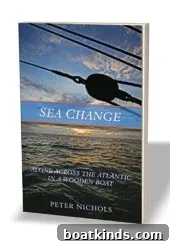
Sea Change, originally published in 1997 and reprinted for a new generation of readers in 2010 (Sea Change, $16.95, Sheridan House Inc.), tells the story of that solitary crossing. Nichols sails without an engine, navigating with a sextant and relying on traditional methods of celestial navigation. The narrative follows the voyage from preparation and departure through the hard, isolated hours at sea, to a critical moment when the boat springs a leak halfway across the passage. Written with a sailor’s attention to practical detail and a memoirist’s eye for emotional truth, the book recounts how Nichols copes with real dangers and small triumphs at sea while confronting the personal consequences of his choices.
The voyage is no mere technical account of seamanship. Nichols uses his time alone on the water to reckon with a broken marriage, to assess his own recklessness, and to re-evaluate the dreams that led him to take such a risk. The passages that describe fixing the leaking hull, improvising repairs, and keeping the small vessel afloat convey both the physical demands of singlehanded sailing and the psychological pressure of facing the ocean’s indifference. At the same time, Nichols reflects on how solitude at sea creates a space for honest self-examination, making the book appealing not only to sailors but also to readers drawn to personal transformation and travel writing.
Nichols is also known for other works that explore extreme voyages and the characters who undertake them. He wrote A Voyage for Madmen, which chronicles the ill-fated 1968 solo race around the world, and Final Voyage: A Story of Arctic Disaster and One Fateful Whaling Season. His background includes work in the film industry as a screenwriter as well as teaching creative writing at New York University, Georgetown University, and Bowdoin College. Now based in Paris, he brings to Sea Change the narrative craft of an experienced storyteller who knows how to balance technical description with evocative scene-setting and thoughtful introspection.
Sea Change appeals to a broad audience. For those interested in small-boat adventure and traditional navigation, Nichols’ account provides clear, engaging descriptions of how a lone sailor manages a long offshore passage using limited equipment. For readers who enjoy literary nonfiction, the book offers well-crafted reflections on recovery, resilience, and the personal costs and rewards of choosing an unconventional path. The story of Toad and the Atlantic crossing operates on two levels: it is a concrete tale of seamanship and survival, and it is a quietly moving meditation on the way a solitary journey can recalibrate a life.
This reprint brings Nichols’ experience to contemporary readers who might be discovering his work for the first time or revisiting a memorable maritime memoir. The balance of practical detail and candid introspection makes Sea Change useful as both a record of one man’s Atlantic crossing and a study of what it means to face the unknown alone. Whether you are drawn to the mechanics of sailing, the romance of singlehanded voyages, or the human story of starting over, Nichols’ narrative offers a thoughtful, vividly told account.
This article originally appeared in the Home Waters section of the December 2010 issue.
For more information about the publisher and the reprint, see Sheridan House.