
Sea Trade — Humboldt Bay, 1898
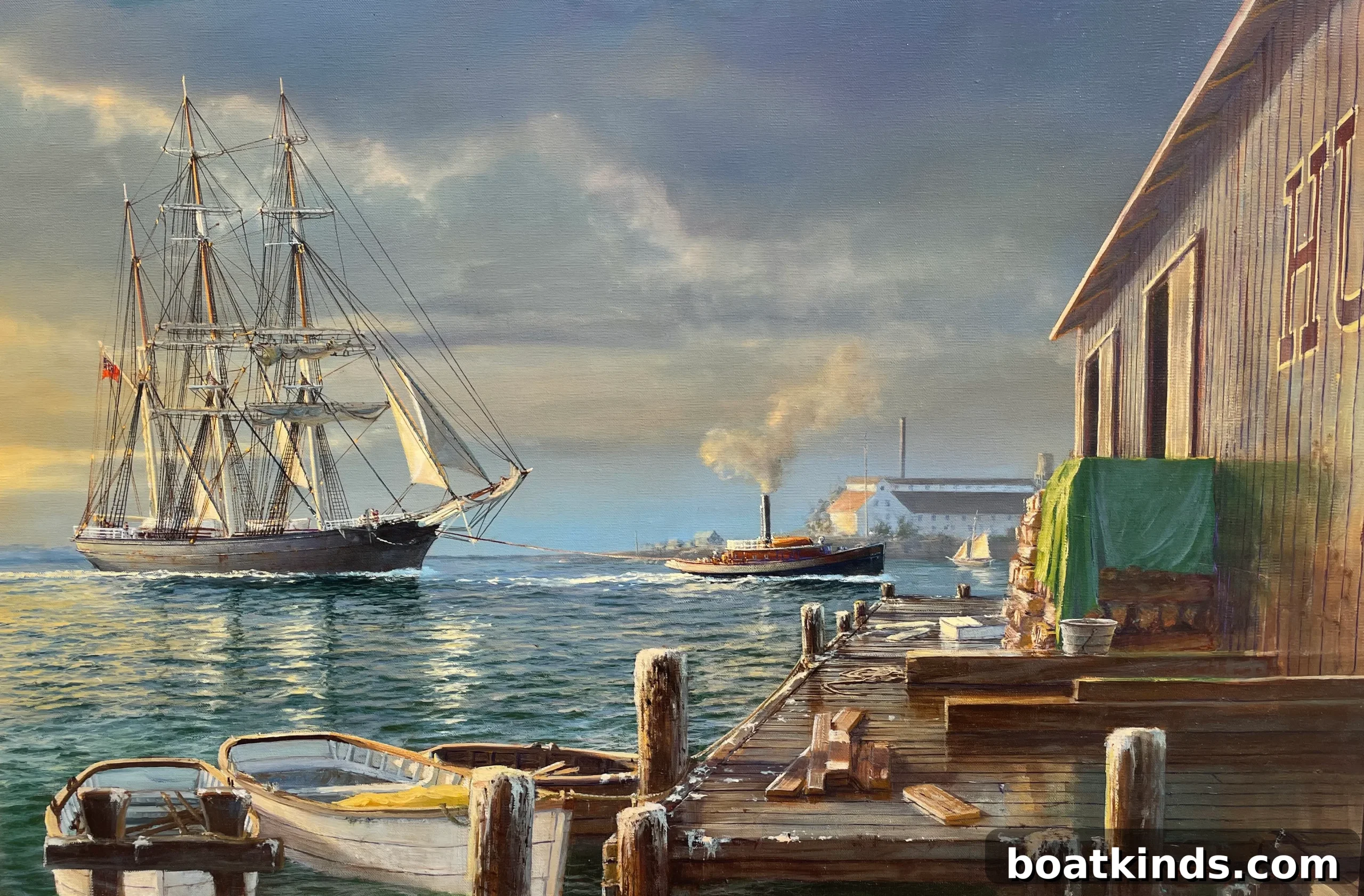
On May 27, 1898, the busy waters of Humboldt Bay, California, formed the backdrop for an era of transition. Euro-American settlement in the region began less than fifty years earlier, when the first ships arrived from San Francisco in the spring of 1850 carrying passengers bound for the gold fields along the Klamath, Salmon and Trinity rivers. As the fervor of the gold rush subsided, the coastal communities redirected their energies toward other abundant regional resources: vast stands of timber, productive salmon runs, and fertile land for agriculture and development.
David Thimgan’s painting Sea Trade captures a moment in that shifting local economy. In the scene, the clippership Woolahra is being towed into Humboldt Bay by the steam tug Ranger. The image brings together two different technologies and eras of maritime commerce: the swift, wind-driven clippers of the mid-19th century and the increasingly dominant steam-powered tugs that helped maneuver larger vessels into crowded harbors. Clippers were purpose-built merchant sailing vessels, prized for their speed and often employed on long-distance runs — notably to China and on routes between New York and California. By the late 1800s, lumber had emerged as one of Humboldt Bay’s principal exports, and shipbuilding had become a major local industry, at one point producing as many as 600 ships per year.
Thimgan specialized in recreating scenes from America’s maritime past, with a particular focus on the West Coast and the Pacific Ocean. His work is notable not only for its atmospheric detail but also for the depth of historical research behind each canvas. Thimgan sought out old photographs, ship records, and archival material to ensure that the vessels, rigging and harbor activity he painted were as accurate as possible. His careful attention to historical detail allowed viewers to connect with both the visual drama of the sea and the economic and social story it represented.
“Getting the story right is an absolutely essential part of my work,” Thimgan said in a 1994 interview for Sea History. “I sort through numerous old photographs to find images of absolutely gorgeous vessels. Many of the names are unknown, but the attraction is there. It is kind of like falling in love with a beautiful woman and not knowing anything about her. I have to find out all I can. The many hours spent sorting out historical puzzles and occasionally solving a small mystery is a painstaking process that can be immensely rewarding.”
Thimgan’s practice of combining visual storytelling with careful scholarship gives Sea Trade the authority of both art and historical record. The painting functions as a window into the mechanics of maritime life at the close of the 19th century — a time when traditional sail-powered merchant ships still shared the water with newer steam vessels, and when ports like Humboldt Bay became hubs for the export of natural resources. The tug and clipper in the painting embody that technological and economic intersection, illustrating how innovation and established practice coexisted in daily port operations.
Beyond its immediate visual appeal, the scene evokes broader themes: the movement of people and goods, the adaptation of communities to changing markets, and the central role of maritime trade in shaping regional identity. For Humboldt Bay and similar West Coast ports, the late 1800s represented a period of rapid growth and industrial activity, driven by logging, fishing and ship construction. The ships built and launched from these yards carried timber, fish and other products to distant markets, linking a rugged coastline to global trade networks.
David Thimgan, who died in 2003, left a legacy of paintings that document and celebrate the maritime past with respect for historical detail and a clear passion for the subject. His work continues to inform and inspire interest in maritime history, offering viewers a textured sense of place and time. This article originally appeared in the November 2022 issue and was prepared with the aim of preserving the historical accuracy and evocative power of Thimgan’s work. — Carly Sisson