
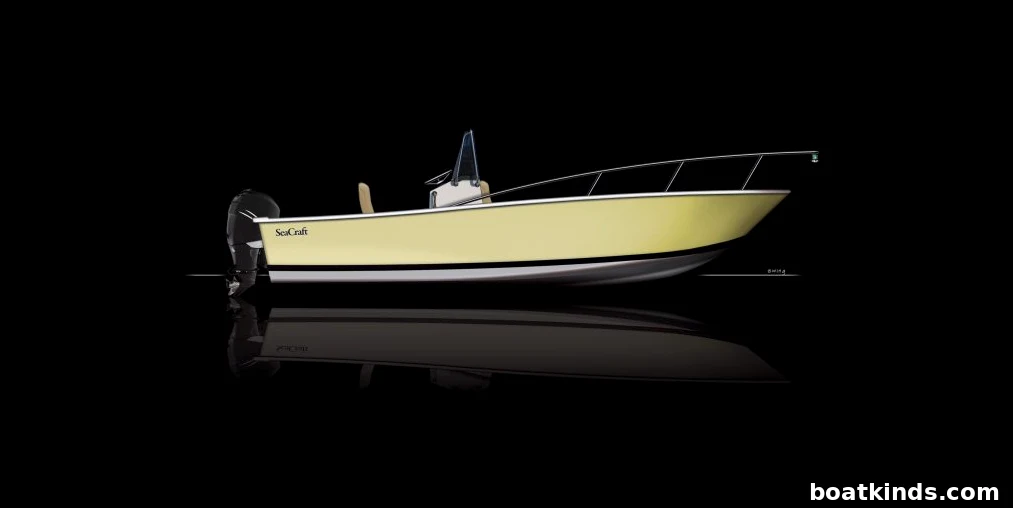
SeaCraft 20: The Pioneer Variable-Deadrise Outboard Open Fisherman
The SeaCraft 20 stands as an important milestone in the early era of fiberglass boatbuilding and hull design. Born out of South Florida’s booming 1960s boat culture, this model reflects a period of rapid innovation when builders experimented with new materials and hull forms to meet growing demand for low-maintenance, high-performance small offshore boats.
Carl Moesly and the South Florida Boatbuilding Boom
Carl Moesly, a Fort Lauderdale native whose background included aviation, business and a lifelong passion for boating, founded SeaCraft in 1961. Using molds acquired from a defunct California builder, Moesly set out to improve on what was then available. Dissatisfied with the initial offerings, he focused his engineering experience on solving a practical problem: a hull that could handle South Florida’s challenging coastal and island conditions while offering comfort, seaworthiness and useful fishing features.
Development of the Variable Deadrise Hull
Applying knowledge from aeronautics and hull design, Moesly developed what became known as the variable deadrise hull. Rather than using a single deadrise angle across the bottom, his design combined multiple deadrise sections: a deep-vee along the centerline to provide better wave-cutting, higher-speed comfort and improved control; with progressively flatter chines moving outward to create stability at low speed and increased load-carrying capacity. This approach sought to blend the best attributes of deep-vee and flatter-bottomed hulls, creating a boat that could perform well offshore and still plane efficiently under load.
Prototype Testing and Racing Success
To validate the concept, Moesly built a 23-foot wooden prototype and entered it in the 1961 Miami-Nassau powerboat race. Although the prototype encountered engine troubles during the event, observers praised the hull form. Boating writer Jim Martenhoff described the craft as a striking design, noting its distinctive longitudinal lines, a sweeping bow and a reverse sheer forward. Despite mechanical setbacks, the prototype’s sea-keeping and handling were judged a success, confirming the promise of the variable deadrise concept.
Following the prototype, the SeaCraft 21 quickly proved competitive on the race circuit, dominating several events and demonstrating that the hull design could deliver both speed and control in ocean conditions.
The SeaCraft 20 Open Fisherman: Features and Performance
In 1967 Moesly introduced the SeaCraft 20 Open Fisherman, the production model that packaged his innovations into a practical offshore fishing boat. Designed as an outboard-powered open fisherman, the SeaCraft 20 combined the new hull form with features intended specifically for anglers: a self-draining cockpit to shed water quickly and improve safety at sea; an outboard well that protected the engine installation while keeping deck space uncluttered; a raised forward casting platform to aid sight fishing and casting; and dedicated storage such as a fishbox and a live well to preserve catches.
Offered with either an 80-hp or 125-hp outboard, the SeaCraft 20 could reach speeds in the mid-30s to around 40 mph depending on conditions and load. Its combination of rough-water handling, practical fishing gear and efficient planing characteristics led contemporaries to call it the first true offshore outboard open fisherman—a small boat capable of reliable offshore work without sacrificing everyday usability.
Legacy and Importance
The SeaCraft 20 represents a transitional moment in small-boat design. It illustrates how practical testing, racing feedback and cross-disciplinary design thinking—bringing aviation principles to marine hulls—can produce meaningful advances. The variable deadrise concept influenced later hull developments by showing how varying deadrise across the bottom can reconcile the competing demands of speed, comfort, stability and load capacity.
Today the SeaCraft 20 is remembered not only for its distinctive hull and successful racing roots but also as an early example of how fiberglass construction and innovative hull geometry reshaped recreational and sportfishing boats for offshore use.
Originally featured in the February 2013 issue.