
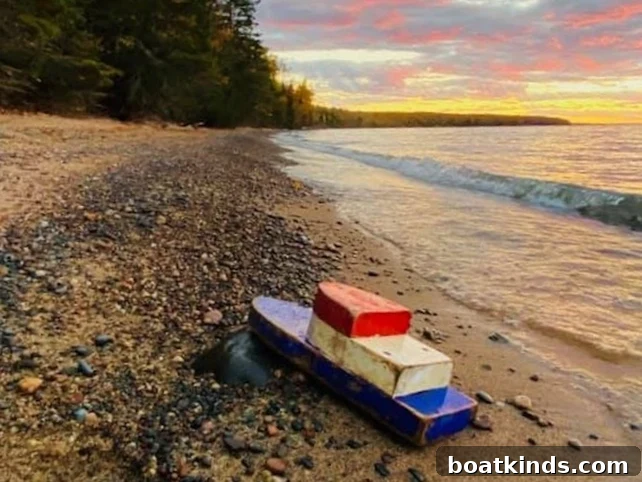
Little Classroom Boat From “Paddle-to-the-Sea” Found on Lake Superior After 27 Years
In 1993, second-grade teachers Brenda Schell and Bonnie Fritch of Duluth, Minnesota, led their class in a lesson inspired by the classic children’s book Paddle-to-the-Sea. After reading the story—about a young Indigenous boy who carves a small wooden canoe and sets it adrift to follow the waterways toward the ocean—the teachers launched two tiny hand-painted boats into Lake Superior as a hands-on classroom experiment.
What began as a simple educational activity became an unexpected long-term experiment in durability, drift and human connection. Decades later, one of those little boats surfaced again in a surprising place and set off a wave of nostalgia across the Duluth community.
The Discovery on the Apostle Islands
While leaf-peeping near the Apostle Islands on Lake Superior, Mike and Lynn Bebeau found a small wooden craft painted red, white and blue. On the boat’s underside was a handwritten message in magic marker asking that whoever found it take a photo and return it to the water. The couple followed those instructions: they photographed the vessel, put it back on the lake, and then reached out to the Duluth school system to report what they had discovered.
The Bebeaus’ discovery confirms that the tiny classroom boat survived far longer than anyone involved in the project expected. Brenda Schell later described her surprise and disbelief that the boat remained intact after 27 years; she had assumed it might last only a few seasons before becoming waterlogged or lost. Instead, the craft continued to float and travel on Lake Superior’s currents for nearly three decades.
Why the Story Resonates
This small episode connects to larger themes that make the original book beloved in classrooms: curiosity about waterways, the idea of sending something out into the world to see where it goes, and the power of storytelling to inspire hands-on learning. For teachers, parents and former students, finding the boat is a concrete reminder of the lessons learned that day—lessons about geography, weather, persistence and respect for nature.
Community interest in the discovery reflects another reason the story resonates: tangible artifacts from childhood memories can trigger strong emotional responses, sparking conversations about continuity, history and local identity. In Duluth, a city shaped by its relationship with Lake Superior, the boat’s survival feels especially meaningful.
What We Know—and What We Don’t
Certain facts are clear: the boats were launched by Schell and Fritch in 1993; one of the small wooden vessels was found near the Apostle Islands decades later by Mike and Lynn Bebeau; the finder photographed the craft and returned it to the lake as requested, then contacted the Duluth school system. Beyond those details, the precise path the boat took over 27 years remains unknown. Lake currents, weather events and shorelines can carry floating objects over long distances and through dynamic conditions, so the boat’s journey is likely a complex mix of drift, beaching and relaunching by waves or other finders.
The message on the boat’s bottom served two practical purposes: it invited documentation by whoever found it, and it asked for the craft to be placed back into the water so its voyage could continue. That simple request underscores the original classroom experiment’s goal—observing movement through natural systems rather than reclaiming the object as a permanent keepsake.
Educational Value and Lasting Impact
Teachers and educators often use projects like this to teach multiple subjects at once: reading and literature are paired with science, geography and environmental stewardship. The boat’s unexpected longevity offers a teachable moment about materials and design—why did this particular small wooden craft survive so long?—and about how human curiosity can sustain an educational initiative far past a single school year.
For former students who participated in the original activity, the news that one of their classroom boats still floats can be a powerful reminder that small acts and small objects can have long, unseen lives. For current educators, the story provides an example of how tangible, creative classroom projects can leave lasting impressions and even become part of local lore.
A Quiet Testament to Time and Place
The tiny, hand-painted boat found on Lake Superior is more than a classroom prop; it is a quiet testament to time, place and human connection. It shows how a simple lesson can ripple outward, touching people decades later in unexpected ways. The boat’s rediscovery also highlights the enduring relationship between communities along Lake Superior and the lake itself—an ongoing conversation between people, stories and the natural world.
While the full itinerary of that small wooden craft may never be known, the discovery reaffirms the value of curiosity-driven learning and the small acts that keep stories alive across generations.