
Listening to Coral Reefs: How AI and Citizen Scientists Are Helping Restore Marine Ecosystems
Picture a classic submarine movie: sonar pings travel through the water, and sailors strain to hear a single echo that reveals an unseen object. Now imagine combining that principle with modern machine learning—and using it to protect and restore the world’s coral reefs. That’s precisely what marine researchers, technologists, and volunteers are doing today.
From Bioacoustics to Big Data
For decades, scientists have studied animal sounds—whales, fish, and other marine life—to understand behavior and communication. Over roughly the last 30 years, the field of bioacoustics has expanded from listening to individual vocalizations to interpreting entire soundscapes. Underwater, sound travels farther and more reliably than light, carrying rich ecological information. These acoustic cues play a vital role for marine animals and now serve as data for researchers.
Advances in affordable and durable recording devices have made long-term monitoring possible. Where researchers once relied on bulky, expensive instruments and students manually trawled hours of audio, compact recorders can now be left on reefs for weeks or months. That steady stream of recordings reveals daily and seasonal patterns: what a healthy reef sounds like, how nocturnal activity differs, and which acoustic signatures indicate recovery or decline.
Scaling Analysis with AI
Manually analyzing thousands of hours of underwater audio is slow and resource-intensive. Students with headphones used to annotate recordings, but a single hour could take a full day to analyze carefully. To scale this work, researchers partnered with Google Research and DeepMind to apply machine learning to bioacoustic data. By training models on months of recordings, AI began identifying patterns and signals that would be impractical for humans to detect at scale. According to researchers, AI identified roughly 100,000 fish sounds in a dataset that would have been far beyond human capacity to review.
The AI system—named SurfPerch—does more than speed up processing. It enables scientists to ask new questions about reef ecosystems, detect early warning signs, and monitor biodiversity in places and times when human observers can’t easily survey. Sound becomes a continuous, non-invasive sensor of reef health.
Citizen Science: Many Ears, Better Data
To train AI effectively, researchers need human-labeled examples. That’s where citizen scientists come in. Google helped develop a platform called Calling in our Corals, where volunteers worldwide learn to listen for fish and other reef sounds, then annotate audio clips. Recruiting a diverse group of listeners helps because hearing varies across individuals—age, language background, and daily environment all influence perception. By pooling many different “ears,” the project creates an “uber-human” collective that can detect signals individual listeners might miss.
Combining crowd-sourced labels from Calling in our Corals with SurfPerch’s machine learning creates a powerful loop: volunteers improve the AI, and the AI helps direct scientific attention to the most important patterns in the data. This synergy expands our ability to monitor reefs across time and space.
Why Acoustic Monitoring Matters for Reef Restoration
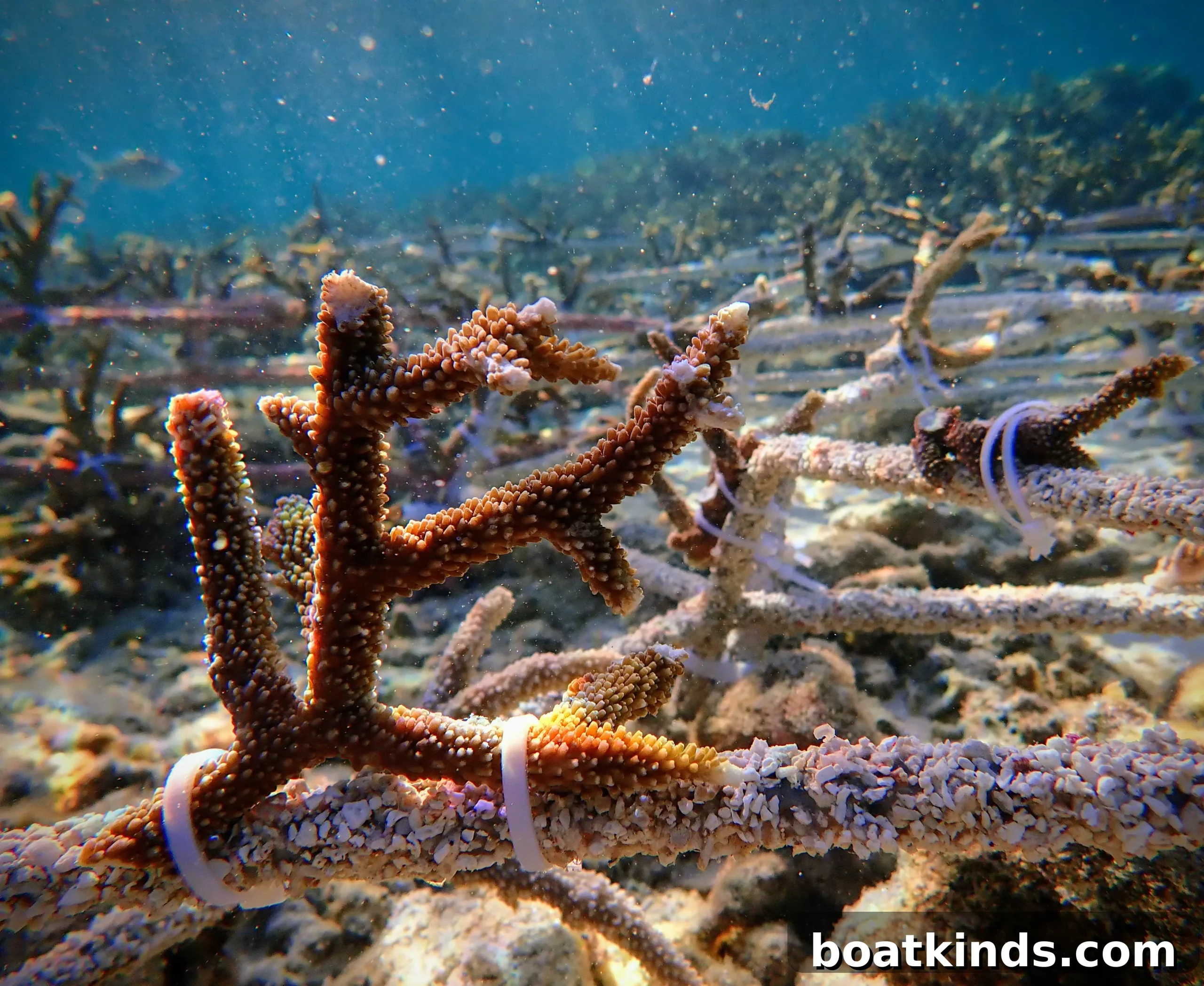
Acoustic monitoring acts as an early-warning system for reefs. Audio can reveal changes well before visible decline is apparent, or before divers can survey remote sites. Many reef species—nocturnal animals, cryptic invertebrates, and small fishes—are difficult to find visually but produce sound. These sonic cues also help other animals locate suitable habitat; healthy acoustic environments can attract settling larvae and encourage recolonization.
For restoration projects, knowing when a restored site is emitting the right soundscape can indicate whether it is becoming a viable habitat. Detecting the return of characteristic sounds helps practitioners evaluate interventions and adapt strategies more quickly.
How Boaters and Volunteers Can Help
Researchers need more reef recordings and more human effort to label audio. Boaters and dive operators can contribute by deploying compact recorders—such as the Hydromoth device mentioned by the research team. Costing roughly the same as a consumer action camera, these recorders are small and easy to deploy on reefs that are visited regularly or in remote locations where continuous monitoring would otherwise be impossible.
Anyone can also join the Listening community by logging into the Calling in our Corals platform to help train AI. Recreational and professional sailors, divers, and coastal enthusiasts often have both an interest in marine environments and practical problem-solving skills, making them valuable contributors to this collaborative effort.
Conclusion
Listening to coral reefs with modern acoustic tools and machine learning is changing how we monitor and manage these fragile ecosystems. By combining affordable recording technology, crowd-sourced human labeling, and powerful AI like SurfPerch, researchers can detect subtle signals of reef health, support restoration work, and scale monitoring across the globe. For boaters and citizen scientists, the opportunity to participate is straightforward: deploy a recorder, lend your ears, and help create a clearer sonic map of reef recovery.
This article was originally published in the September 2024 issue.