
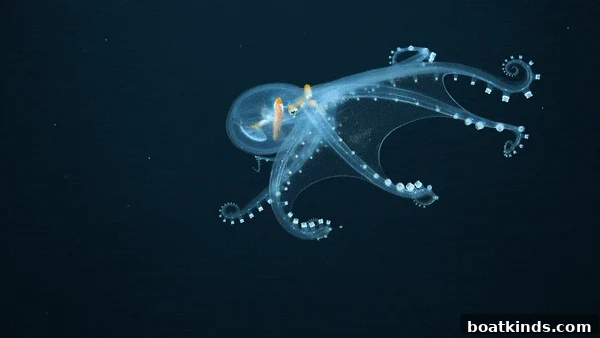
Rare Glass Octopus Filmed in Deep Waters off the Phoenix Islands
A rarely seen glass octopus was recorded on camera by an underwater robot during a 34-day research expedition in the Central Pacific Ocean. The sighting occurred in the remote region of the Phoenix Islands, roughly 3,200 miles northeast of Sydney, Australia, and offers a rare glimpse of one of the ocean’s most transparent and elusive inhabitants.
What Is a Glass Octopus?
Glass octopuses are notable for their nearly transparent bodies. In most species, only a few internal structures—such as the cylindrical eyes, the optic nerve and the digestive tract—appear opaque. This exceptional transparency helps them blend into the dimly lit waters of the mesopelagic and bathypelagic zones, commonly referred to as the twilight and midnight zones, where sunlight is extremely limited or absent.
Deep-Sea Habitat and Behavior
These octopuses inhabit depths ranging from the upper twilight zone down to much deeper waters. The depth range reported for similar species spans roughly 656 to 9,800 feet (200 to 3,000 meters), which places them well within environments that are difficult to observe directly. Because of their habitat, glass octopuses are rarely seen by humans and are primarily documented using remotely operated vehicles (ROVs) and other deep-sea imaging technologies.
The Falkor Expedition and the Role of Underwater Robots
The glass octopus was captured by an ROV operated from the research vessel Falkor, a ship managed by the Schmidt Ocean Institute. The institute, co-founded by Wendy and Eric Schmidt, supports oceanographic research by providing ship time, advanced instrumentation and collaborative platforms for scientists. ROVs and autonomous underwater vehicles are essential tools for exploring the deep sea: they allow researchers to film living organisms in their natural environment, collect samples when possible, and gather environmental data without putting divers at risk.
Why Sightings Matter
Every verified sighting of a transparent deep-sea octopus adds to our understanding of biodiversity in poorly studied oceanic regions. High-quality video and photographic records help taxonomists, ecologists and conservationists confirm species identifications, study behavior, and map distribution patterns. Such observations can also reveal interactions with other species and responses to environmental factors like temperature and light. Because many deep-sea organisms are sensitive to changes in their environment, documenting their presence contributes to broader efforts to monitor ocean health.
Challenges of Deep-Sea Research
Exploration at depths of hundreds to thousands of meters presents significant technical and logistical challenges. The darkness, high pressure and cold temperatures require specialized equipment and careful mission planning. Even with advanced cameras and lights, capturing clear images of transparent animals is difficult because illumination can either reveal or obscure delicate features. Nevertheless, incremental advances in imaging technology and longer expedition campaigns increase the chances of encountering rare species.
Public Interest and Scientific Value
Rare encounters like this glass octopus sighting often capture public imagination and spark increased interest in ocean science. Visual documentation shared by research teams and media outlets helps raise awareness of deep-sea ecosystems and the need to study and protect them. At the same time, careful scientific analysis of such footage can yield insights without disturbing fragile habitats.
The sighting recorded from the Falkor expedition adds to the limited but growing catalog of observations of glass octopuses and similar transparent cephalopods. Researchers involved in the mission continue to analyze the footage and associated data collected during the cruise to better understand the species’ behavior and distribution.
While many questions remain about the lives of glass octopuses, each new observation expands our knowledge of deep-ocean life and underscores the importance of continued exploration with remote technologies.