
Queen Bee: The Unbelievable Journey of a 26-Foot Regulator Center Console
A well-built small boat can withstand far more abuse than many of us imagine. The extraordinary story of Queen Bee—a 26‑foot Regulator center console lost off Nantucket in 2008 and discovered years later floating off the coast of Spain—underscores that truth and highlights both the durability of modern boat construction and the power of ocean currents.

The boat vanished in August 2008 when owner Scott Douglas and his brother-in-law, Rich St. Pierre, were swept overboard by a breaking wave off Nantucket. Both men survived and made it ashore; according to contemporary accounts, St. Pierre was aided by an inflatable device from a survival bag that was also dislodged from the vessel. The Regulator center console itself remained missing for more than three years.
When the yellow-hulled Queen Bee was finally spotted afloat about 20 miles off the coast of Spain—some 3,500 miles from where she had last been seen—the discovery made headlines and prompted amazement from the boat’s manufacturer. Joan Maxwell, president and co-founder of Regulator Marine in Edenton, North Carolina, described the recovery as proof of the boat’s rugged construction. “Thirty-five hundred miles,” Maxwell marveled. “It had to have been rolled and tumbled. There were six named hurricanes in the North Atlantic during that time period.”
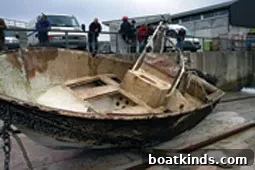
Photos taken after recovery showed a vessel that had clearly spent a long time at sea. Hatches and deck fittings were gone, engine cowlings had been torn off, and marine growth had colonized the hull. Yet the twin Yamaha outboard engines remained bolted to their bracket, and parts of the console and electronics were still aboard. The T-top frame remained present, although twisted. Remarkably, the boat was found floating stern‑down with only a portion of the bow above the surface, a condition that allowed the Coast Guard to comment that it “probably could have drifted for another three years.”
Queen Bee’s construction details help explain how she survived prolonged exposure to open-ocean conditions. Maxwell noted the boat was built in 2003 with a solid fiberglass hull and foam injected into its stringer system—features that increase structural rigidity and buoyancy, according to her account. Regulator is working with Spanish authorities to secure the vessel’s release so it can be returned to North Carolina for a thorough inspection. Maxwell worries the boat might otherwise be treated as a derelict and disposed of before the company can examine it.
For owner Scott Douglas, the recovery provided a form of closure after recounting the story of the loss many times over the intervening years. Maxwell says Douglas was stunned by photographs of the vessel and acknowledged how dramatically the boat’s appearance had changed during its years adrift. The discovery has also opened a new chapter: Regulator is considering restoring the wanderer and using her as a public demonstration of the company’s hull durability. If those plans go forward, Queen Bee could even appear at a boat show.
Speculation about the boat’s route across the North Atlantic remains just that—speculation—but the prevailing currents and weather systems, including the Gulf Stream and recurring storm activity, make a long, circuitous drift plausible. Maxwell suggested the possibility that the boat “might have made two laps around the Pond on the Gulf Stream and other currents.” Whatever route Queen Bee took, her return to human attention is a striking reminder of how resilient well-designed small craft can be in the unforgiving environment of the open ocean.
“The sailor cannot see the North but knows the Needle can.” – Emily Dickinson
This article originally appeared in the April 2012 issue.