
Mark Bruckmann and Mark Ellis, Bruckmann Yachts, Mississauga, Ontario. www.bruckmannyachts.com
Many cruisers hesitate to consider a motorsailer because they expect to trade sailing performance for power-driven convenience. In reality, the modern motorsailer is meant to offer the best of both worlds: efficient, comfortable passage-making under sail or engine, excellent seakeeping, and simple handling. For bluewater cruisers who value range, versatility and ease of operation, a well-designed motorsailer should deliver performance rather than compromise it.

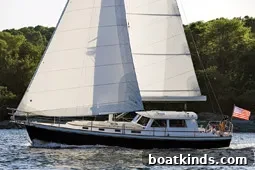
At Bruckmann Yachts the philosophy is clear: a motorsailer must first be a swift, balanced bluewater sailboat while adding the advantages of dependable power and expanded onboard amenities. The Bruckmann 50 MkII, designed by Mark Ellis, exemplifies this approach. It combines a long waterline, moderate displacement and a generous sail area to produce a hull that sails and motors with efficiency. These design choices result in performance that routinely outpaces comparable cruising sailboats and most traditional trawlers.
Under sail the Bruckmann 50 is noted for its ability to point well to windward, along with steady balance and stable behavior in a seaway. The rig uses swept double spreaders and a jib furler for straightforward headsail changes, while the mainsail is fully battened and reefed and can be furled inside a Leisure Furl boom. Those features, with all primary sail controls led back to the cockpit, make short-handed or single-handed sailing far easier and safer.
Powering the standard model is a 200-hp John Deere diesel, chosen for low-revving reliability and steady cruising performance. The drivetrain is matched to hull form and appendages—a skeg-protected, balanced rudder and a substantial bow thruster—to create precise, confidence-inspiring handling in tight quarters and under power in adverse conditions. The broad, flat sections aft increase stern buoyancy so the boat can exceed 10 knots under power, surpassing most trawlers, while maintaining a comfortable, sea-kindly motion for crew and guests.
Fuel efficiency is an important advantage: the low-revving diesel will cruise easily at roughly 8.5 knots while consuming under 3 gallons per hour, making long passages economical. The Bruckmann 50 MkII is explicitly conceived to be efficient under sail, power or a combination of both. By balancing sail area and engine power, the design enables extended range and the potential for trans-Atlantic passages while using fuel sparingly when motoring is required.
Ergonomics and crew comfort are central to the layout. The boat can be piloted from the cockpit or from the sheltered saloon pilothouse, with large pilothouse windows providing excellent visibility from either helm station. Movement between cockpit and pilothouse is effortless because both are on the same level, simplifying watchkeeping and onboard traffic in all weather. That level circulation, combined with insulated accommodations and purposeful systems layout, makes the Bruckmann 50 a capable all-weather cruiser that keeps the crew comfortable in both hot and cold climates.
Storage and tankage are generous, reflecting the design intent for extended cruising. Ample room for provisions, spares and water, together with systems designed for redundancy and serviceability, make this motorsailer practical for long-range voyaging. The layout and systems support comfortable liveaboard use as well as serious passagemaking.
Related articles and commentary on modern motorsailers and their design considerations:
– A modern motorsailer
– The best of both worlds
– What makes a good motorsailer? Jim Leishman
– What makes a good motorsailer? Bob Johnson
– What makes a good motorsailer? Ted Hood
– What makes a good motorsailer? Walt Schulz
The original article appeared in the September 2009 issue.