
Why Diesel Sterndrives Are Becoming a Real Alternative to Outboards
A pair of outboards remains the most common propulsion choice for today’s large center consoles, day boats and sport cruisers, but it’s no longer the only viable option. Volvo Penta’s DPI Aquamatic D6-440 diesel sterndrive is gaining traction as an alternative to outboards. Several production builders now offer this diesel sterndrive on boats roughly 42 to 56 feet long because it delivers markedly better fuel economy and greater range at comparable cruising speeds. While outboards can still produce higher top speeds, many experienced boaters prioritize economy, comfort and reliable cruise performance over maximum speed.
Solace Boats in Florida is one builder that has added a diesel sterndrive option. The company reworked its 41 CS—a 41-foot center console originally designed around Mercury or Yamaha outboards—to accept Volvo’s DPI Aquamatic. That modified model is marketed as the Solace 415CS.
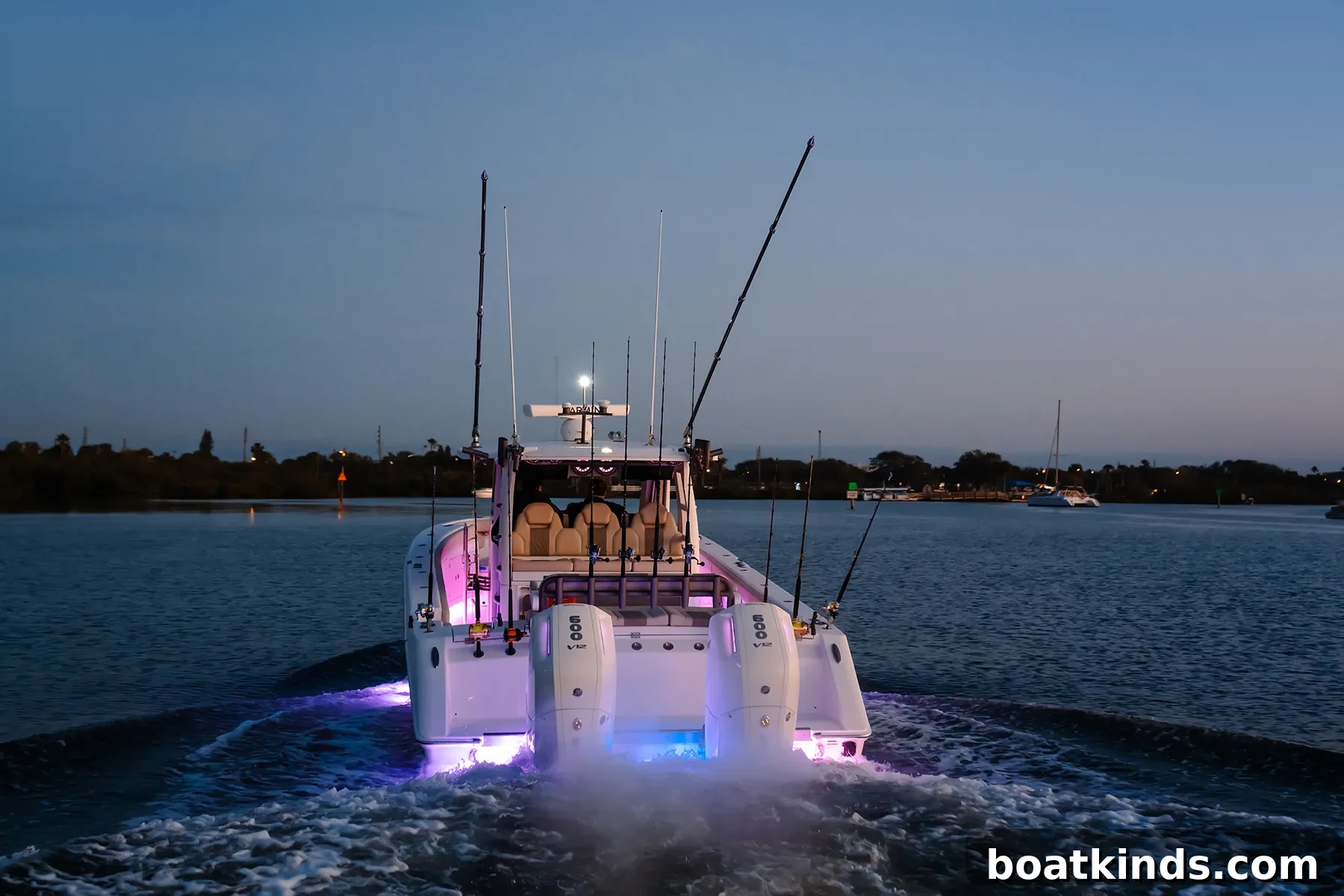
Solace CEO Stephen Dougherty highlights the driving feel: the diesel torque and large dual props make the boat behave more like a big inboard sportfish, giving the captain strong control and confident handling. The engines cruise comfortably at 45 mph and tend to run efficiently at those speeds. Dougherty also reports significant savings on long runs—fuel costs to the Bahamas were cut roughly in half on some trips.
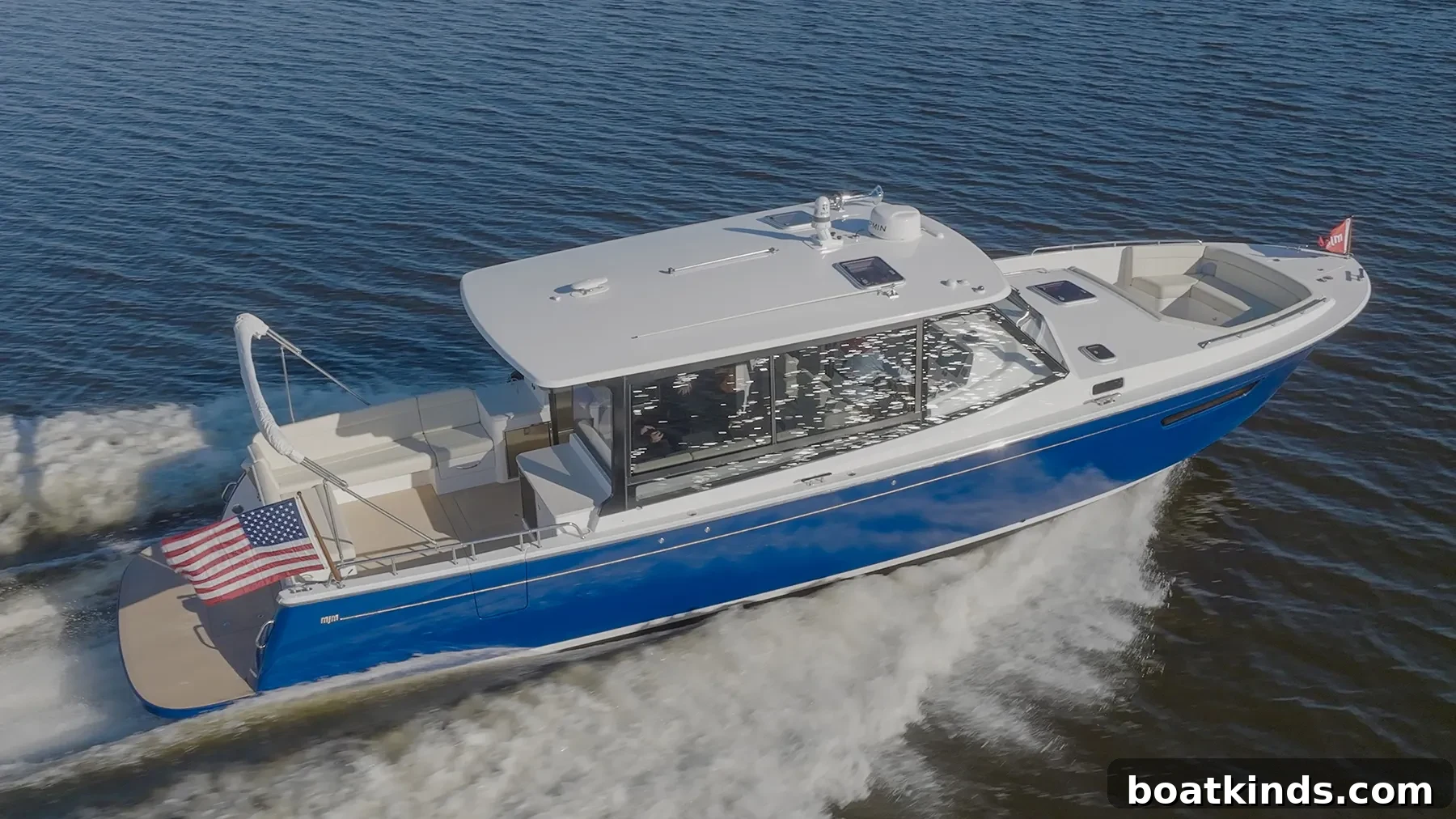
MJM Yachts similarly offers customers a choice between outboards and the DPI Aquamatic. Its MJM 4—a 46-foot, 8-inch Carolina Downeast–style day yacht—can be ordered with twin Mercury 600 Verado outboards or with twin Volvo Penta DPI Aquamatics. The same option will be available on the new MJM 42 liveaboard performance yacht.
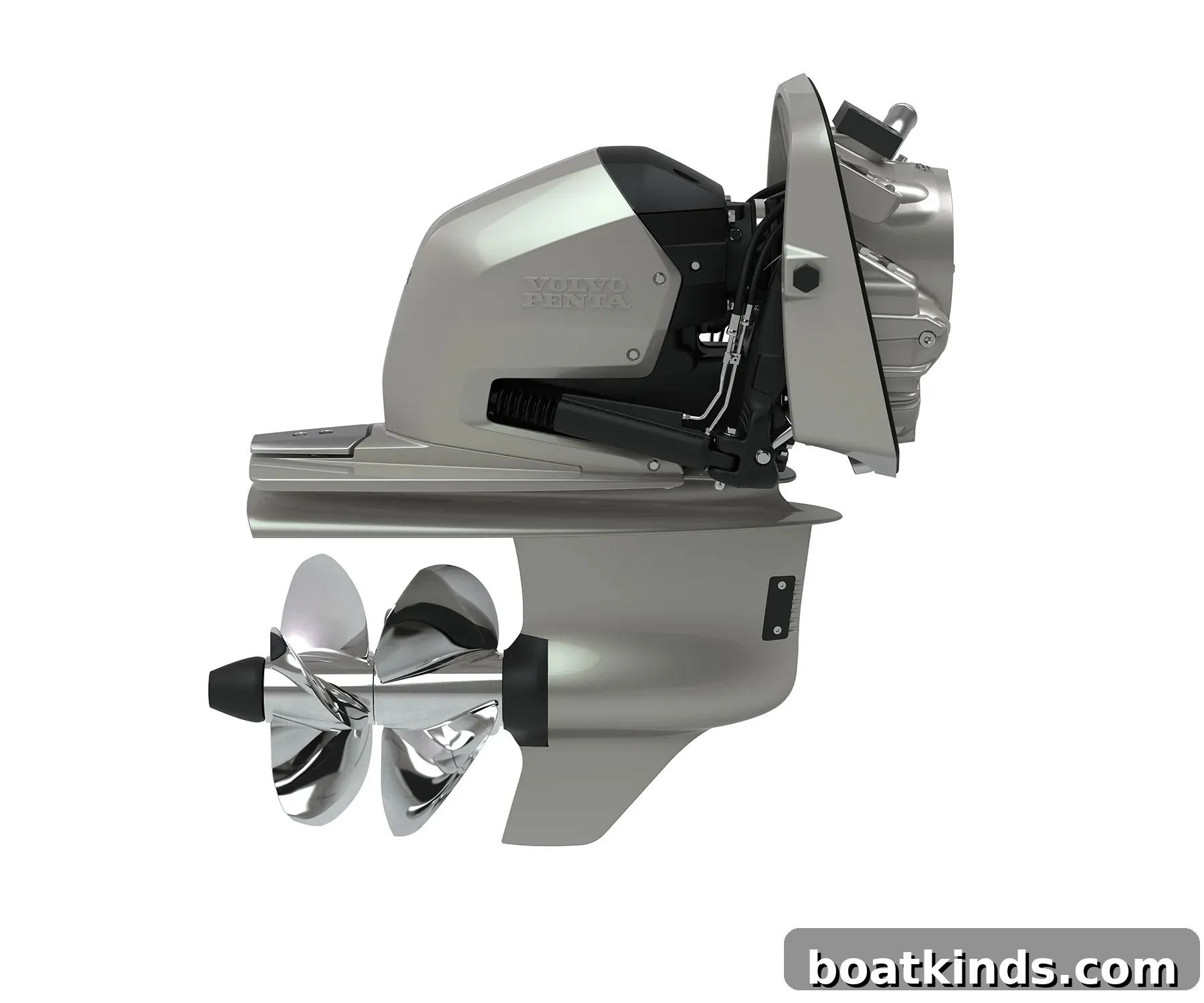
Chris Hughes of MJM Yachts notes the shifting perceptions: while some owners still favor the look of large outboards on the transom, many are reconsidering. Advances in corrosion protection, electronics and drivetrain design have removed many of the old objections to sterndrives in saltwater. Volvo Penta markets the system as the DPI Advanced Drive rather than a traditional sterndrive. It pairs the efficiency of diesel power with a trimmable outdrive and a clear transom, giving an open stern and a practical platform for tenders—an arrangement that outboards can sometimes compromise.
Historically, sterndrives were introduced to combine inboard engines with steerable transom-mounted drives and deliver higher power than contemporaneous outboards. By the mid-1960s sterndrives were producing several times the power of available outboards. Today, however, modern outboards match or exceed conventional gas sterndrive power, and large boats can be fitted with multiple high-horsepower outboards to reach very high top speeds.
Volvo Penta launched the DPI Aquamatic in 2019 to compete directly with multi-engine outboards on large premium boats. Paired with Volvo Penta’s D6 diesel engine (up to 5.5 liters and 440 hp), the DPI Aquamatic offers diesel efficiency, a trimmable outdrive and a clean transom while delivering acceptable performance for builders and owners who value range, torque and comfort. At present, Volvo Penta is the only manufacturer offering this specific pairing; competing companies have not produced a directly comparable diesel outdrive solution.
The DPI Aquamatic includes a smooth-shifting hydraulic clutch that slips at low engine speeds to facilitate docking and trolling. It integrates modern control features such as Electronic Vessel Control (EVC), auto trim, joystick control, Dynamic Positioning System and Assisted Docking for multi-engine installations. The drive draws on robust internal components developed for the Volvo Penta IPS pod drive and employs durable alloys, corrosion-resistant finishes and isolated prop sets to resist saltwater exposure. Optional Active Corrosion Protection and sensors monitor conditions such as water in the engine oil or bellows wear. The drive commonly uses contra-rotating Duoprop stainless-steel props—typically a three-blade front prop and a four-blade rear prop—to maximize thrust and blade area.
Outboards retain important advantages: they are easy to access and service, relatively simple to replace, free up internal boat space and offer very high individual horsepower ratings today—some producing 400 to 600 hp each. Those benefits have driven the design of larger, faster day boats. Critics of outboards point to the complexities of rigging multiple engines, transom space occupied by the motors and the visual impact of large outboard racks.
From a performance perspective, the DPI Aquamatic excels at delivering abundant torque and favorable weight distribution. High torque allows the large, paired props to lift and hold a heavy boat on plane at lower speeds, producing more comfortable cruising and strong throttle responsiveness. The D6-440 reaches about 774 lb-ft of torque and sustains that level from roughly 2,000 to 3,000 rpm—covering most of the engine’s practical cruising range. By comparison, a gasoline V8 option rated near 430 hp makes substantially less torque and must be run at higher rpm to achieve peak torque, underscoring why diesel power is attractive for larger craft.
On economy and emissions, Volvo Penta reports the DPI Aquamatic delivers 30 to 67 percent better fuel economy at cruising speeds compared with the Mercury Verado outboards evaluated in MJM and Solace performance data. Volvo Penta’s marine-leisure director, Arjen Steegstra, also states the DPI Aquamatic system produced lower emissions than a four-stroke outboard in their testing.
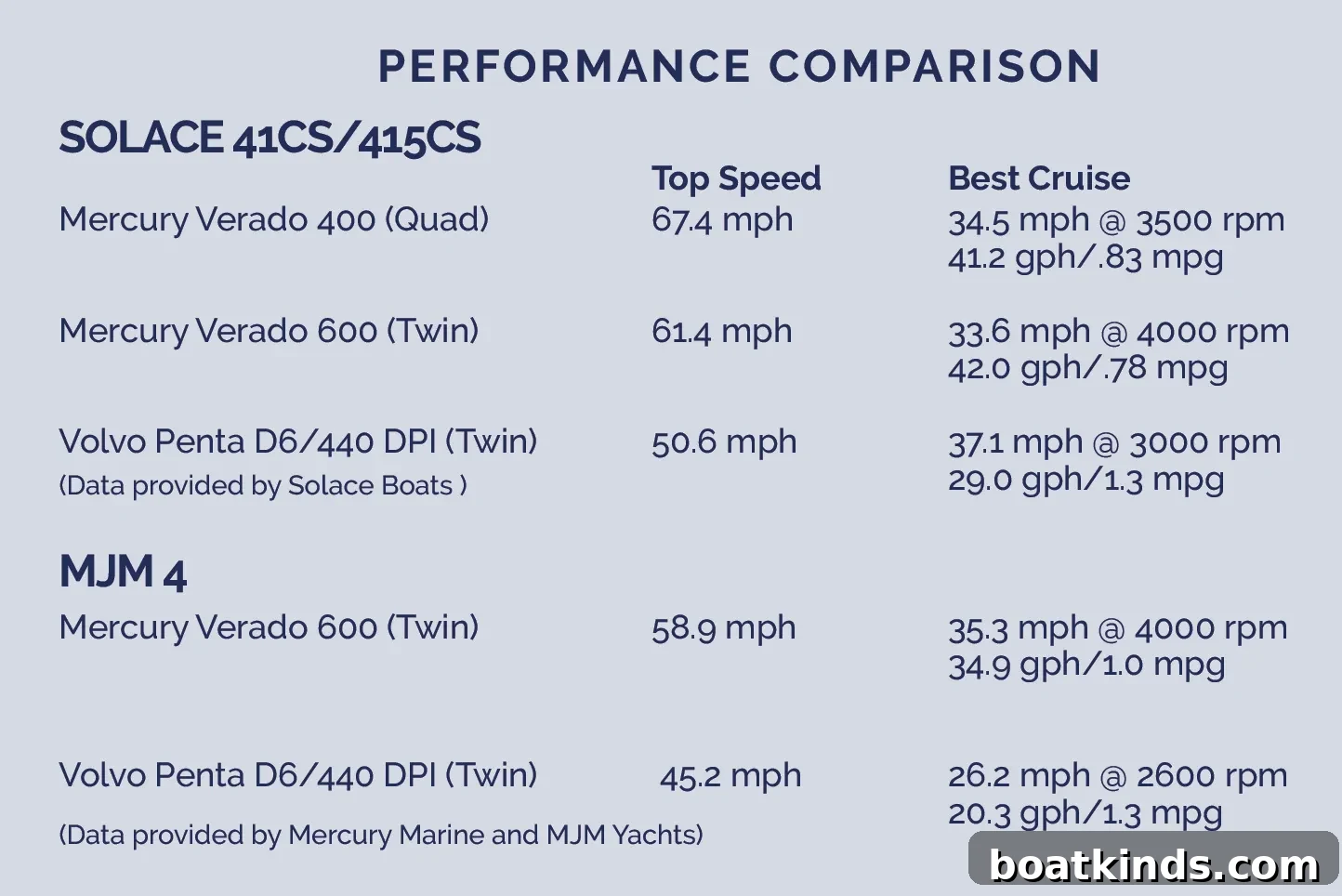
Weight and placement matter. A twin DPI Aquamatic installation weighs about 3,520 pounds dry—heavier than many outboard setups (a pair of Mercury 600 Verado outboards totals about 2,600 pounds; four Mercury 400 Verado outboards about 2,800 pounds). But much of the DPI weight sits inside the hull rather than hanging off the transom. That forward weight bias can improve seakeeping and reduce pitching in rough conditions. Dougherty recounts a crossing from Florida to the Abacos where his diesel sterndrive 415CS outperformed a near-identical outboard 41CS in heavy seas, delivering faster, more comfortable passage-making.
Volvo Penta offers jack shaft options that let builders locate the DPI engines further forward for optimized balance, and that layout also enables a parallel hybrid architecture currently under testing with Groupe Beneteau on a Jeanneau NC 37. In that parallel hybrid, an electric motor sits between the engine and outdrive so the boat can move on diesel, electric or a combination of both. Volvo Penta anticipates pre-production testing of that system in 2025.
One clear advantage of the DPI Aquamatic is a clean transom. On the Solace 415CS this allows a 4-foot-deep, full-width swim platform and a convertible lounge/aft seat with an unobstructed stern view. The trade-off is a motorbox roughly 10 inches tall that occupies some cockpit deck area—Solace places the aft seat over it. On the MJM 4 the engines mount below the sole so there’s no cockpit deck penalty. Below-deck machinery does reduce available stowage and system space, and builders typically fit somewhat smaller fuel tanks in DPI-equipped models; however, the diesel’s superior fuel efficiency mitigates the need for larger fuel capacity.
Cost remains a factor. The DPI Aquamatic option adds price compared with outboards: MJM lists the 4 with DPI power about $95,000 higher (rising from $1,914,000 to $2,009,000), and Solace’s 415CS base price is about $172,000 more than the outboard-powered 41CS (from $1,638,000 to $1,810,000).
Expect more builders to offer the choice of outboard or DPI Aquamatic power as demand grows. Southport Boats converted a 30 FE center console to a single DPI Aquamatic D6-440 and will make that option available due to customer interest. Boston Boatworks now offers its 44 and 52 Offshore Express Cruiser models exclusively with DPI Aquamatic power. Volvo Penta has also introduced a triple-DPI Aquamatic installation for commercial and leisure use, with one of the first applications in a 48-foot aluminum patrol boat built in Sweden.
After initial hesitation, builders like Dougherty have been convinced by real-world results. “We resisted for a long time because it was a major change and we didn’t design the boat for this power,” he says. “But after building the prototype and running it, we were impressed—this is a very capable, comfortable boat.”
This article was originally published in the April 2024 issue.