
A cruising couple finds their new smaller boat to be big on comfort and convenience
Story and photos by George Sass Sr.
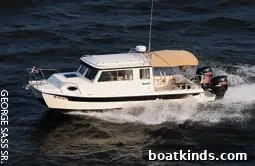
After more than a decade and more than 12,000 safe, comfortable miles aboard a custom 43-foot Down East–style cruiser, we decided to simplify and downsize. Our goal was to continue cruising while reducing upkeep, complexity and cost as we move toward retirement. After months of evaluating 25- to 29-foot boats and many sea trials, we settled on a C-Dory TomCat 255 power catamaran. A summer of cruising aboard ViewFinder confirmed that a smaller, trailerable power cat can deliver surprising comfort, convenience and value for couples who cruise part time.
With our youngest son in college, we knew most cruises would be for two; overnight guests would be occasional. Because we’re not yet retired, cruising time is limited, so we wanted a boat that would let us spend more time exploring destinations and less time simply getting there. We plan to continue exploring Chesapeake Bay and to revisit favorite routes such as Lake Champlain, the Rideau Canal, the Trent-Severn Waterway, the Florida Keys and the Bahamas. That meant wanting a boat that could get us to these cruising grounds quickly, be easy to maintain and be economical to run.
Our requirements boiled down to a straightforward list:
• a genuine downsize rather than a midsize compromise
• trailerable (but typically shipped rather than towed by us)
• fast while remaining fuel-efficient
• simple, low-maintenance systems
• comfortable living space that works in all weather
• modest upfront cost and good long-term value
Seaworthiness and build quality were non-negotiable. We examined both used and factory-new boats and, because the market was soft, found a dealer demo that fit our needs: a 2009 TomCat with twin Suzuki 150s and a custom Float-On trailer. Our prior boats—ranging from a 26-foot Folkboat to a Thomas Point 43—had served us well, but we wanted something even simpler that would minimize daily chores and maximize time on the water.
Early on during trials of nine small boats, one decision became clear: outboards. Small diesel installations often limit engine access and transmit more noise and vibration into the boat. Modern four-stroke outboards, mounted far aft, are remarkably quiet and nearly vibration-free at cruising speeds, and they free up interior space for storage—critical on a small boat. The ability to tilt the engines for shallow anchorages and even beaching was attractive. Many outboard boats also offer twin-engine setups; after decades of cruising to remote places, we prefer redundancy and the precise control twin engines provide when docking.
Our shortlist narrowed to four outboard models. Although the Maine-built Padebco 27 and the Canadian Caledon 27 impressed with looks and build quality, availability and price ruled them out. That left the popular Rosborough 246 and the C-Dory TomCat 255. Both sea-trialed well, but the TomCat ultimately won our choice.
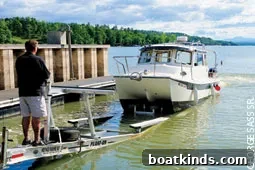
Why the TomCat? Two features sealed the decision: the interior layout—most notably a comfortable queen forward berth and a fully enclosed head with a shower—and the multihull configuration. The catamaran’s static stability is a major advantage over a monohull of similar length. Simple actions like stepping onto the gunwale to board from a dock barely tip the TomCat, and at anchor it stays noticeably flatter than many monohulls, reducing rolling caused by passing wakes or choppy conditions.
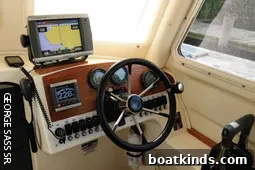
The TomCat we chose came from a dealer in the Gulf Coast region that had inventory following the market slump. The dealer’s knowledge of trailerable cruising boats and C-Dorys, combined with an active owners’ community online, gave us confidence. The demo we purchased showed improved interior finish—teak trim, a finished headliner and nicely dressed cabin sides—compared with earlier production. After negotiating price and specifications, we arranged commissioning and upgrades with a local marina, including a barrier coat and bottom paint, a full Garmin electronics package and upgraded Suzuki multifunction digital gauges. A new teak dash complemented the boat’s higher-level interior finish.
Marc towed the TomCat to Annapolis in early May, and my wife Stacey and I spent the next weeks outfitting the boat and taking day trips to adapt to the smaller platform. The true test came during a two-week cruise on Lake Champlain. We contracted a professional marine trucking service to haul the trailer and boat to Westport Marina, New York. Door-to-door truck delivery saved time, wear on the engines and many nights of travel compared with running the boat under its own power; the cost was comparable once fuel, marina fees and meals were considered, and the time savings were substantial.
On Lake Champlain we covered New York and Vermont ports, alternating nights in marinas with nights on the hook. Despite being a compact 26-foot hull-to-hull (not counting outboard brackets and anchor gear), the TomCat offered plenty of storage. We carried two weeks of dry goods, clothing and fresh provisions, supplemented occasionally with local stores. Our camping and RV experience made adapting to compact galley cooking easy: a single-burner butane stove and cockpit barbecue met our needs. The 9-gallon holding tank was workable with two- to three-day cycles between pumpouts, and for hot water after days on the hook we used a simple sun shower rigged on the roof.
We also embraced inflatable kayaks to access shore when anchored. Stowed on top of the pilothouse, our lightweight, stable kayaks make short excursions easy and can carry our 55-pound dog, Schooner. With the outboards tilted up, the TomCat’s shoal draft—about 2 feet—let us anchor close to shore in protected spots away from crowds.
The cockpit felt nearly as roomy as our 43-footer’s, preserving one of our favorite pastimes: relaxing under the bimini and watching the world go by. Daily routines were simplified: deploying the anchor with a windlass from the helm, using a preventer line from the foredeck (reachable from inside in rough conditions), and docking with the precision that twin outboards enable. The boat’s single-level layout—cockpit to forward berth—made living aboard straightforward and surprisingly comfortable. Small conveniences, like reaching the fridge or bottle opener while seated at the dinette, emphasized how efficiently the space works.
Navigation and electronics were much easier than expected. The Garmin package’s touchscreen interface minimized the learning curve; it was intuitive compared with more complex systems I’d used on larger yachts. With lower slip fees—often 40 percent less than for larger boats—and easier access to slips thanks to the boat’s draft and size, we found marinas more affordable and available even without reservations.

On the water, the differences between a small catamaran and a larger monohull are obvious. We no longer push through large, steep seas; careful weather planning becomes more important. In under-3-foot seas the TomCat cruises very comfortably at 20–25 knots, and at higher speeds its tunnel lifts clear and the boat rides on an air cushion, softening the ride and improving speed and efficiency. Head-on chop can produce pounding in the tunnel and some trapped wave noise at slow speeds, so we learned to angle off a few degrees into head seas. When conditions turned rough—we once faced 30-knot headwinds and 4-foot seas—we slowed and tacked upwind until we could find shelter. Slowing down maintained comfort and safety.
At the end of our Lake Champlain cruise we were surprised to find we had logged only about 20 engine hours on the Suzuki outboards while seeing everything we planned. Maintenance needs were minimal: routine oil checks and little else. After 25 years of cruising, Stacey said she had never seen me more relaxed. Downsizing to a simple, trailerable power catamaran gave us exactly what we wanted—more cruising, less fuss—and proved that a well-chosen small boat can deliver big benefits.
This article originally appeared in the December 2011 issue.