
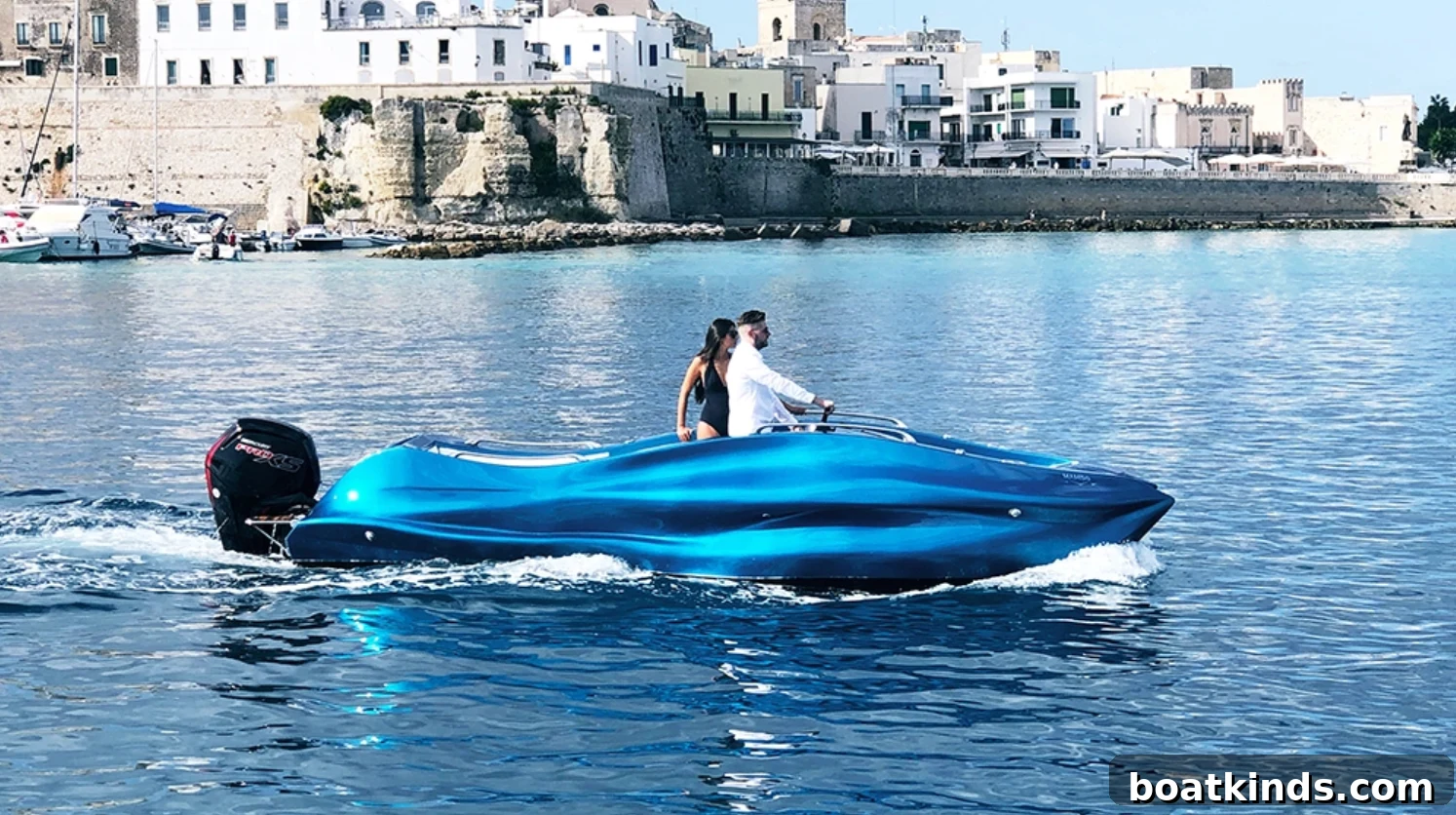
Moi Composites Debuts MAMBO: The World’s First 3-D-Printed Fiberglass Boat
At the Genoa Boat Show this weekend, Moi Composites is unveiling MAMBO, a milestone in marine manufacturing described as the world’s first 3-D-printed fiberglass boat. The name MAMBO stands for Motor Additive Manufacturing Boat and the vessel was produced using continuous fiber manufacturing technology. By depositing reinforcing fibers into a thermosetting resin matrix during the printing process, the company created a hull and deck material that maintains the strength characteristics of traditional fiberglass while offering new advantages in shaping and cost efficiency.
Design and On-Board Features
MAMBO measures 21.5 feet in length with just over an 8-foot beam. The interior layout emphasizes a blend of comfort and contemporary styling: cork flooring, white leather seating, and a modern navigation suite are fitted aboard. Power is supplied by a 115cv engine, and with a reported dry weight of approximately 1,763 pounds, the boat is expected to be relatively light for its size. Official performance figures have not been released, but the combination of modest displacement and a mid-range outboard suggests lively on-water behavior for coastal cruising or day trips.
What Makes Continuous Fiber Additive Manufacturing Different
The defining feature of MAMBO is its manufacturing method. Continuous fiber additive manufacturing differs from traditional layup and mould-based fiberglass production by placing continuous reinforcement directly into a resin during a controlled additive process. The result is a consolidated composite that can match the structural properties of conventionally produced fiberglass while enabling more complex, bespoke shapes without the same tooling costs. This approach can reduce waste and shorten the time between design iteration and finished hull.
Benefits and Practical Implications
- Cost-effectiveness: Eliminating extensive moulds and manual layup steps can reduce upfront tooling expenses, particularly attractive for prototyping and low-volume production runs.
- Design freedom: Additive continuous fiber processes allow designers to produce forms and internal structures that would be difficult or expensive with traditional methods, enabling optimized weight distribution and integrated fittings.
- Material performance: Because the reinforcement remains continuous through critical load paths, the printed composite can achieve stiffness and strength comparable to hand-laid fiberglass in many applications.
- Potential for reduced waste: Additive processes can be more material-efficient, producing less excess resin and offcuts compared with conventional fabrication.
Industry Context and Future Prospects
Moi Composites has not announced plans to move MAMBO into serial production, but the prototype serves as a practical demonstration of what continuous fiber additive manufacturing can achieve in marine applications. The boat could inspire other builders and designers to explore similar technologies for both small craft and larger composite structures. This debut follows a trend of additive manufacturing pushing boundaries in boatbuilding: last year, the University of Maine revealed the largest vessel produced by a 3-D thermoplastics printer, highlighting the rapid evolution of 3-D printing methods in maritime contexts.
Considerations and Challenges
Despite the promise, adopting 3-D-printed continuous fiber composites for widespread marine production faces challenges. Regulatory approval, long-term durability data, repair practices, and industry familiarity will influence how quickly builders embrace the technology. Thermosetting resins used in continuous fiber processes differ from thermoplastics, and each material family has trade-offs in recyclability, repairability, and manufacturing logistics. As more prototypes like MAMBO appear at international boat shows, these practical questions will be addressed through testing, certification, and real-world use.
Conclusion
MAMBO represents a noteworthy step in the evolution of boatbuilding, combining continuous fiber additive manufacturing with classic marine fit-out elements such as cork floors and leather seating. While Moi Composites has not confirmed production plans, the vessel demonstrates potential pathways for reducing tooling costs, increasing design flexibility, and achieving competitive structural performance. Observers at the Genoa Boat Show will see firsthand how this 3-D-printed fiberglass boat performs as a concept and how it may shape future approaches to composite boat design and manufacturing.