
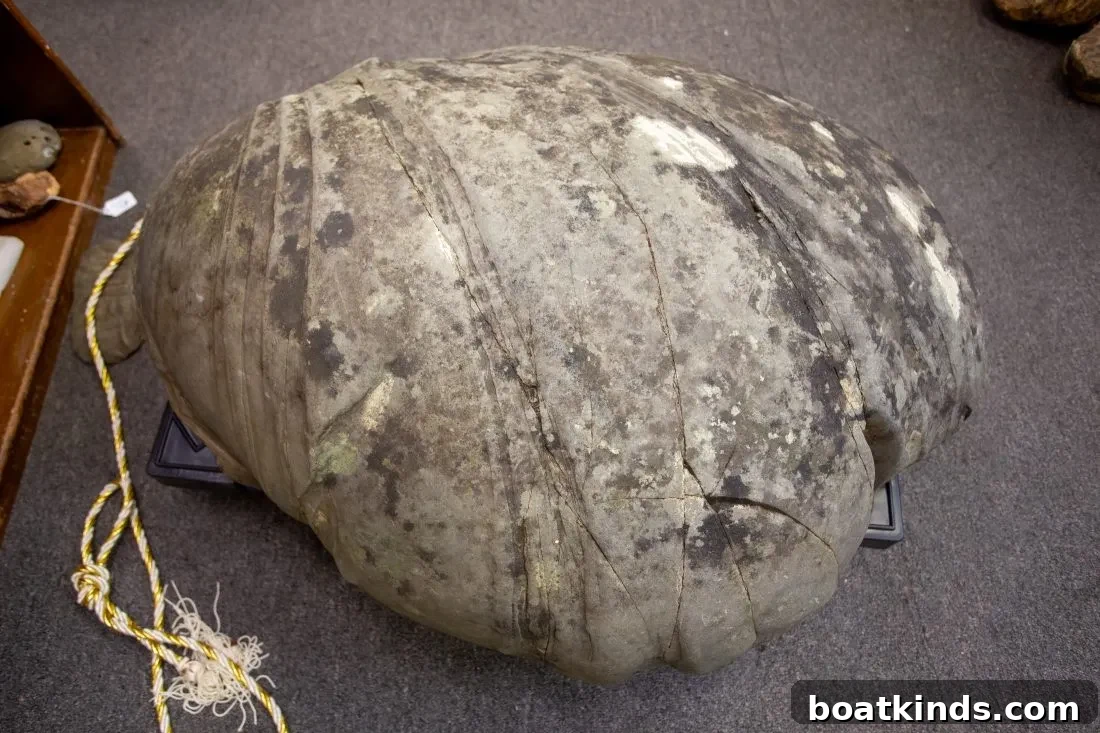
Petrified Giant Clam Discovered in Pennsylvania Woods
In August, while exploring wooded terrain in Pennsylvania in search of fossils and arrowheads, local resident Laura Roan noticed what at first looked like a turtle shell protruding from the mud. On closer inspection she realized the object was not a shell at all but a large, petrified clam—an ancient bivalve preserved in stone and believed to be roughly 380 million years old.
From a Muddy Bank to a Shop Window
The find captured immediate attention. Because of its size and weight, removing the specimen required a team effort: four men used a refrigerator cart to carefully extract the fossil from the woods and transport it out of the site. The clam now has a new public home in Williamsport, Pennsylvania. It is prominently displayed in the front window of the Rocks Off Shop on Pine Street, where residents and visitors can see this impressive relic from deep time up close.
Age and Geological Context
Experts and local reporters have noted the specimen dates to the Devonian period, commonly called the Age of Fishes, a span of time roughly 419 to 359 million years ago. The estimated age of about 380 million years places the fossil well within that era, when shallow seas covered much of what is now eastern North America. Bivalves and other marine organisms were common in those environments, and under the right conditions their shells could become mineralized and preserved as fossils over millions of years.
Why This Discovery Matters
Large, well-preserved petrified bivalves are not everyday finds for casual fossil hunters. Beyond its size and visual impact, a specimen like this provides a tangible connection to ancient ecosystems and to the processes of fossilization that turned once-living shells into stone. Displays in local shops and small museums make paleontology accessible to the public and can spark interest in regional geology and natural history.
Reporting and Community Interest
The discovery received coverage in local media and quickly became a topic of curiosity in the community. Residents have been drawn to the Rocks Off Shop window to get a close look, and the story has prompted conversations about local fossil resources and the area’s deep geological past. The find highlights how everyday walks in the woods can yield remarkable reminders of Earth’s ancient history.
Responsible Fossil Hunting
For anyone interested in searching for fossils, this discovery serves as a useful reminder of best practices: always obtain permission before collecting on private land, avoid disturbing scientifically important sites, and document the find’s context with photos and notes. When in doubt, contact local museums, universities, or amateur paleontology groups for guidance. Large or scientifically significant specimens are best handled by professionals so their context and scientific value can be preserved.
Seeing the Fossil in Williamsport
If you are in the Williamsport area, the petrified clam is on display in the Rocks Off Shop window on Pine Street, where it offers a striking glimpse into the deep past. The Williamsport Sun-Gazette covered the discovery in a local feature that provides additional background and reactions from the community.
This unexpected find—discovered by a walker in the woods, moved with ingenuity, and placed on public display—illustrates how ordinary places can hide extraordinary remnants of Earth’s history. Whether you are a casual passerby, an amateur collector, or someone curious about paleontology, the petrified clam is a reminder that ancient stories can turn up in the most familiar settings.