In many ways hurricanes feel like ticks: spend enough time on the water and you will collect your share of bites. I’ve owned and lived aboard many boats, cruising different waters for most of my life, and I have accumulated a long catalog of hurricane stories. It’s always satisfying to swap those stories once the storm has passed. Here are four that remain vivid in my memory.
My earliest clear memory involves my very first boat. Uncle Ernest built her for me at my father’s request when I was nine: a 12-foot wooden skiff with side decks, painted battleship gray — my favorite color. Like every boat I’ve owned since, she became part of my heart.
A couple of years after we launched her, when autumn rolled around and talk of storms began, word spread that something much worse might be on the way. That “bad time of year” was when I normally had to haul the skiff up the beach on logs, enlist my father and friends to load her into the pickup, and take her home for the winter. Losing the chance to boat for the season was bad enough; we soon learned that Hurricane Hazel would be far worse.
Even in the mid-1950s we had advance warning. We gathered by the radio each night, listening to the crackling reports as forecasters tried to pin down Hazel’s track. To us it felt as if she came right up the York River toward West Point, Virginia, the small peninsula town where I was growing up. I kept my skiff anchored off the little beach at the end of town; from there the fetch ran most of the length of the York River. It had worked for calmer weather, but I knew that exposure was a recipe for disaster in a hurricane.
We pulled the boat up onto logs just past Main Street and hoped for the best. Of course, we made the mistake of watching the storm from the street — not wise, but I was worried about the skiff. When the street began to flood I dragged the boat farther up toward the houses, convinced it would be safe there.
Mr. Browning, the town’s “rich man,” owned a long dock that extended well out into the York. Hurricane Hazel loved that dock so much she ripped every board, piling and post clean off. Then, in a cruel twist, she vomited the whole structure onto Main Street — right on top of my little skiff. My mother had wisely pulled me back inside, so I watched from the house. When the storm eased I ran out to find Main Street strewn with trees, downed power lines and wreckage. The high-water mark was well above where I’d expected the boat to be safe. Down the street, all I could see was a tangled heap of planks and pilings.
I started tugging at the timbers. Most were heavier than I could lift, but neighbors and other townsfolk joined in. Slowly, painfully, the shape of my boat emerged beneath the debris. Bit by bit we cleared the wreckage until the little gray skiff was free, surprisingly intact except for a knocked-off oarlock support. I bolted it back on the next morning, found more logs — they were plentiful in the aftermath — and rolled her into the water for a few more weeks of boating. Mr. Browning’s boat, which someone had tried to “save” by taking it into the marsh, was left upside down and high in the mud.
The selection widens
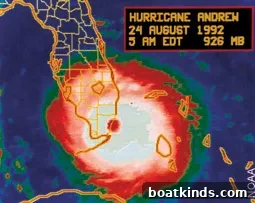
Hazel taught me that storms can appear almost eerily selective. Years later I witnessed that selectivity on a much larger scale during Hurricane Andrew.
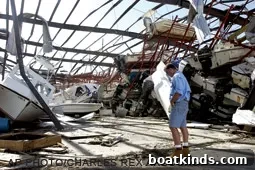
We were sailing south and tracked Andrew closely as it developed and barreled across the Bahamas toward Florida. It struck like a broad, savage tornado: intense, narrow and catastrophic. We had friends in Miami Beach where damage was surprisingly light, but farther south in Homestead the destruction resembled footage of bombed cities — houses leveled and people wandering in stunned silence. The devastation was apocalyptic yet concentrated to a relatively narrow corridor.
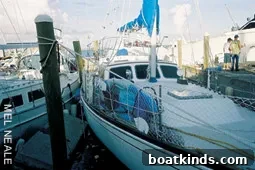
On the way through the Bahamas we found Cat Cay nearly smashed to pieces while nearby Bimini had been largely spared. At Chub Cay we eased into a surge-protected harbor and found boats sunk at their slips, pilings collapsed and a 70-foot mast wound around a piling like spaghetti. The island was littered with dead animals, fallen power lines and the wreckage of buildings. One storm window, engineered to survive 200 mph winds, remained standing amid a flattened house — a stark illustration of the storm’s fury and randomness.
The reefs we had once dove were whitewashed and ruined; years would be needed for any recovery. Still, the islanders we met were determined to rebuild. They were devastated, but not defeated.
We sailed on to New Providence and Nassau, where much of the island seemed comparatively spared. Andrew had no mind of its own; it was a force of nature shaped by atmospheric conditions and physics. It left clear winners and losers on a terrifyingly local scale.
The best and the worst
Another memorable storm — I believe it was Hurricane Edouard — came during a summer we lived at anchor in Newport, Rhode Island. Newport harbor is beautiful but dangerous in a hurricane because the bottom there is rock rather than forgiving mud or sand. Our refuge was the Kickemuit River, which, for Rhode Island, is well inland and surrounded by higher ground and decent holding.
Weeks before the storm we and half a dozen liveaboards prepared carefully. We set multiple anchors, spaced the boats to allow safe swing, and rigged our ground tackle with help from neighbors. The community worked together all day in dinghies carrying anchors and securing gear. A local man even rowed out to offer help: if anyone wanted shelter ashore or a last-minute run to town for supplies, his house and car were available. That kindness mattered more than the shelter itself — the offer eased a lot of fear.
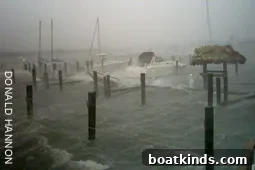
As conditions darkened, a tug and barge entered the river and secured huge spuds into the bottom, which calmed us. But other boats arrived late, setting inadequate anchors and then abandoning their vessels to be picked up ashore. Their careless, last-minute decisions could easily have created floating wreckage that might crush other boats. We armed ourselves with machetes to be ready to cut lines in an emergency — an ugly but practical precaution.
In the end the storm shifted course and weakened over our area. We had heavy wind and rain but emerged with our boats largely unscathed. The man who had offered help rowed out the next morning to check on us; we thanked him again. The storm hadn’t been “good” to us, only less harmful than it might have been, and the memory that remains most clear is the human kindness and the thoughtless indifference we encountered that day.
The payback
In 2004 Central Florida was hammered by three successive storms: Charley, Frances and Jeanne. We were not there — we were cruising in the Chesapeake Bay — but we followed the devastation closely. Those storms ultimately destroyed a boat that had been our home for nearly two decades: Chez Nous. We moved aboard her in 1979; our daughters were born while we lived on her, and they grew up learning seamanship, engine repair and diving. The boat was special to us.
Chez Nous was later sold and lived aboard by a couple who kept her in Fort Pierce City Marina. After Frances the marina was a tangle of damaged boats; Chez Nous was one of the few still floating. As salvors worked to refloat and move boats into a temporary yard, Jeanne formed quickly. During a lift the straps broke and Chez Nous fell back into the water. A large floating dock then broke loose and rolled over her, crushing and submerging our old home. The owners ashore sent us a photo of the mast sticking out of the water. The wreck remained in the yard for years — a painful footnote and, for me, a kind of payback for the skiff that once survived buried beneath Mr. Browning’s dock.
I’ve collected many more hurricane stories over the years, and I’m sure you have your own. One recurring thought is how easily we personalize storms, give them names and talk about them as if they have intent. The reality is simpler and harsher: hurricanes are forces of nature that do not care. What we should focus on are the people affected — the kindnesses offered, the acts of carelessness and the resilience of those who rebuild. Those are the human stories worth remembering.
February 2014 issue