Two Connecticut non-profit organizations have formally expressed interest in taking ownership of the Saybrook Breakwater Light, a 122-year-old beacon that the U.S. Coast Guard has declared excess property.
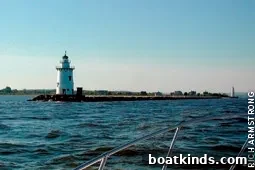
Officials say Beacon Preservation of Ansonia and Belzer Cacoethes Israel Inc. of Westport received application materials on Oct. 23 to start the transfer process for the Saybrook Breakwater Light, also known as Saybrook Outer Light. The General Services Administration’s New England Region has classified the structure as disposable, opening the door for transfer under the National Historic Lighthouse Preservation Act (NHLPA) of 2000.
Bill Brookover, the National Park Service historical architect overseeing the evaluations, said both groups were given 90 days to return completed applications. “We want them to return the forms by Jan. 12, so they have 90 days,” Brookover said. That timetable begins the NHLPA review, which evaluates applicants on a four-part scoring rubric.
The application asks organizations to document how they will physically maintain the lighthouse, how they intend to use the property, how they will educate the public about lighthouse history, and how they will ensure the site’s long-term financial support. Each section carries equal weight—25 points apiece—and applications are totaled after a 60-day internal review. The highest-scoring applicant may be awarded the property at no cost.
Brookover noted that applicants sometimes receive a chance to refine their proposals: “Often, once we score them, we give them a chance to improve the application, sort of a second chance. But after the initial process, if there is one clear winner, we forward that to our Washington [D.C.] office.” How long the Washington office takes to complete its review can vary, he added.
If neither applicant satisfies the criteria, the lighthouse could be offered at public auction. “If neither applicant is suitable for us, we will put the lighthouse up for auction to the public,” Brookover said. The primary concern throughout is ensuring that any new owner can maintain the structure “forever,” he added.
The Saybrook Breakwater Light presents distinctive challenges that can make long-term stewardship costly and complicated. The cast-iron lighthouse sits at the end of a half-mile jetty guarding the entrance to Old Saybrook Harbor and is most easily reached by boat. Land access requires crossing private property that is not open to the public, which complicates routine maintenance, volunteer visits, and public access.
Despite those hurdles, Breakwater Light remains an iconic local landmark frequently seen from the water and celebrated on Connecticut’s “Preserve the Sound” specialty license plates. It was first illuminated on June 15, 1886, and is often referred to as the younger sister to Lynde Point Lighthouse (Saybrook Inner Light) inside the harbor. The Coast Guard automated Breakwater Light in 1959 and has periodically monitored or serviced the station since then.
In 1996 the Coast Guard carried out a renovation estimated at $64,000 that included exterior painting and removal of a 500-gallon fuel tank. The structure is currently boarded and would require substantial restoration work to be fully rehabilitated, but it continues to function as an active navigational aid.
Because the lighthouse still serves as a navigation station, any organization that receives the property must allow the Coast Guard continued access to maintain the light and foghorn. That requirement is a critical condition of transfer under the NHLPA and reflects the Coast Guard’s responsibility to maritime safety.
Brookover said that if no viable applications are returned to the Park Service, the earliest the lighthouse could be put up for public auction would be the coming summer. For now, the decision rests on the application review and approval process overseen by the National Park Service and the GSA, with final clearance coming from Washington.
This article originally appeared in the January 2009 issue.