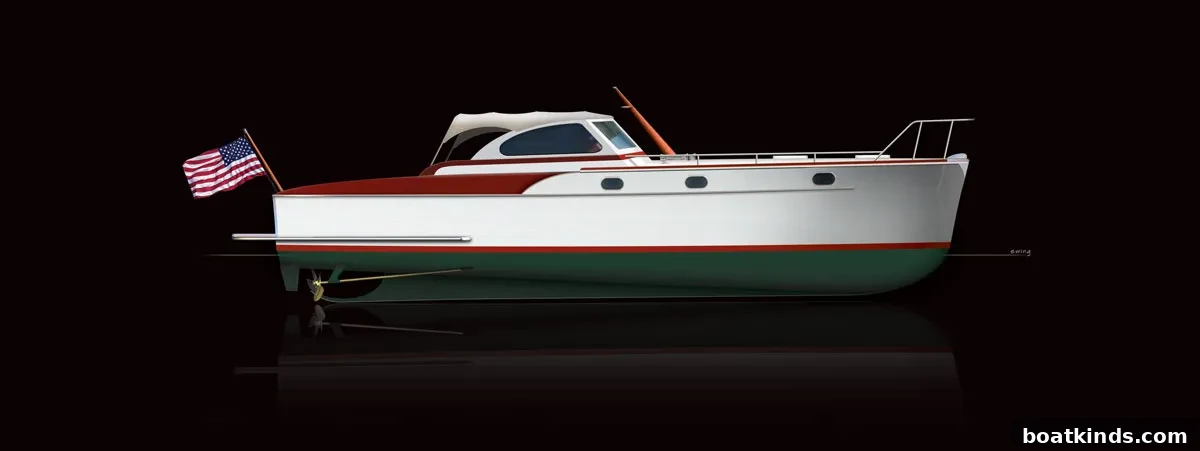
Matthews Martinique Express and the Classic 42-Foot Hull
The Matthews Boat Company began in Bascom, Ohio, in 1890 and moved to Port Clinton in 1906 after Scott J. Matthews and his family completed a remarkable 9,000-mile Great Loop cruise aboard a 74-foot, double-ended cruiser that he had built. For six decades the company earned a reputation for finely crafted wooden powerboats. In the mid-20th century Matthews introduced a standardized 42-foot “stock” hull that would become an enduring example of the company’s design approach and craftsmanship.
Design and Hull Characteristics
The 42-foot stock hull is instantly recognizable for its classical lines and purposeful underwater profile. Forward, a near-vertical stem descends to a deep forefoot below the waterline, giving the bow a pronounced entrance. The topsides are relatively high with a modest bow flare that eases into a graceful tumblehome toward the stern. Early-developing keel lines near the turn of the stem run nearly the full length of the bottom and terminate in a protective shoe around the running gear. The bottom itself features smoothly rounded bilges with a flat run aft, a shape that balances seakeeping with predictable handling.
Construction and Finish
Construction of Matthews boats relied on durable traditional materials. The hull planking was typically rot-resistant Honduran mahogany laid over steam-bent oak internal frames. This combination produced a strong, resilient structure with the warm grain and finish that wooden-boat enthusiasts prize. While most exterior surfaces were finished in glossy white paint for protection and a clean appearance, certain elements — the transom, coaming boards and helm — were often left clear-finished to showcase the fine joinery and varnish work that signaled quality craftsmanship.
Martinique Express Layout and Accommodations
The Martinique Express, introduced in 1956 as a fifth variation of the 42-foot hull, was offered in limited numbers and reflected a design focused on both utility and comfort. The cockpit featured high coamings and space arranged to accommodate a pair of fishing chairs, making it practical for anglers. A slight step-up led to a covered bridgedeck with two forward bench seats, providing sheltered seating and good visibility underway.
Below deck the layout was arranged to make the most of available space: sleeping accommodations for five, a convertible dinette for dining and lounging, and a compact galley for meal preparation. These features made the Martinique and other 42-foot variants suitable for short cruises, weekend trips, or extended days on the water with family and friends.
Power and Performance
Matthews offered the 42-foot hull with a range of propulsion options, both gasoline and diesel, in single- or twin-engine configurations. The standard single-engine installation was a 130-hp Chrysler Crown Special, which could push the hull to comfortable cruising speeds in the 10- to 12-knot range. Owners seeking higher performance could choose from additional single-engine options or several twin-engine setups; Matthews advertised a top speed of 23 knots, which would have required powerful twin installations such as optional Chrysler V-8 engines of the era.
Regardless of the power choice, the hull’s lines and robust construction provided a steady, predictable ride. The early keel development and rounded bilges helped the boat track well and maintain composure in moderate chop, while the protective shoe at the stern defended the running gear during tight maneuvering or when operating in shallow harbors.
Legacy and Collector Appeal
By the early 1970s Matthews Boat Company had ceased building boats as they navigated the transition from traditional wooden construction to the then-new world of fiberglass. Despite that shift, boats from the company’s wooden era continue to attract attention for their timeless lines, quality construction and classic detailing. Owners and restorers prize Matthews boats for their aesthetic appeal and the connection they provide to a long tradition of American boatbuilding.
Collectors and enthusiasts often seek original features—clear-finished woodwork, original hardware, and period-correct engine installations—while others sympathetically update systems for reliable modern use. Whatever the approach, Matthews-built boats remain a respected and valued part of the vintage boat community, celebrated for the workmanship and character that timber construction brings to the water.
This article was originally published in the September 2021 issue.