
Thieves stole a 34-foot Spectre center console from the backyard lift of Jay Palini in Pinellas County, Florida.
Palini was awakened around 4 a.m. by loud knocking and a Pinellas County sheriff’s deputy on his doorstep asking, “Do you usually have a red-and-white boat on your lift?”
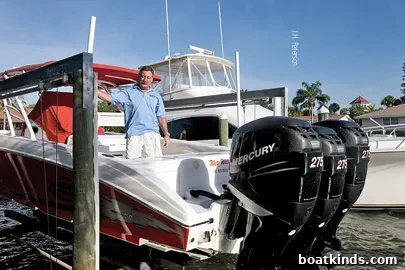
At the time he went to bed on the night of March 2, Palini had two boats behind his home in Tierra Verde: his own 43-foot Ocean sportfishing yacht moored in the canal and a friend’s 34-foot red-and-white Spectre center console, named Wet Willys, sitting on the lift.
“We went back to take a look,” says Palini, 48, president of Spectre Sportfish of Pinellas Park, Florida, which builds the Spectre fishing boats. When they inspected the area, the Spectre was gone.
Tierra Verde is a waterfront community threaded with canals and known for fast offshore boats that head out into the Gulf. About two hours before deputies questioned Palini, a sheriff’s marine unit had observed the sleek Spectre motoring down a nearby canal with its lights off.
Equipped with quiet triple 275-hp Mercury Verado outboards, the stolen boat slipped quietly past homes. Authorities say the thieves navigated into another canal, stopped behind a vacant house and loaded 30 gallons of gasoline they had previously stashed there. Police later found a case of water and a gallon of oil on the vessel, suggesting the crew planned a longer run offshore.
The $175,000 Spectre was seen heading from a canal toward the Pass-a-Grille Channel and the Gulf of Mexico when deputies intercepted it. In an attempt to escape, the thieves ran the boat into a pole, tearing a two-foot gash in the hull, then abandoned the vessel at a dock behind a home. They jumped ashore and fled on foot. Police dogs tracked two men to a hiding spot beneath an outdoor staircase; a third suspect was found concealed outside another house.
Authorities charged three Florida men — Christobal Rodriguez-Contreras, 36, of Miami; Diomere Mendez, 32, of Hialeah; and Yordis Gutierrez, 31, of Naples — with felony grand theft. Gutierrez was released on $50,000 bond, and the other two on $25,000 bonds each.
Palini says the lift at his home still had power that night. The thieves lowered the Spectre into the water, crawled under the console, unplugged Palini’s key switch and connected their own. He doubts a power cut would reliably prevent theft, noting a recent triple-engine Fountain that was taken from a lift while its power was switched off. “They must bring their own power source,” he says.
Palini suspects the thieves intended to take the larger Ocean as well. “They had the spring lines off it and in the boat that they took,” he says. “I assume they planned to tow that one out of there. … They must have had some sort of problem.”
This theft is not isolated. Pinellas County sheriff’s spokeswoman Marianne Pasha says seven high-end powerboats were stolen from southern Pinellas County last year, and so far in 2009 law enforcement has investigated a theft and an attempted theft, both in Tierra Verde. Thieves appear to target fast offshore “go-fast” center consoles they can seize quickly and run out to the Gulf. Investigators are exploring links to organized crews operating in Dade and Monroe counties, where boat thefts are especially common.
Boat theft across Florida has become a growing problem, says Mark DuPont, senior intelligence officer for the Florida Fish and Wildlife Conservation Commission (FWC). The FWC reports boat thefts in the state rose 46 percent last year to 3,399 incidents. Many stolen vessels are believed to be used in trafficking—some for drugs, but a large number for transporting illegal immigrants. Stolen boats are also used in human smuggling rings and other illicit activities.
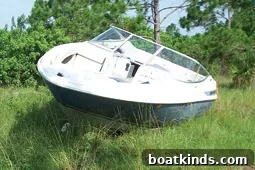
DuPont explains that Florida’s southern counties—Lee, Collier, Monroe and Miami-Dade—see the most boat thefts because of their proximity to pickup points such as Cuba, Haiti, the Dominican Republic and the Bahamas, and because of easy ocean access. Smugglers favor sturdy offshore center consoles in the 29-to-36-foot range, powered by two or three large outboards: these boats are fast, offer cargo space for people, and have redundancy if an engine fails. Smugglers reportedly charge $10,000 to $15,000 per person; a single stolen boat used repeatedly can be extremely profitable, and many vessels are ultimately abandoned after a few hard runs.
One notable case involves Cuban-American radio personality Lazaro Mendez, whose 33-foot Hydrosport, Offshore Pimp, was stolen from a lift behind his Florida Keys home. The boat had a satellite tracking device from Guardian Mobility, which alerted Mendez when the vessel left the dock at 11:08 p.m. on Oct. 16, 2007.
Mendez called neighbors and authorities, but Offshore Pimp reached open water quickly and eluded immediate pursuit. He tracked the boat’s satellite signal for three days and watched it move toward the northwest tip of Cuba, then into a remote Cuban lagoon. From there it crossed the Yucatan Channel to wait off Isla Mujeres, ultimately landing human passengers on a small island. Working with an insurance representative and a team of Mexican police, Mendez helped capture the smugglers ashore at an Isla Mujeres marina; the suspects were jailed in Mexico.
Mendez says Mexican authorities later moved the Hydrosport to a Mexican Navy marina, where it remained for more than a month as he navigated the paperwork to reclaim it. An insurance representative noted there are often numerous Florida-registered vessels in foreign marinas—many stolen or abandoned by smugglers—and insurers or private investigators frequently negotiate their release.
Given these risks, DuPont recommends boat owners consider buying satellite tracking devices, which cost only a few hundred dollars but can help recover boats valued in the tens or hundreds of thousands. He also urges better coordination among the many agencies that patrol Florida waters and asks the public to report suspicious behavior on the water.
Deputy Pasha says the deputies who intercepted Wet Willys were patrolling Tierra Verde because of a recent theft in a neighboring canal and a tip about possible targeting of the area, along with reports of suspicious activity that night.
“[The thieves] were working this particular area pretty hard,” Palini says. He’s now weighing additional security measures—such as a hidden fuel shutoff or a satellite tracker—to deter future attempts.
Stolen Vessel Statistics
Source: FWC Stolen Vessel Database
Compiled by: Katie Fojtik, Division of Law Enforcement
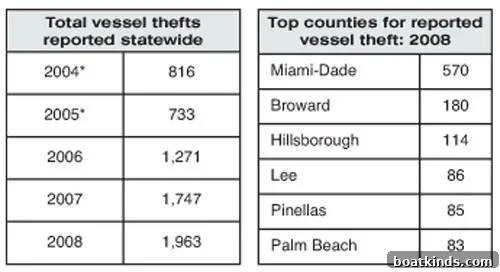
* Vessel thefts may appear lower than actual numbers for these years, as the stolen vessel database began to be utilized more in 2006.
** The data contained in this report was obtained from the FWC Stolen Vessel Database on 3/30/09 and may differ somewhat from the figures in previous reports due to delays in reporting and data entry.
This article originally appeared in the Florida & the South Home Waters Section of the June 2009 issue.