
Eddie Fay: Newport Maritime Artist Capturing the Peril and Poetry of Working Boats
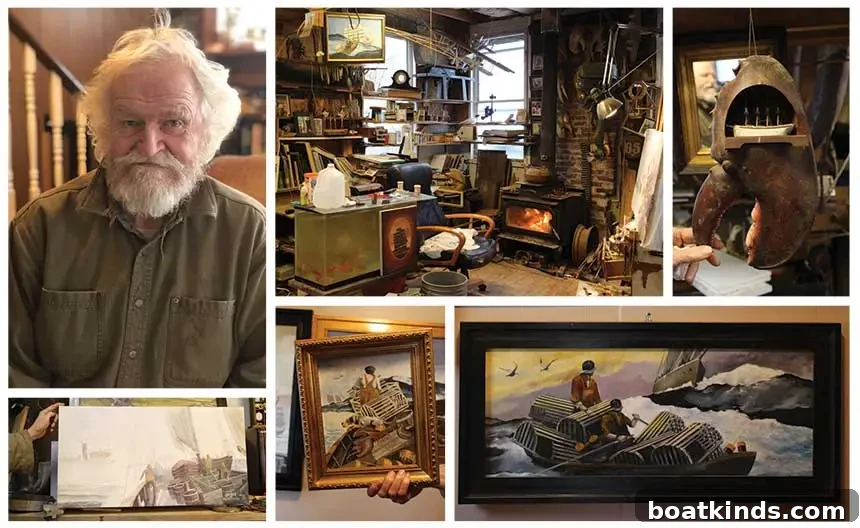
Newport-based artist Eddie Fay has spent a lifetime aboard commercial vessels, and his paintings reflect an intimate knowledge of the sea’s moods. At 71, after 53 years earning his living on New England waters, Fay paints the moments he knows best: working boats, tense approaches to disaster, and the daily rhythms of life at sea. “When a boat goes down, you’d be surprised at how fast it disappears from under your feet, especially at night in a storm,” he says. “That’s what I would really like to convey in my paintings.”
Fay’s home studio is divided between two passions: ship modeling and painting. One half of the space is devoted to painstakingly built models and folk-art pieces made from remnants of commercial fishing; the other half is where he composes canvases that balance realism with narrative drama. His work draws on decades at sea and often evokes the compressed tension and naturalism of Winslow Homer, an artist Fay admires.
Early experiences shaped both his respect for the water and the subjects he chooses. Fay began drawing and painting as a child in Boston. In 1968 he joined the U.S. Coast Guard; although he was largely unable to paint during those four years of service, the experience deepened his understanding of maritime life and danger. After his Coast Guard service, Fay worked with a Gloucester, Massachusetts, fishing fleet, setting trawl lines with as many as 2,400 hooks. The hard physical labor and the unpredictable elements of that work inform many of his most compelling pieces.
Rather than producing idealized seascapes, Fay favors scenes that reflect the hazards and humor of working vessels. Many of his favorite paintings depict “a real disaster about to happen,” a dramatic moment that communicates the precariousness of life at sea. He also lightens subject matter when he wants to move a piece away from gloom: instead of a fisherman cleaning fish on the drag, for example, he might paint a man playing a piano on deck beneath a sky of falling water faucets, or a chef sprinting across the deck with a bottle of wine and fine glasses. These touches of whimsy keep his portfolio varied and prevent his work from becoming a catalogue of clichés.
Fay’s studio contains tangible traces of his commercial fishing years. He kept the largest lobsters’ claws from trips when the animals died on the way back to port, and he transformed sections of those claws into small folk-art objects: clocks, miniature ship models, and carved figures fitted into the hollowed sections. He has used swordfish bills in the same inventive way. This resourceful reuse of materials connects his artwork directly to the boats and catches that defined his working life.
In addition to maritime painting and ship modeling, Fay’s creative practice includes boat portraiture, murals, automobile pinstriping, and custom sign painting. His range reflects a practical, hands-on approach to art-making born of decades of working seafarers’ trades. Summers still find him tied to the water: now retired from full-time fishing, he works seasonally on a commercial dayboat out of Point Judith, Rhode Island, and goes clamming whenever he can. The sea remains central to his life and his subjects.
Fay’s work has been exhibited locally, including at the Newport Public Library and the Armory Antique Marketplace. He does not treat his paintings as commercial commodities; many pieces bear no price tag. “It’s a labor of love,” he says—a remark that captures his commitment to authenticity over trend or marketability. His paintings aim to communicate the truths of life aboard working boats: the unsentimental dangers, the occasional levity, and the enduring connection between people and the sea.
For collectors, maritime art enthusiasts, and anyone drawn to seascapes grounded in real experience, Eddie Fay’s paintings offer a direct view into the world of New England fisheries and the resilience of those who work them. Rooted in memory, material, and lived experience, his work remains a vivid record of a life spent on unpredictable waters.
This article originally appeared in the April 2019 issue.