The America’s Cup World Series returned to Newport, Rhode Island this summer, and while the scene brought back memories of the city’s storied regatta past, the boats on the racecourse were a radical departure from the classic 12 Meters of old. Modern high-performance catamarans — loud, fast and visually spectacular — drew crowds to Fort Adams and transformed the waterfront into a bustling maritime festival.
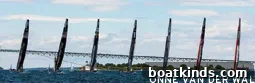
Nearly 60,000 spectators visited Narragansett Bay for the June 26–July 1 regatta, the sixth and final stop of the America’s Cup World Series. Unlike the heavy monohulls that once defined Cup racing, this series features 44-foot AC45 catamarans constructed from honeycomb-cored carbon fiber and equipped with fixed wing sails. These machines have a beam of roughly 22.6 feet and are capable of astonishing speed — often sailing at about twice the wind speed and pushing into the high 20s in knots in moderate conditions. Agile and nimble, they accelerate quickly and turn tightly, occasionally providing dramatic moments such as capsizes that make onlookers reach for solid footing.
On the water the competition combined fleet racing — where all teams competed together — and match racing, which pits two boats in direct head-to-head tactical duels. Skipper Jimmy Spithill and Oracle Team USA, backed by Larry Ellison, took the AC World Series season championship against seven other international teams from New Zealand, France, Italy, Sweden and Korea. The racing emphasized speed, tactics and teamwork in a format designed to be accessible and exciting for both seasoned sailors and newcomers.
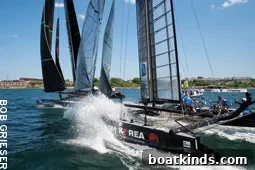
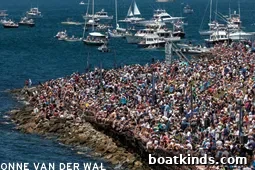
What stood out at Newport was how close the action was to shore. Race organizers positioned the course to give the public an up-close view of the catamarans slicing across the bay, and spectators embraced that proximity. Team tents lined the park entrance, with crews working openly on rigging and last-minute adjustments just yards from the promenade. Brenton Cove became a lively mix of powerboats, sailing craft, kayaks and small tenders jockeying for position to watch the AC45s that were moored roughly 50 feet offshore.
The atmosphere on land felt like a summer festival as much as a sporting event. Music thumped from a promotional vehicle, a big outdoor screen showed racing highlights and post-race interviews, and families spread out on the grass between exclusive hospitality areas and casual food stands. Exhibits ranged from composite catamaran demos that visitors could touch, to an underwater camera offering views from below the surface and displays of antiques that honored classic maritime tradition, like ship’s wheels and brass engine telegraphs.
Support operations were visible and efficient. Oracle’s two AC45s, one skippered by team CEO Russell Coutts, were backed by a flotilla of RIBs and support craft ferrying crew and equipment. As sailors boarded their launch boats for warm-up runs, the crowd responded with enthusiastic applause. Race commentators helped bridge the gap for general audiences, explaining tactics, course choices and the unique handling characteristics of the cats in plain language so spectators could better appreciate the strategy unfolding on the water.
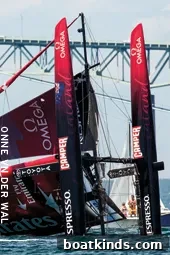
The final day of racing was broadcast nationally, marking a rare network television appearance for Cup sailing in the United States and attracting a large TV audience. While traditionalists may lament the shift from classic cup yachts to carbon-fiber catamarans and sailors wearing helmets, the new format undeniably delivers adrenaline-fueled, visually thrilling sailing that is easy to follow and hard to forget.
Looking ahead, the America’s Cup World Series continues to expand the sport’s reach. The next season’s events will include a stop in San Francisco, and the Cup finals were scheduled to feature larger AC72 catamarans on San Francisco Bay in September 2013. For fans of high-speed sailing, modern boat technology and close-up spectator experiences, these regattas offer a compelling mix of innovation and spectacle.
This article originally appeared in the September 2012 issue.