Phil Taylor’s Refit of a 1987 Sisu 26
For his first boat and his first refit project, Phil Taylor took a hands-on approach to bring his Sisu 26 up to his standards—and enjoyed every step.
Living part-time on Bailey Island, Maine, Phil Taylor first fell for boating by riding in a neighbor’s 18-foot Corson runabout and hopping among local islands. He wanted independence on the water and considered a center-console boat, but Maine’s unpredictable weather convinced him he needed an enclosed helm. As a corporate helicopter pilot, Taylor already had navigation and mechanical instincts, which made him comfortable tackling a boat project.

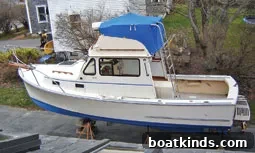
After visiting boat shows and inspecting used boats along the Connecticut shore and Narragansett Bay, Taylor decided he preferred a Down East–style vessel with inboard power. In 2004 he bought a 1987 Sisu 26 Offshore, appreciating its solid construction and classic lobster-boat heritage. He became the boat’s fourth owner, paying roughly $40,000. The purchase came with a realistic expectation that the boat would need work, but Taylor embraced the learning curve.
The Sisu 26 was designed by Royal Lowell and built by Sisu Boats of Portsmouth, New Hampshire, between 1979 and 1988. Its fiberglass composite construction features balsa coring and resin-coated plywood panels, reflecting traditional rather than cutting-edge methods. The Offshore version that Taylor bought included a three-sided pilothouse, a small galley and a head—features he wanted for comfortable island cruising.

The engine displayed around 1,300 hours—high for a gasoline inboard—but ran satisfactorily at the time of purchase. Taylor knew repowering would be necessary eventually, but much of the vessel was functional. Calling himself a “shade tree mechanic,” he made a priority list and began addressing one item at a time while using the boat with his wife, Liz. Each upgrade came with its own challenges and lessons.
One of the first changes was the pilothouse glazing. The original Plexiglas windows in rubber frames were replaced with aluminum-frame windows—similar to RV windows—to improve durability and fit. Because the boat’s original window cutouts used an uncommon 2-inch radius, Taylor located a Miami supplier willing to work from his templates. The new side windows slide and the center windshield panel opens for ventilation. A roll-up weather canvas and refreshed interior panels painted with Interlux products completed the pilothouse upgrades.
Work continued on the interior: a local team will rework the galley, replacing the countertop with a custom Corian surface, and will mount the icebox and sink with an electric pump below. Plans also include a folding helm seat to improve ergonomics while underway.
Systems upgrades focused on safety and redundancy. Taylor doubled bilge-pump capacity and added a manual Whale pump. He installed a diverter valve on the engine’s seawater intake so the engine can run as an emergency dewatering pump, a useful feature on a smaller vessel where a little water can quickly affect stability. He also added a saltwater washdown that uses the head’s seawater intake as a supply.
For fire and fume protection, Taylor fitted a Fireboy automatic fire-extinguishing system in the machinery space with manual activation and a remote discharge alarm. He added a remote bilge-fume detector at the helm and a carbon monoxide detector in the accommodations. Electronics upgrades include a Raymarine 530 chartplotter integrated with a DSC VHF radio; the depth sounder remains an independent unit. The boat retained its monochrome radar, now mounted on a mahogany radome cradle built by a neighbor.
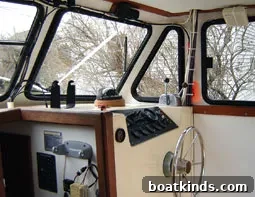
When the electrical system needed modernizing, Taylor enlisted local specialist Stu Cauldwell of Cauldwell Electronics. They replaced much of the wiring, added a high-water bilge alarm and provisions for a port windshield wiper, and swapped the original fuse panel for a Blue Seas circuit-breaker panel. New engine instruments and a custom pilot-style dash were installed, with clearly labeled switches. The boat runs on two AGM house batteries, supported by a solar charger; a battery monitor system is in progress.
Taylor discovered water intrusion in the machinery space that the survey had missed. Sound-deadening material had concealed wooden bulkhead damage. He redesigned the deck seal, repaired or replaced affected wood, and encapsulated repairs with WEST System epoxy. Engine cowl vents that had allowed water into the deck core were temporarily sealed with 3M 4200 while Taylor evaluates a long-term solution for airflow into the machinery space.
In 2007 the original engine developed catastrophic sludge buildup and had to be removed. Taylor coordinated with local help and bought a new Crusader Power Pack: a 300-hp Vortec base engine with complete fuel and ignition systems. Reusing the bell housing and major exhaust components reduced installation complexity and cost. He upgraded the cooling system with an oil cooler (heat exchanger), added a new fuel filter assembly with shut-off valves, and installed an engine oil transfer pump to simplify oil changes. Exhaust manifolds and risers were ceramic-coated to reduce machinery-space heat and protect components from seawater corrosion.
The new engine required 4-inch exhaust hose and corresponding bronze through-hull fittings, so Taylor replaced the old 3-inch exhaust plumbing. He applied aviation technicians’ advice—use of Loctite, safety wire and anti-seize on critical fasteners—to ensure reliability and serviceability. His one regret: he would have painted the bilge while the engine was out.
Reflecting on a project that began in 2004 and continues as a long-term maintenance and improvement effort, Taylor says the purchase was sensible. The Sisu 26 now serves exactly as he intended: a reliable platform for island cruising and enjoying Maine’s coast. He learned to plan upgrades carefully, to get subcontracted work in writing, and to balance hands-on learning with professional help.
Buying and refitting his first boat proved to be as rewarding as using it. With thoughtful planning and incremental upgrades, Taylor preserved the boat’s integrity while staying within his budget. He’s proud of his 1987 Sisu 26—and justifiably so.
This article originally appeared in the March 2010 issue.