Shipwrecks draw our attention because they blend drama, human error and the raw power of the sea. They happen to all kinds of vessels, on rivers and oceans alike, and each one offers lessons—sometimes about nature’s dominance, sometimes about human negligence, and often about a mix of both.
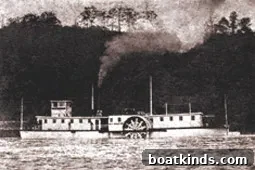
The steamship New Orleans is an early and dramatic example. Built to prove the commercial viability of steam travel from Pittsburgh to New Orleans, she measured 148 feet long and 26 feet wide and was driven by a powerful 160-horsepower, 34-cylinder steam engine that turned amidships paddlewheels. Her maiden voyage began Oct. 20, 1811, amid a climate of unusual natural phenomena that many at the time took as ominous signs.
That year saw the Great Comet of 1811, a total solar eclipse in the region, and a massive and inexplicable squirrel migration that prompted local superstition. The river trip itself was hazardous: to descend the Ohio River the new steamship had to navigate a perilous two-mile set of rapids below Louisville. The pilot’s skill got her through treacherous currents and narrow channels without damage.
In December 1811 the New Madrid earthquakes struck. Three powerful shocks hit on Dec. 16, followed by other catastrophic temblors in early 1812. While refueling with coal on Dec. 11 the ship experienced violent earth movement, fled downriver to avoid floating debris and anchored behind an island—only to discover the island had vanished by morning. Passengers watched the riverbanks heave, trees tremble and parts of the river bottom rise and reverse flow, creating flooded, unfamiliar terrain. At one point a wide chasm opened in the water, forcing the vessel to navigate around what had become a submerged rupture.
On top of the seismic chaos, local Chickasaw people reportedly attacked, believing the steam-powered “fire canoe” caused the earthquakes. The New Orleans escaped the assaults and the quakes and completed her pioneering run, opening the way for many more steamboats on the western rivers.
Despite surviving those extraordinary hazards and likely benefiting from expert piloting and luck, the New Orleans met her end years later in a mundane yet fateful accident. Tied to a landing while taking on wood for fuel during a severe thunderstorm, the ship remained alongside overnight. As floodwaters rose and currents altered, the hull settled onto a submerged stump that had been hidden beneath the swollen river. The stump holed her, and that was the end. It’s a stark reminder that even vessels with remarkable histories can be sunk by ordinary hazards.
An even more tragic human-caused disaster occurred in New York Harbor in 1904 aboard the excursion steamship General Slocum. Built in 1891 and used for pleasure cruises, she had a record of minor accidents and poor maintenance. On July 15, 1904, around 1,342 passengers—many from Little Germany in Manhattan’s Lower East Side on a church outing—boarded with joyful anticipation. Shortly after departure a fire reportedly started in a forward lamp room and quickly spread through straw and oily waste that should not have been aboard.
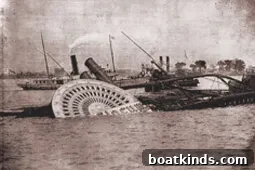
Rather than beaching or docking immediately, the captain steamed into strong winds and through Hell Gate, which worsened conditions by driving flames back toward passengers. Life preservers were rotten, lifeboats could not be deployed, and firefighting gear failed—or had never been tested. There had reportedly been no fire drills for the crew. As decks collapsed and panic spread, many passengers jumped overboard although few could swim; others were crushed by paddlewheel action. The ship later settled near North Brother Island.
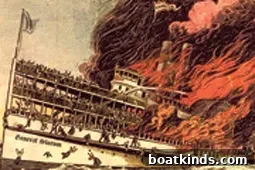
The death toll reached 1,021. The captain received a prison sentence but served only part of it after a pardon; manufacturers and regulators faced legal scrutiny for defective or misused life preservers, some of which had been left exposed to sun and rain for years and allegedly altered to meet regulatory requirements. The General Slocum disaster became one of New York’s worst peacetime tragedies and underlines how negligence and poor maintenance can turn a routine outing into catastrophe.
Not all wrecks are caused by poor maintenance or negligence; some are the consequence of ocean dynamics. Whale Cay Passage in the Abacos illustrates how seemingly calm conditions can suddenly become deadly. Swells traveling thousands of miles across the North Atlantic can steepen rapidly as they meet the shallow Bahamas Banks and then collapse into breaking seas. Rogue sets from distant storms can arrive at the wrong moment and create heavy, unpredictable waves in narrow cuts.
On April 20, 1986, a 51-foot yawl passed through Whale Cay Passage without incident, but roughly ninety minutes later the 160-foot freighter Violet Mitchell entered on a following sea. The freighter’s stern lifted, the rudder lost effective water flow and steerage was lost. Her bow dug into a wave and she rolled and sank. The captain and his daughter were among those lost; other crew survived. Investigations showed the fatal wave impulse originated from a distant storm off Cape Hatteras, illustrating how distant weather can trigger deadly local conditions.
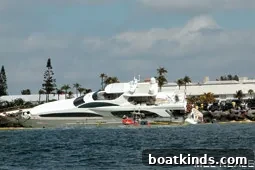
Even experienced mariners can be undone if they rely too heavily on technology and not enough on situational awareness. I watched a multimillion-dollar megayacht approach Big Rock Cut near Staniel Cay. The helmsman followed the electronic chartplotter intently and failed to monitor his boat’s lateral movement as an incoming tide pushed the yacht toward a reef. The vessel grounded on a prominent rock and reef in the cut, the sound of grinding coral was unmistakable, and powerful waves pinned her sideways. Fortunately nearby island boats were able to pull her free before her hull was holed; no lives were lost. The incident shows that technology should augment, not replace, seamanship and local knowledge.
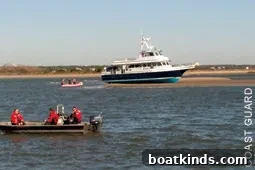
Small-boat wrecks and collisions also demonstrate that human choices matter most. In April 2009 a 22-foot boat returning to Jacksonville on the Intracoastal Waterway struck a stationary barge. Fourteen people were aboard; five died and nine were injured. Toxicology reports indicated alcohol and drugs were factors for those killed. In constricted channels, speed, inattention and inexperienced helmsmanship are deadly combinations.
Other incidents reinforce this point: near Charleston, a fast night-time crash into an unlit aid raised media outrage about lighting, when the real issue was excessive speed and poor planning. In the Rappahannock River a 23-foot boat struck a lighted aid at about 35 mph late at night after a tiki-bar visit; nine were seriously injured and one person was killed. In a separate June 2011 case on the same river, a small craft struck a navigational marker then later slammed into a marina seawall at high speed; both occupants died. Alcohol and reckless speed again featured prominently.
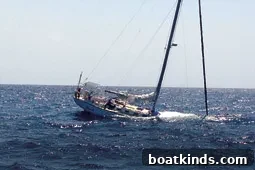
Shipwrecks and boating accidents are varied in cause and scale. Some are the product of storms, rogue waves or unexpected environmental forces. Many, however, result from poor maintenance, inadequate safety equipment, insufficient training, impaired judgment or simply a failure to respect the water’s demands. When we boat we enter an unfamiliar environment—one that requires respect, preparation, vigilance and practical seamanship.
Modern initiatives to expand public access and recreational boating make safety education more important than ever. No online course can replace experience, sober judgment and basic precautions: don’t operate vessels under the influence, carry reliable life jackets, rehearse emergency procedures, maintain equipment and always look where you’re going. In narrow channels and at night, slow down and use proper lighting. Technology like chartplotters and autopilots are useful but should never replace constant visual checks and local knowledge.
Shipwrecks are reminders that even today the sea can humble us. They prompt hard questions about regulation, maintenance and competence, but they also call for renewed emphasis on hands-on seamanship, common sense and personal responsibility. Respecting those lessons is the best way to prevent another story of preventable loss on the water.
August 2014 issue