
Phin Sprague shares his insights on design and construction, shaped by decades of experience at sea
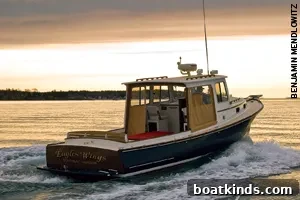
The right fit: Choosing a boat that matches your life
What makes a good boat? Talk to people at your marina and you’ll hear many answers, yet common themes emerge. No one wants a vessel that will founder in a storm or disintegrate if it grounds. For Phineas “Phin” Sprague, owner of Portland Yacht Services in Portland, Maine, a good boat is first and foremost one that matches the owner’s resources and expectations.
“A good boat is one that doesn’t put the owner in the poorhouse, delivers a lot of enjoyment and causes minimal pain,” Phin says. That pain often comes from maintenance. Too many buyers choose a boat they cannot afford to maintain or operate, then become frustrated. Either you must be prepared to do the upkeep yourself or pay a yard to handle it.
Phin also warns against confusing correlation with causation when it comes to systems and reliability. Boats with many systems tend to experience more failures, and people blame the complexity. In reality, more systems simply offer more potential failure points; the real causes are often lack of maintenance or low-quality components. Phin’s approach aboard the 65-foot Alden-designed schooner Lions Whelp was to install high-quality gear where it would be accessible for service, and then to keep up with the maintenance. “If it isn’t a burden to maintain, why not have the comfort and convenience?” he asks.
At the same time, simplicity has its virtues. “Part of what makes a boat good is that it suits you,” Phin observes. “If you prefer a straightforward, simple boat, then buy one.” When evaluating powerboats, he recommends considering redundancy: what happens if the main engine on a single-screw boat fails? The further offshore you plan to go, the more urgent such questions become.
Finally, a good boat is fit for purpose. If your priority is offshore passage-making, seaworthiness must trump creature comforts. If you primarily entertain at the dock or cruise protected waters, accommodations and deck layout will be more important. Recognize a vessel for what it is: a Carver or Silverton may be an excellent floating living room for inshore cruising, but it is not designed for long open-ocean passages.
Heavy weather and seaworthiness
Phin names Tony Marchaj’s Seaworthiness: The Forgotten Factor as essential reading. Marchaj’s work highlights dynamic stability as well as static stability, and Phin concurs that understanding both is critical to assessing a boat’s behavior in real seas.
Static stability refers to the restoring forces created by the offset between a hull’s center of gravity and its center of buoyancy at a given heel angle. Dynamic stability adds the effects of wind, waves and the vessel’s motion—factors that can push a design beyond what simple static numbers imply. Heavy weights placed too far fore or aft can cause excessive pitching; too much sail on a boat with only modest initial stability can provoke capsize in strong beam winds. A design that looks stable on paper can behave unpredictably in rough conditions if dynamic effects are not considered.
Phin contrasts a typical 39-foot production sailboat with his Lions Whelp. While a 39-footer might have a stability range on the order of 109 degrees, Lions Whelp is stable through roughly 145 degrees of roll. That extra range can be the difference between a dire situation and a soggy cabin with spilled coffee. Dynamic stability matters when you find yourself on the side of a breaking wave and the roll angle climbs quickly.
Speed and propulsion matter too. Ask whether your boat is fast enough to outrun a weather system or, if caught, capable of riding it with control. Many incidents begin in sheltered waters, where owners rarely test their boats’ systems under severe conditions. When storms arise, fast-developing leaks over electrical systems or failing batteries can turn into cascading failures: unable to start the engine, raise sails, call for help, or even use basic systems without power. Phin carries a portable starting-fluid injection unit for Lions Whelp as one example of planning for electrical failures.
Marchaj emphasizes the human factor: “Seaworthiness is a function of the crew.” Phin echoes this, stressing that captains must continually process incoming information, question assumptions and look for errors in judgment. Complacency is dangerous. Treat safety systems and contingency plans as layered protections—redundancy, not a single fragile skin. If a captain does not understand a vessel’s limitations or neglects preparation, the boat’s theoretical seaworthiness is compromised.
Learning the ropes: experience that shapes design
Phin’s hard-earned views have roots in long, challenging voyages. In 1972, at age 22, he and partners bought a 1931, 72-foot Alden-designed schooner they named Mariah. They immediately faced heavy weather, structural damage and hard lessons about life offshore. A period of repairs and refitting in Florida preceded passage through the Panama Canal and into the Pacific, and the circumnavigation stretched nearly four years.
Navigational tools were sparse by modern standards: a Loran-A and celestial navigation skills filled the gap before GPS. A rotating cast of crew—56 people joined at various stages—taught Phin practical lessons in leadership and seamanship. Rather than a long list of strict rules, the crew adopted a simple code: behave like a gentleman or lady, and ask when unsure.
These voyages informed Lions Whelp’s later design. Phin learned the peril of grounding firsthand: rocks and coral can quickly work through hull planking under a boat’s weight. To guard against this, Lions Whelp’s hull incorporates substantial thickness and engineered core materials to resist puncture and intrusion. He recalls multiple groundings and damaged vessels—examples that convinced him thicker, well-built hulls reduce catastrophic failure in grounding events.
After the circumnavigation Phin and his fiancée settled in Maine, married, raised a family and built a boatyard and marina. Yet the sea remained central to his life and informed how he approaches design, construction and maintenance. Boating always involves balancing risks and rewards. Risk depends on distance from safe harbor, season, regional hazards and crew skill and vigilance. Choosing a boat suited to the kind of cruising you intend, understanding its limitations and maintaining systems diligently will reduce risk and increase the chance of rich, lasting memories.
“We are all in God’s hands when we are out on the water,” Phin reflects. “The sea teaches a lot of lessons.” Those lessons—on matching boat to owner, on planning for redundancy, on respecting dynamic stability and on the value of experience—make for safer, more enjoyable cruising.
Eric Sorensen is a consultant to boat- and shipbuilders and to the government. He was founding director of the J.D. Power and Associates marine practice and is the author of “Sorensen’s Guide to Powerboats: How to Evaluate Design, Construction and Performance.” A longtime licensed captain, he can be reached at [email protected].
This article originally appeared in the November 2010 issue.