
Powerboat Team Sets Sights on Around-the-World Circumnavigation Record
Ask Chris Fertig what he dreams about and he answers without hesitation: he wants the record for the fastest powerboat circumnavigation. Fertig has already taken a major step toward that goal. In September, he and partner Tyson Garvin set the Bermuda Challenge record, a non-stop powerboat sprint of nearly 780 miles from New York to Bermuda.
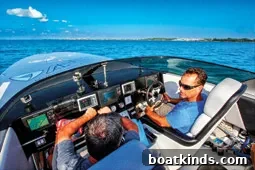
Their next objective dwarfs that achievement: a nonstop, around-the-world powerboat run covering roughly 26,500 miles. To prove the concept and validate the technologies before committing to the full-scale project, Fertig and Garvin are building a 50-foot demonstrator power catamaran. The demonstrator is intended to test hull performance, propulsion layouts and systems integration so the team can confidently design and outfit the 86-foot racecat that will attempt the circumnavigation.
The 50-foot demonstrator, currently under construction, is expected to be finished in the spring or early summer. Fertig and Garvin plan at least two competitive warm-up runs with the demonstrator to both promote the project and demonstrate real-world performance to potential sponsors. Their stated fundraising target to build and equip the 86-foot raceboat is about $15 million. “I don’t like to say I’ll do something if I don’t know 100 percent that it will happen,” Fertig says. “The key is raising the money, and I think we can do that by showing potential sponsors that this is no pie-in-the-sky dream.”
Fertig, 35, brings deep maritime experience to the program. He is general manager of maritime technical services for Maersk Line Ltd. in Norfolk, Virginia, where he helps create and implement advanced commercial propulsion systems. A Pittsburgh native who grew up boating on the city’s three rivers, Fertig graduated from the U.S. Coast Guard Academy and served on a specialized unit that chased drug runners in the Caribbean. In addition to his professional duties, he frequently contributes piloting and safety advice to specialty boating publications.
Garvin, 38, of Joplin, Missouri, owns Apex Manufacturing, an engineering and machine shop. The two met at a boat show a few years ago and quickly discovered a shared appetite for extreme endurance racing. “I want to do the biggest endurance race there is, and that’s around the world,” Garvin says. “When I do something, I want it to be the biggest. The Bermuda Challenge was great, but this is the biggest, longest endurance race there is.”
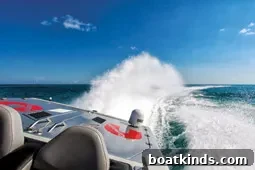
The planned 86-foot raceboat will employ a CODAG propulsion system—combined diesel and gas turbine power. That configuration on their design is expected to include two diesel engines and four gas turbines, producing a combined output Fertig describes as roughly equivalent to 30,000 horsepower. The high-speed catamaran hull form is intended to deliver exceptional top speeds while retaining the seaworthiness required for ocean passages. “It will be a high-speed catamaran configuration, which we think can run almost full speed in about 7-foot seas,” Fertig explains. “The challenge we have now is making sure we have the range we need for several of the longer legs of the race.”
Top speed, the team believes, should not be the limiting factor. With light fuel loads the racecat is expected to approach very high speeds; Garvin projects that, under optimal conditions, they could sustain an average near 100 mph for portions of the route. “If everything works out right with the boat and the weather, we’ll be running at an average speed of 100 mph,” he says.
By comparison, Earthrace, a biodiesel-powered 78-foot trimaran, set the around-the-world powerboat record in 2008 with a time of 60 days, 23 hours, 49 minutes. That vessel was powered by twin 540-hp Cummins diesels and reached top speeds near 40 knots.
The demonstrator will be powered by twin diesel engines in the 550–600 hp range, Fertig says. Its first competitive test will be a long-distance run up the Mississippi River from New Orleans to St. Louis, a 1,039-mile course that carries its own powerboat record history. Howard Arneson currently holds the event record, averaging 82 mph in a Skater 32 catamaran equipped with turbine power. Fertig and Garvin’s demonstrator, built by Skater, is not intended to outpace Arneson’s machine outright; instead, their strategy focuses on fuel efficiency and uninterrupted runs to close the time gap. “That’s how we’ll capture the record—through efficiency,” Fertig notes.
The second warm-up will be a Miami-to-New York dash. George Morales set a longstanding record on that route in 1985, averaging 64.35 mph and finishing in 19 hours, 33 minutes, 47 seconds in a 46-foot Skater catamaran. Completing these two races successfully will provide data and publicity the team needs to move forward with the full-sized raceboat.
Fertig and Garvin aim to finalize design, construction and systems integration on the 86-foot racecat after the demonstrator trials, with a tentative start for construction in February or March 2015 and about six months of testing planned thereafter. Their proposed circumnavigation would begin and end at the same location, as required for record recognition; the team intends to start and finish at the eastern entrance of the Panama Canal in Colón. Fertig anticipates the Mediterranean as one of the most challenging stretches due to its variable sea states and dense maritime traffic. “Once we get clearance to transit the canal, the clock starts ticking,” he says.
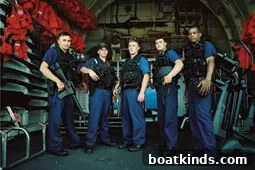
For the Bermuda Challenge record they set, Fertig and Garvin used a 39-foot stepped monohull Skater powered by twin 480-hp Cummins diesels with surface drives. Skater is building both the demonstrator and the larger raceboat, using identical hull shapes so the demonstrator can inform final power and gear ratio choices for the racecat. Garvin will fabricate the transmissions, as he did for the Bermuda run. Construction techniques will include advanced composites—fiberglass fabrics, Kevlar and carbon fiber—combined with high-grade resin infusion to create a strong, lightweight structure.
The demonstrator will be unveiled publicly at the Multi-Agency Craft Conference in June, where the team expects to showcase performance, design intent and engineering solutions aimed at achieving a successful around-the-world powerboat circumnavigation. “I think this boat will blow people away, and the big boat will be even more impressive,” Garvin says. “We are two highly competitive guys, and we really want this.”
March 2014 issue