
How Breck Marshall Revived the Catboat
In the 1960s boating entered a new era. Fiberglass construction, bolder styling and improved auxiliary propulsion combined to change both sailboat and powerboat design. As builders experimented with these modern methods, classic wooden workboats that had been developed and refined over generations began to disappear. Among those designs was the quintessential New England catboat, a single-masted, wide-beamed craft that had served fishermen and families for more than a century.
The Challenge: Tradition vs. Modern Materials
Catboats were prized for practical reasons: shallow draft for working in shoal waters, a capacious cockpit and hold, and the simplicity of a single large sail. Those same qualities made them appealing to recreational sailors, but as fiberglass and new production methods took hold, the wooden catboat seemed at risk of becoming an anachronism. Many feared it would disappear the way other regional working-boat designs had nearly vanished.
Breck Marshall: Builder, Racer, and Enthusiast
Breck Marshall, a sailor and boatbuilder raised amid catboat country around Buzzards Bay, Massachusetts, and Newport, Rhode Island, saw an opportunity to preserve the design by marrying traditional lines with modern materials. He learned his craft building Beetle Cats in John Beetle’s New Bedford shop and went on to apply that practical knowledge to fiberglass construction. His goal was to retain the catboat’s defining characteristics while making a boat better suited to the postwar boating market.
The Sanderling: A Pioneering Fiberglass Catboat
In 1962 Marshall produced a pioneering fiberglass catboat, the 18-foot Sanderling. He campaigned the design aggressively, taking it to every catboat regatta he could find and consistently winning races. Those victories did more than add to his reputation as a designer and sailor — they generated renewed interest in the catboat form and proved that traditional hull shapes could excel when built with modern materials.
The Marshall 22: A Modern Classic
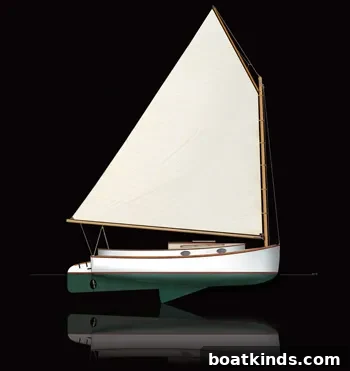
Responding to the growing interest after the Sanderling’s success, Marshall designed a larger catboat for day sailing and coastal cruising. The Marshall 22 debuted in 1965. It measured just over 21 feet at the waterline with a broad 10-foot beam, giving the boat the roomy cockpit and interior that had made catboats so popular. The single-mast arrangement used a mast with one stay carrying a full 388-square-foot mainsail, while a 21-hp diesel provided reliable auxiliary power. A sloop version was later offered for those who preferred a headsail in addition to the main.
Belowdecks the Marshall 22 offered accommodations for short cruises: two berths, a head and an optional small galley. Marshall retained many traditional aesthetic and functional touches—such as a trunk cabin with oval ports, a large “barn door” rudder and wooden mast hoops—so the boat felt familiar to sailors who loved classic catboat lines while benefiting from the durability and lower maintenance of fiberglass construction.
Legacy: Preservation of a New England Tradition
Marshall’s designs proved pivotal in sparking a catboat revival. He helped found the Catboat Association, which brought owners and enthusiasts together and played an important role in promoting the boats, organizing events and preserving the design’s heritage. Marshall Marine, based in South Dartmouth, Massachusetts, went on to produce more than 1,700 catboats, keeping a traditional style in active production when many similar designs had faded. Today John Marshall, Breck’s son, continues to run the company, maintaining the link between traditional catboat character and modern boatbuilding practices.
The success of the Marshall 22 and the company that followed demonstrates how thoughtful adaptation—using modern materials while respecting classic proportions and functions—can preserve a regional boatbuilding tradition for future generations of sailors.
This article originally appeared in the August 2016 issue.