Key West Marlin Fishing: The 1971 Discovery That Rekindled a Tradition
March 16, 1971 — Key West: a proud father and two young anglers posed with a marlin caught aboard the charter boat Cay Sal. Images like this, captured through the years, recall the era of big-game fishing immortalized by Ernest Hemingway in the 1930s and reflect a long-standing tradition of marlin sportfishing in the Straits of Florida.
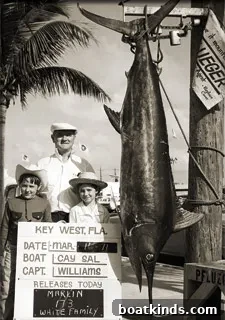
Although marlin offered spectacular action, they were long considered an elusive quarry in the region. Anglers had long known marlin appeared around Cay Sal in the Bahamas, off the Cuban coast, and farther west toward the Dry Tortugas. Local Keys captains Capt. Norman Wood and Danny O’Laughlin developed a working hypothesis that the marlin were migrating between the Gulf of Mexico and the Atlantic on a route that ran roughly 20 miles south of Key West.
After a number of targeted trips to test their theory, Wood and O’Laughlin finally connected with a marlin — a powerful 470-pounder. “Wild as hell and trying to stick his bill in the back of the boat,” Wood later recalled, capturing both the ferocity of the fight and the exhilaration of landing such a specimen. That catch provided strong evidence that marlin followed predictable pathways along the Straits and that those waters could sustain consistent large-game fishing.
The successful catch came while fishing over a distinct offshore drop-off and a series of canyons that run east-west along the Straits of Florida. These underwater features concentrate baitfish and medium-sized gamefish, creating conditions that attract larger predators like marlin. The discovery of such productive structure in relatively close proximity to Key West helped rekindle a renewed era of marlin fishing for local charter captains, sportfishermen and visiting anglers alike.
By 1982 that renewed interest had grown into organized competition. The inaugural Key West Marlin Tournament drew 92 boats and roughly 400 anglers to an area known simply as “the wall.” The winning fish that year weighed 462 pounds, a testament to the size and quality of marlin available in the waters south of the Keys. The tournament also reflected a growing emphasis on conservation-minded practices; by 1985 catch-and-release categories were already being recognized, with Wood and his wife Shirley taking top honors in that division.
Over the decades the Key West Marlin Tournament has continued as a major event on the fishing calendar, appropriately scheduled to coincide with Key West’s Hemingway Days Festival each July. The pairing honors both the sporting tradition popularized by Hemingway and the living culture of angling that thrives in the region today. The tournament remains a focal point for anglers seeking trophy marlin and for local guides showcasing the unique offshore landscape that produces such memorable encounters.
Beyond the trophies and photographs, the history of marlin fishing around Key West demonstrates how local knowledge, careful observation and a willingness to explore offshore structure can transform a sportfishing scene. The early work of captains like Norman Wood and Danny O’Laughlin helped establish patterns that guide anglers to this day, and the continuing popularity of the Key West Marlin Tournament highlights the lasting appeal of blue-water fishing in the Straits of Florida.
March 2014 issue