
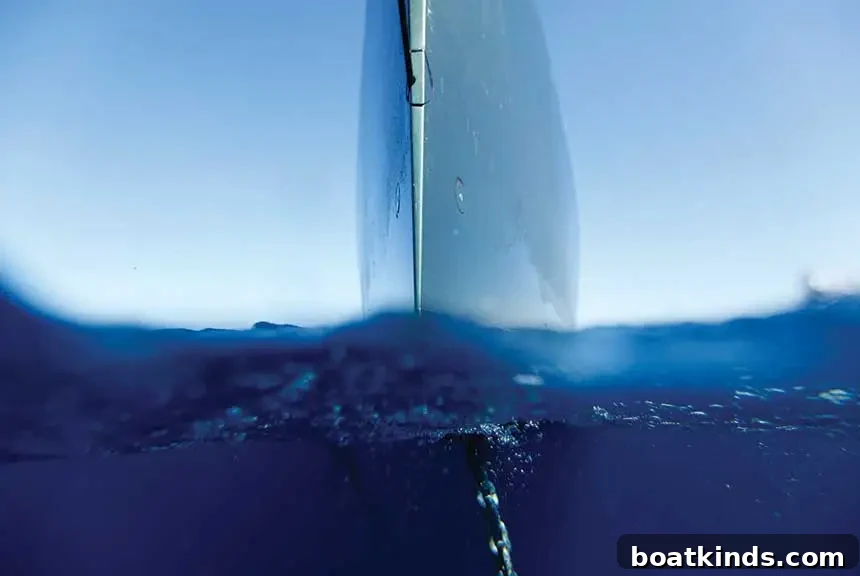
In previous columns we examined how ground tackle works, different anchoring techniques and how to choose a safe anchorage. Equally important is knowing how to detect and react if your anchor begins to drag. Preparing for that possibility starts the moment you set the anchor.
The first step after settling in is to establish a clear position baseline. This baseline is what you will compare against to detect any movement. The simplest and most time-honored method is to take visual bearings to three distinct objects ashore. They don’t need to be charted—what matters is consistency, not exact latitude and longitude. A tree, a distinctive roofline or a flagpole will serve. At night, use shore lights as reference points.
Choose bearings that have a good spread—at least 45 degrees—and include one roughly on the beam if possible. Avoid bearings that are directly ahead or astern, since those give little information about lateral movement. Reciprocal bearings are redundant and reduce the effectiveness of your checks.
Radar ranges are another effective way to monitor position, especially when the shoreline produces a steady echo that isn’t dramatically affected by tide. Unlike visual bearings, radar ranges work best dead ahead or dead astern. If you can identify a reliable echo in front of or behind you, use a variable range marker (VRM) set tangent to that echo. If the boat drifts away from a forward echo, the VRM ring will visibly pull away; if you drift toward an echo astern, the ring will close into it. Radar is particularly valuable when visibility is poor and it complements visual bearings well.
Expect the boat to swing around the anchor as wind and tide change; small movements are normal. When you monitor position, allow for this natural swing. Log the depth at the time you set the anchor—if subsequent depth readings change in ways that don’t match the tide, that can be a sign you are dragging. In areas of uniform depth, soundings may be less helpful, but they can still corroborate other indicators.
Modern electronics simplify position monitoring. Note your GPS coordinates when you anchor and use your chartplotter to watch for movement. Many chartplotters, radars and depthsounders have alarm features that warn of unexpected position changes. An alarm isn’t definitive proof of dragging, but it should prompt an immediate position check.
There are several common causes of dragging: insufficient scope, weak or inappropriate anchor for the bottom, sudden changes in weather, or marginal ground tackle. The quickest corrective action is often to increase scope by paying out more rode. Greater scope increases the horizontal pull on the anchor, which helps the flukes re-set in the seabed. To do this safely you must have rode in reserve and enough room for the boat’s swinging circle; both considerations underline the importance of choosing an anchorage with options.
If adding scope doesn’t stop the drag, consider deploying a second anchor. A second anchor can share the load and prevent a single anchor from continuing to drag. Pay out the second rode until both anchors are sharing tension; if one anchor bears the entire load it may still fail. Be mindful that you might run out of rode on the first anchor before the second becomes effective—so plan scope for both anchors when you choose your spot.
If neither extra scope nor a second anchor will hold, your options are limited. You may need to pick up and re-set in a better location, or in severe circumstances head to open water and ride out the conditions. Resetting anchors is easier when conditions are calm; if conditions are already deteriorating, getting clear water may be the safer choice.
When strong weather is forecast, consider setting two anchors from the start while you still have full control. The ideal angle between two anchors is roughly 60 degrees. Typical methods involve dropping one anchor, maneuvering away while paying out rode, then dropping the second. Once both are down, shorten the first rode until the strain on each anchor is roughly equal. This process relies on good judgment and observation rather than precise instruments.
In extreme cases, you may be forced to abandon ground tackle temporarily—perhaps because you are dragging too fast toward shallows or because another vessel dragging downwind threatens collision. This is why prudent seamanship requires securing the bitter end of the rode so it can be released in an emergency, even under load. The bitter end should be tied to a robust point in the chain locker that can be reached safely in all conditions.
Fiber rode can be cut in an emergency, but cutting chain is more difficult. A common approach is to lash the last link of chain to a strong point with several turns of stout synthetic line. That lashing can carry most of the chain’s strength but remains cuttable when necessary. Some hardware—such as a pelican hook—is designed to be released under tension and can serve the same purpose.
If you do jettison ground tackle, be prepared to recover it later when conditions improve. That’s another reason to log your position when anchoring. To reclaim lost chain, buoy it before releasing. Pass a line outboard of lifelines and rigging, attach it to the rode, and tie the other end to a sufficiently large float so it will reach the surface at high tide. Keep everyone clear of entanglement risks, then release. When it’s safe to return, retrieve the buoy with a boathook, haul in the tether until you reach the rode, and then heave until you get the anchor. When the tackle is recovered, reattach the rode and stow gear properly.
—D.S. Parrott
Key Takeaways
- Establish a position baseline: Take visual bearings when you anchor and use radar ranges or GPS to supplement position monitoring.
- Recognize normal movement: Boats swing with wind and tide; use depth readings and electronic alarms to separate routine shifts from true dragging.
- Respond to dragging: First add scope to try to re-bury the flukes. If needed, set a second anchor so both share the load.
- Be prepared for emergencies: Secure the bitter end so it can be released under tension; use cuttable lashings or releasable hardware on chain rode.
- Recover jettisoned tackle: If you must abandon ground tackle, buoy the rode before release so you can retrieve it later when conditions permit.
This article originally appeared in the June 2019 issue.