
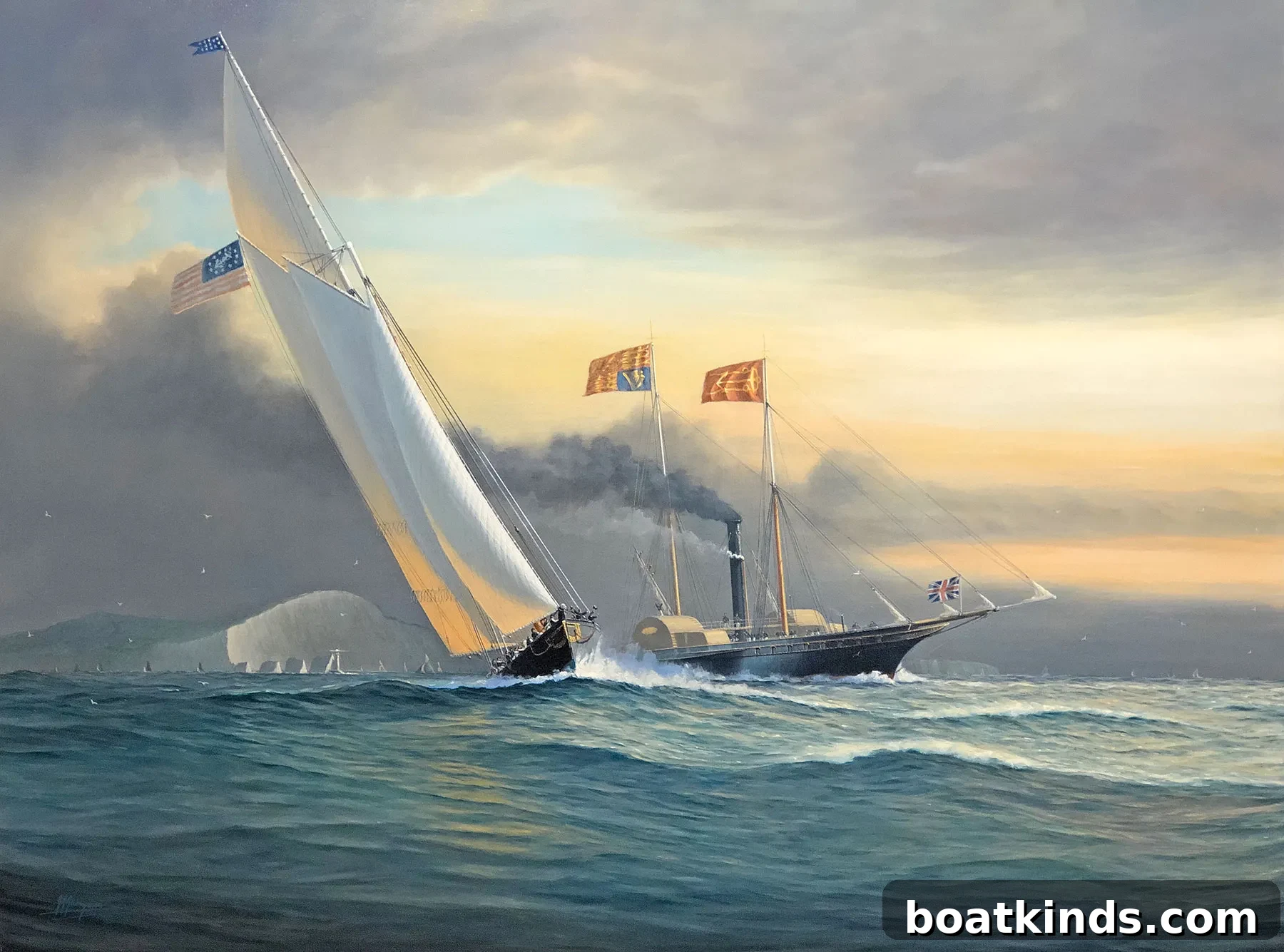
“Schooner Yacht America and the Royal Yacht Victoria and Albert off the Needles, 1851” by Tim Thompson
In this evocative work, British artist Tim Thompson depicts the American-built schooner America decisively leading the annual Queen’s Cup regatta, the storied 53-mile race around the Isle of Wight. The schooner cuts through choppy water while its European rivals trail far behind. Observers aboard the royal steamer Victoria and Albert — including a visibly disappointed Queen Victoria — watch the scene unfold, bearing witness to one of the most famous moments in yachting history.
The trophy won in that event later became known as the America’s Cup, a prize that has inspired competitive sailors for more than a century and a half. Thompson’s painting is more than a straightforward historical illustration; it captures the drama and kinetic energy of sail and sea. His signature approach renders movement and atmosphere so convincingly that the work reads as much as a portrait of the ocean itself as it does a record of a race.
Composition, Light and Movement
Thompson’s composition balances vessel, sky and water in a way that emphasizes motion. The angled sails, the spray driven off hulls, and the low, sweeping clouds combine to suggest speed and momentum. Light plays an essential role: subtle contrasts between sunlit canvas and shaded rigging articulate form, while the shimmering reflections on the waves give the sea a living quality. Rather than freeze the scene, Thompson’s brushwork invites the viewer to feel the pull of wind and current.
Color and layering are key to the overall effect. Thompson builds luminous backgrounds with multiple translucent washes, allowing the colors beneath to glow through and harmonize. This technique produces an atmospheric depth that makes the painting read as a whole — sky, sea and sail fused into a single, dynamic impression.
Origins and Influence
Thompson’s maritime sensibility has deep roots. He was raised in the Channel Islands, a region in the English Channel off the Normandy coast where the coasts of Jersey and Guernsey nurture a long seafaring tradition. On the small island of Herm, where light and tide offer an endless variety of visual patterns, a six-year-old Thompson painted his first seascape: a watercolor of the ocean liner Queen Mary. That early encounter with sea light and vessel form set the course for his artistic interests.
At 27, Thompson left his horticulture work with the Parks Department to pursue painting full time. That decision allowed him to devote himself to studying the particularities of sail, rigging and the behavior of water under different weather conditions. Over the years he has become known for translating those observations into paintings that feel authentic to sailors and accessible to general audiences.
Subjects and Reputation
Although Thompson is especially celebrated for his America’s Cup scenes, his subjects range broadly across maritime history and contemporary yachting. From the Age of Exploration vessels associated with figures like Sir Francis Drake to today’s high-performance racing yachts, he has addressed an array of ships while maintaining a consistent focus on atmosphere and movement. Collectors and enthusiasts often cite his works for their ability to evoke the sensory experience of being at sea — the smell of spray, the tilt of a hull, the tension of wind in canvas — without resorting to detail for its own sake.
For Thompson, technical accuracy matters but always in service of mood. He pays close attention to how sails form around a turn, how water behavior changes in a squall, and how shifting light can alter a seascape’s emotional tone. These observations inform his layered, wash-based technique and produce paintings that feel both studied and alive.
Why This Painting Matters
“Schooner Yacht America and the Royal Yacht Victoria and Albert off the Needles, 1851” stands out as an example of Thompson’s capacity to fuse historical narrative with painterly atmosphere. It documents an iconic racing moment while inviting viewers to linger in the broader spectacle of sea and sky. The image is at once documentary and expressive: a scene of competition and a meditation on the maritime environment that frames it.
Through restrained composition, layered color, and a focus on natural phenomena — wind, light, and water — Thompson creates a work that resonates beyond its specific subject. It is a painting that speaks to sailors and non-sailors alike, offering a vivid reminder of why the sea has long inspired artists and why certain moments in yachting history endure in the cultural imagination.
This article was originally published in the March 2021 issue.