
Keeping your boat’s batteries charged while away from the dock is easier than ever thanks to solar charging systems. Whether your goal is to run the refrigerator, shorten generator runtime, or keep batteries topped off at a mooring, a well-designed marine solar setup is often the best solution.
Choosing the right system means balancing energy needs, budget and boat layout. Rigid and semi-flexible panels each have clear strengths and trade-offs. Your decision usually comes down to preferred mounting style, available space and how much you want to spend.
RIGID PANELS
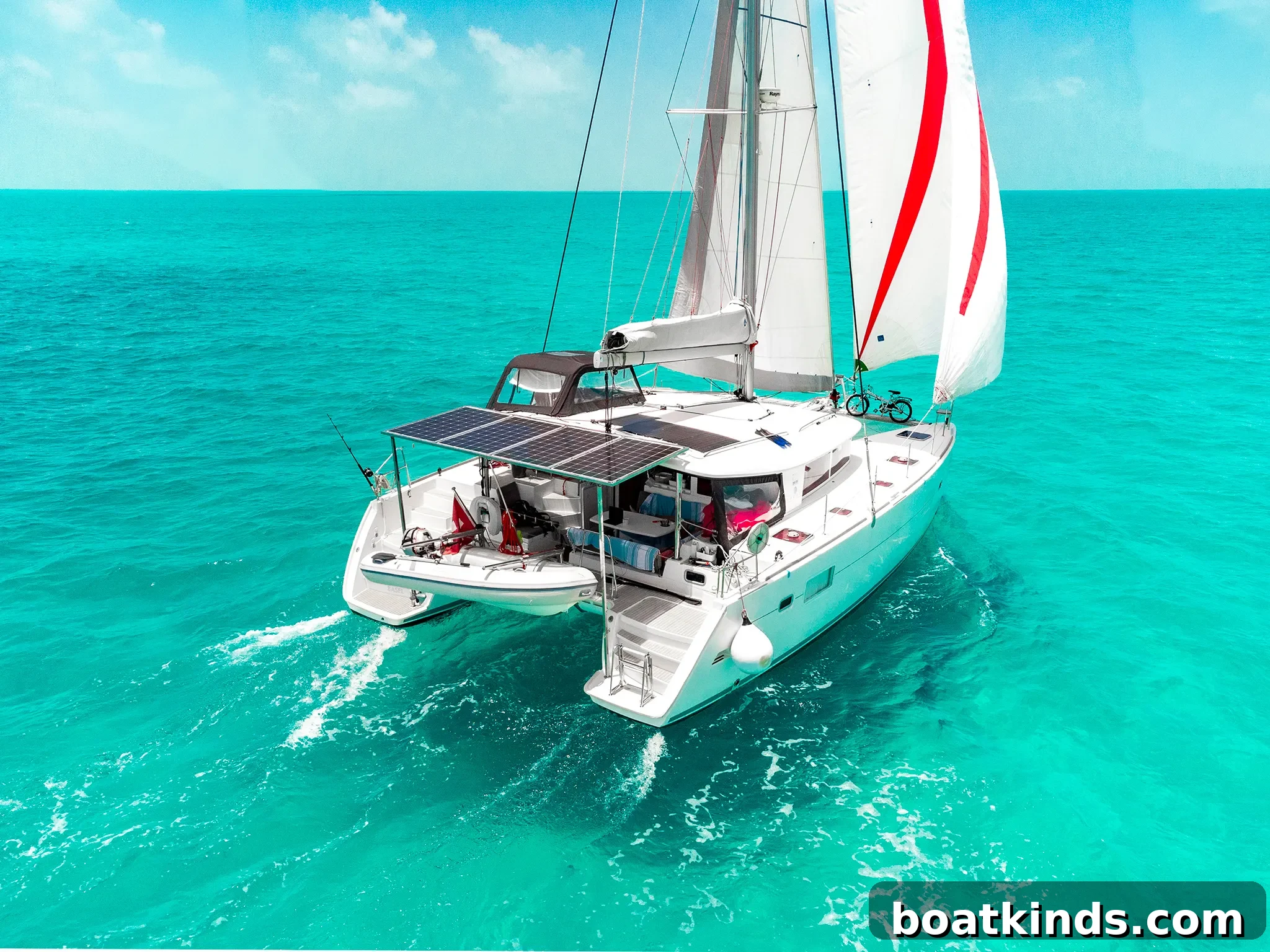
Rigid solar panels are the longest-established option in marine solar. Typical real-world efficiencies range from about 16 to 24 percent, and many panels last 20 years or more. Cost often runs between $0.50 and $2.00 per watt, which makes rigid panels one of the most cost-effective choices for boats. Constructed with an aluminum frame and tempered glass over the cells, rigid panels are durable and commonly mounted on solar arches, dinghy davits or lifeline rails.
There are trade-offs: rigid panels are heavier (roughly 7 watts per pound), not designed to be walked on, and can be damaged by overhead hazards. Large rigid panels can also increase shipping and installation costs.
When shopping for rigid panels you’ll usually encounter three main types: standard, bifacial and half-cut. Bifacial panels capture light on both sides, taking advantage of reflections from water or deck surfaces and improving low-light performance—often about 18 percent higher output compared with a similar standard panel. Even if mounted close to a surface that partially blocks the rear side, bifacial modules can still produce a modest boost in energy.
Despite the advantages of bifacial technology, standard rigid panels remain the most common choice in the marine market because they are widely available, offered in more sizes, and generally more affordable.
Half-cut panels split each cell into two smaller cells, producing the same voltage at about half the current. This reduces hot-spot formation and typically increases efficiency by 2 to 4 percent, while improving performance under partial shading—a frequent concern aboard boats. Half-cut cell technology can be combined with bifacial designs for additional benefit.
SEMI-FLEXIBLE PANELS
Semi-flexible panels are popular for their sleek look and flexible mounting options. They are generally less efficient than rigid panels—about 13 to 17 percent—but offer an excellent power-to-weight ratio (around 25 watts per pound). They can be walked on when mounted to a deck and integrate cleanly into canvas installations.
Semi-flexible options fall into two broad price and quality tiers: budget and premium. Budget panels from brands such as Renogy, Lensun, EcoFlow and Topsolar typically cost around $1.30 to $1.60 per watt and can be a sensible match for marine canvas that has a similar lifespan. Premium brands—Solbian, Solara, Merlin, Sol-Glo and Xantrex—use higher-quality silicon and often include features like MTAT, MTW and blocking diodes. Those premium panels typically range from $3.50 to $5.00 per watt and offer improved durability and performance.
The main downside of semi-flexible panels is lifespan. Most last between five and ten years, and improper mounting can lead to failures in under two years. For canvas-mounted installations I often recommend budget panels because their expected life aligns with the canvas itself, while durable, top-tier panels are a better choice for deck-mounted applications where repair or replacement is more difficult.
KNOW THE PITFALLS
Semi-flexible panels are convenient, but several failure modes can shorten their useful life. Understanding these risks helps you plan a reliable installation.
Excessive bending: Most semi-flexible panels are rated to a maximum flex of about 30 degrees. Bending beyond that can crack silicon cells and break internal wiring. Panels are especially vulnerable when bent inward, where cell compression is greatest.
Microcracks: Movement and vibration—common with canvas-mounted panels—can produce tiny fractures in the cells that reduce output over time. Keeping canvas installations taut and fastening panels securely reduces vibration and the risk of microcracks. Deck-mounted panels are much less susceptible to this problem.
Delamination: Delamination typically shows up as translucent bubbles on the panel surface and is often caused by water ingress and heat-driven vapor pressure. It can result from manufacturing defects, damage around grommets or edges, or stitching through a panel. For canvas attachments, adhesive options for securing Velcro or zippers are generally more reliable than sewing and help reduce delamination risk.
UV degradation: Flexible panels use plastic encapsulants that can haze with prolonged UV exposure, especially lower-cost PET constructions. Salt buildup accelerates degradation, so regular cleaning helps preserve output. ETFE-coated panels resist UV-induced clouding far better than PET and are recommended for marine use.
Temperature and hotspots: Flexible panels trap heat between layers, which makes them slower to shed heat than glass panels. Excess heat can accelerate UV degradation, delamination and microcracking. Blocked or damaged cells can become hotspots that draw energy from adjacent cells; in rare cases hotspots can cause local burning. High-quality panels, careful installation, and routine cleaning and inspection reduce these risks.
ETFE VS. PET
Semi-flexible panels are typically made with either ETFE or PET surface materials. ETFE (ethylene tetrafluoroethylene) is a fluoropolymer that offers better UV resistance, chemical resistance, dirt-shedding properties and optical clarity than PET (polyethylene terephthalate). PET surfaces tend to discolor and cloud over time, reducing output. The trade-off is cost—ETFE panels are usually more expensive and their darker appearance can contribute to heat buildup—but for marine conditions ETFE is the preferred choice for longer-lasting performance.
CRYSTALLINE SILICON
Crystalline silicon (c-Si) cells dominate both rigid and semi-flexible marine panels. Monocrystalline cells are now the standard because of better efficiency and broader availability; polycrystalline panels are generally not recommended for new marine installations.
HOW MANY WATTS?
To size a solar array, start with a power audit to determine your daily energy use, then select a solar setup that can produce full-rated output for a conservative baseline of about three peak-sun hours per day. For example, a 100-watt panel producing roughly 8.3 amp-hours per hour will yield about 25 amp-hours daily under that assumption. This is conservative for sunny locations but gives a reliable starting point.
Since refrigeration is a common driver for solar on boats, a practical rule of thumb is to aim for at least 300 watts of solar capacity as a minimum baseline. The actual requirement depends on refrigerator efficiency, insulation and your overall energy budget, so calculate your specific daily amp-hour needs when possible.
“More solar is better” is a useful guiding principle: seasonal changes in sun angle and day length can dramatically affect daily output. Extra capacity helps maintain battery charge through cloudy stretches and restores battery state-of-charge more quickly after heavy usage.
Choosing appropriate panels is the first step; understanding technologies, mounting constraints and environmental stresses ensures better output, longer life and a happier cruising experience.
Mike Garretson owns Sea & Land Yacht Works in Wakefield, Rhode Island. This story appeared in the January 2025 issue of Soundings magazine.