
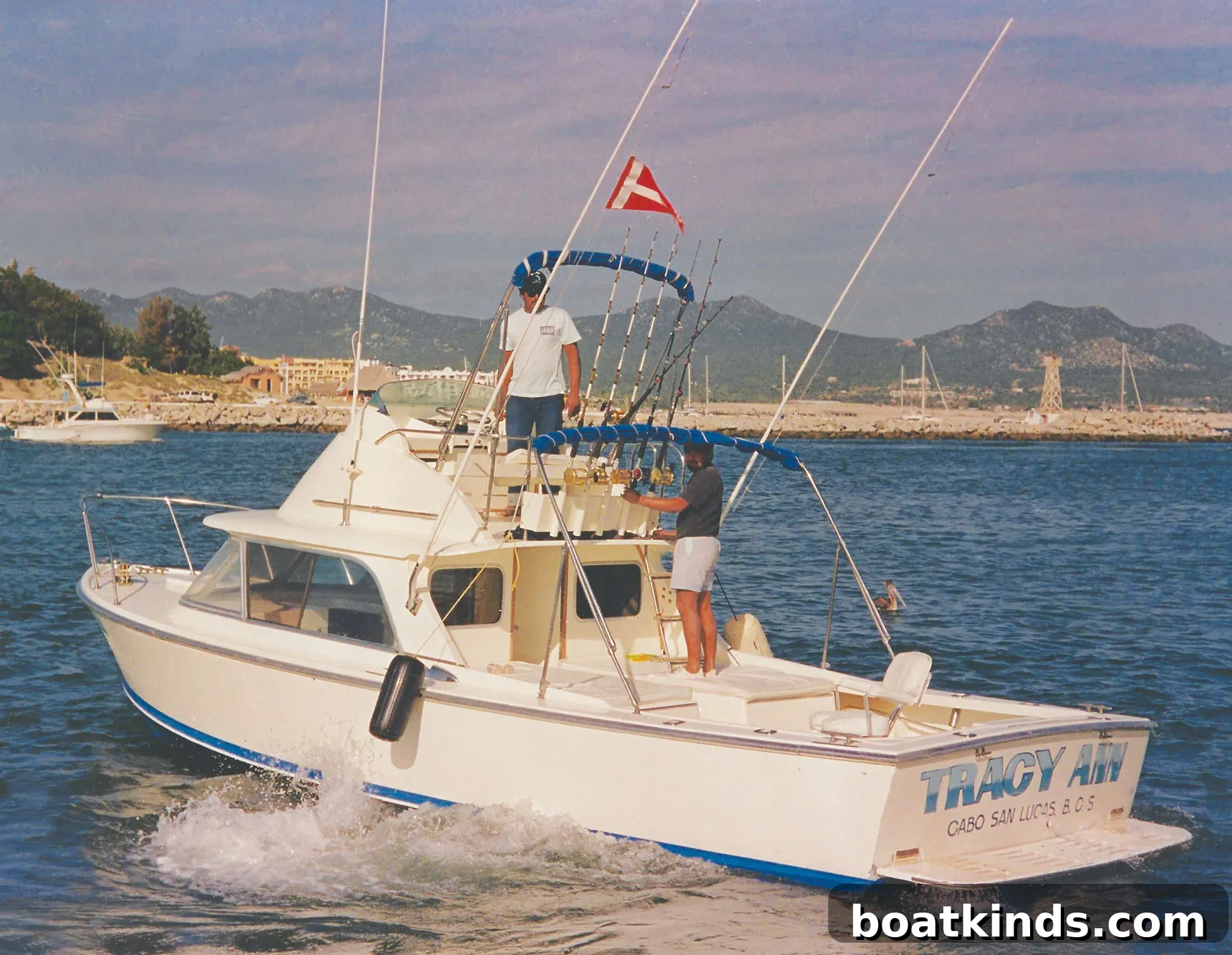
The Bertram 31 Tracy Ann is shown here rigged for a day of sportfishing off Cabo San Lucas, a picture from the Soundings archive that captures the boat’s purposeful silhouette. Authors David Patten and Jeffrey Rodengen labeled the compact convertible “the workhorse of the sportfishing industry” in their book The Legend of Bertram, a fitting tribute to a design that quickly became a global favorite among anglers and professional crews alike.
Introduced during the Space Age of the early 1960s, the Bertram 31 arrived at a moment when roughly 37 million Americans were embracing new fiberglass boats. That timing mattered: the 31 offered a modern alternative to earlier wooden and modified hulls, and it benefitted from the era’s enthusiasm for lightweight, durable construction and contemporary styling. Its low profile, uncluttered lines and roomy cockpit made it equally at home chasing big game in the Mediterranean, fishing the inlets of Florida, or running the Baja coast.
Much of the boat’s performance reputation stems from its deep-V hull, a design by the celebrated naval architect Ray Hunt. Race driver Sam Griffith, who piloted a 31 prototype to victory in the 1960 Miami‑Nassau race, called the design “a breakthrough.” The deep-V hull handled rough water better than many contemporaries: it resisted broaching, kept props submerged more consistently in a beam sea, and offered more predictable inlet performance—qualities that appealed to sportfishermen who needed a reliable, fast platform in demanding conditions.
Dick Bertram introduced the 31 to a curious public at the 1961 New York Boat Show, where the hull form drew particular attention. As Patten and Rodengen recalled, showgoers would gather around and point out the shape of the bottom, a visual sign that this was something new in offshore boating. Production began that same year, and the company relied on a highly skilled workforce that included Cuban craftsmen who had recently left Fidel Castro’s Cuba. Bertram himself later acknowledged that the influx of Cuban talent had been critical to the company’s early success.
The 31 was offered in four primary configurations to meet a range of boating needs. The Sport Fisherman featured a lower helm station with an open wheelhouse for a more compact profile and direct access to the cockpit. The Flybridge Cruiser added a raised helm on a flybridge with a rear bulkhead, improving visibility and offering a more protected helm environment. The Hardtop Cruiser provided a hardtop shelter over the cockpit and living spaces, while the Express Cruiser presented an open, minimalist layout for those who preferred a cleaner deck plan and easier cockpit access. This flexibility in layout helped broaden the boat’s appeal, from tournament anglers to cruising families.
Over a 16‑year production run, Bertram built 1,860 examples of the 31, a testament to the model’s broad acceptance and enduring practicality. Those numbers reflect not only a successful production run but also a design that met the real-world needs of fishermen, charter operators and recreational boaters who demanded seaworthiness, reliability and a practical working cockpit.
Beyond the statistics, the Bertram 31 left a lasting impression on sportfishing culture. Its combination of sea‑keeping, straightforward functionality and clean, purposeful styling set a standard for subsequent convertible and express designs. Even decades after its introduction, the model is still recognized by many as a defining small convertible—one that helped shape what sportfishing boats would look and perform like for years to come.
Photographs such as the one above, showing the Tracy Ann at work off Cabo San Lucas, remind us why the 31 earned its reputation: a compact, no-nonsense boat built to do a job well. Its legacy persists in the many hulls still maintained by enthusiasts and professionals who appreciate a design that placed seaworthiness and practical utility at the forefront.
This article was originally published in the December 2020 issue.