
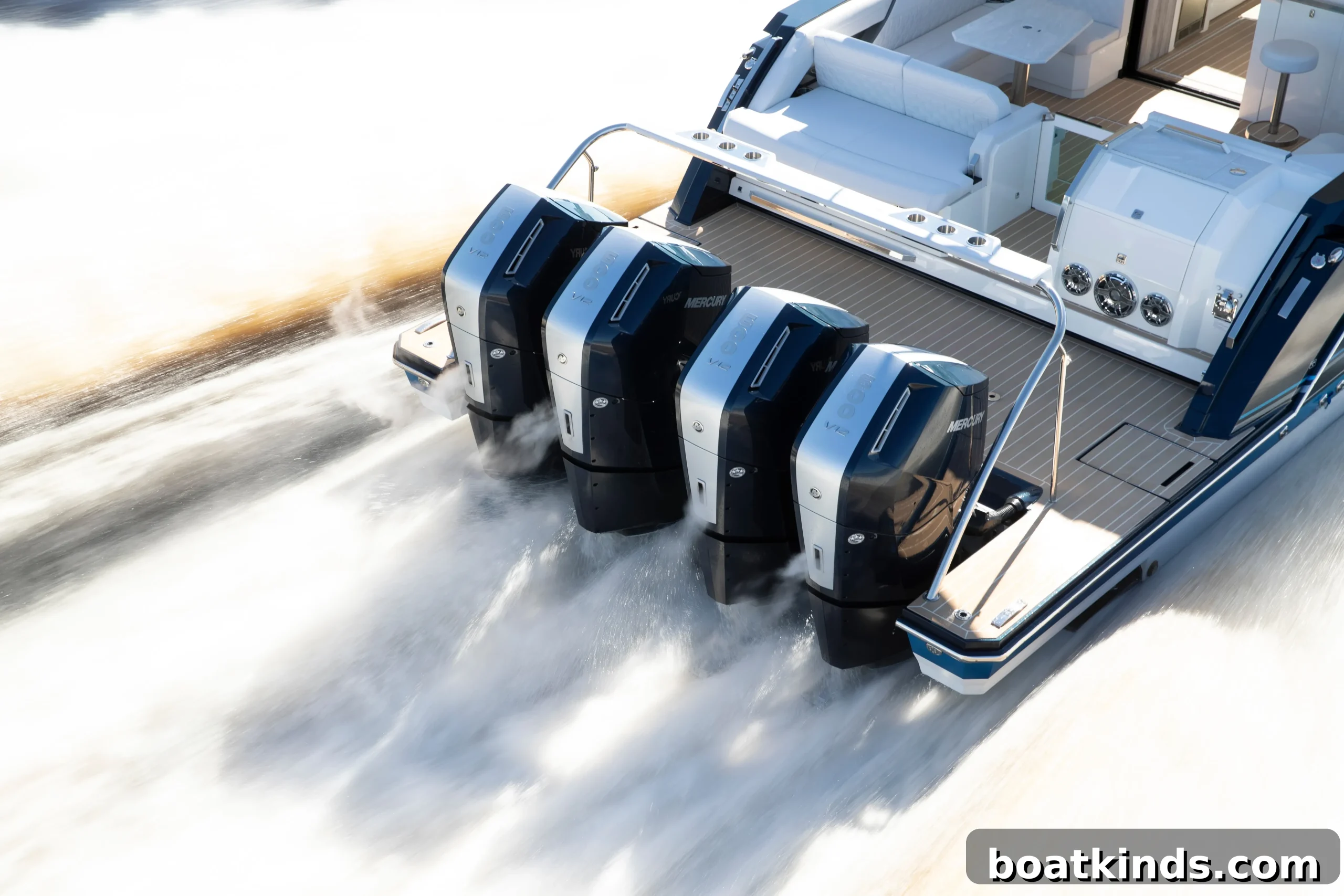
The Mercury Verado 600 is, technically, an outboard motor because it mounts to a boat’s transom. But in practice it represents a major rethink of what an outboard can be for large center consoles, dayboats and other big offshore craft. Rather than being a scaled-up conventional design, the Verado 600 combines a V12 powerhead, contra-rotating props, a two-speed automatic transmission and a steerable gearcase into a single, integrated propulsion system aimed at reducing drag, improving acceleration and delivering refined, quiet operation.
The headline specs are striking: 600 horsepower from a 7.6-liter V12 driving a contra-rotating propeller set, an advanced two-speed powershift transmission, and a package designed to match the performance and refinement of high-end boats. Mercury positions the Verado 600 as a premium solution — and its projected price reflects that — intended for boats typically 60 feet and longer, though Mercury will offer a shorter 20-inch model for other applications such as large pontoons.
“We’ve dedicated substantial investment and years of effort toward enhancing our ability to turn highly creative ideas into practical, functional and dependable solutions,” said Tim Reid, Mercury Marine vice president of development and engineering, referring to the company’s R&D and manufacturing investment since 2008.
V12 Configuration
The Verado 600 uses a V12 architecture with a 64-degree cylinder angle, double overhead camshafts and four valves per cylinder, a layout that shares developmental lineage with Mercury’s 4.6-liter V8 family. The V12’s bore and stroke are larger than the V8, resulting in the 7.6-liter displacement needed to produce 600 hp while maintaining a center-to-center spacing compatible with multi-engine installations. The engine’s primary balance is essentially perfect, delivering exceptionally smooth operation.
The powerhead mounts to an Advanced MidSection (AMS) — an aluminum halo with elastic isolation mounts similar to those used on Mercury’s inline six-cylinder models — which keeps vibration and noise from transferring to the boat. The trim/tilt pivot is positioned further aft, allowing full tilt within the same motor well dimensions used by Mercury’s V8 outboards. Alternator output is 150 amps to meet the electrical demands of large vessels.
Two-Speed Transmission
Below the powerhead sits a two-speed automated powershift transmission developed by Mercury and manufactured by ZF. The transmission uses multiple clutches to provide a first gear that is approximately 20 percent lower than second, delivering roughly 20 percent more torque to the props when needed. Gear ratios at the prop shaft are 2.95:1 in first and 2.50:1 in second, which are substantially lower than ratios used in smaller Verado models. Those lower ratios amplify torque to drive twin props with large blade area, improving planing acceleration and maintaining efficient low-speed hold.
Shifting is managed automatically by the engine controller based on torque demand. In multi-engine installations each Verado 600 shifts independently; shifts are intentionally staggered by fractions of a second to preserve smoothness so the operator rarely feels a change. The system will downshift when extra torque is required, for example during an aggressive pass or when accelerating from a slow cruise. Manual shifting beyond forward-neutral-reverse selection is not provided.
Dual-Prop Gearcase
Contra-rotating propellers were developed for the Verado 600 to maximize blade area without requiring an excessively large single propeller and deep gearcase. The forward prop has four blades and the rear prop three, each with different shapes and diameters to optimize interaction. Nine prop sets will be offered with pitches from 23 to 37 inches; the larger pitch choices are supported by the low first-gear ratio and help keep prop rotational speed down for better efficiency. Forward prop diameters range roughly from 18.25 to 16.5 inches, while rear prop diameters range from about 16.75 to 15.0 inches. The aft prop is designed for swirl recovery, capturing energy that would otherwise dissipate outward from the front prop and converting more of it into thrust.
Because the transmission handles the shift function, the gearcase can remain relatively compact, improving hydrodynamics and reducing drag compared with a single large prop and deep housing.
Steerable Gearcase
The Verado 600 uses a steerable gearcase while the powerhead remains stationary. This design eliminates boat-mounted steering torque at the transom, allows engines to be mounted closer together, and provides increased steering range. In joystick maneuvering the gearcase can pivot up to 45 degrees to either side, compared with about 30 degrees for more conventional outboards, giving greater low-speed maneuvering authority for heavy boats. At higher speeds the steering range is reduced to approximately 30 degrees. Digital helm signals convert to hydraulic action at a steering rack inside the engine, operating much like pod-drive steering systems.
Ease of Maintenance
To make servicing practical for owners and dealers, Mercury engineered top-access service points into the cowl so routine maintenance for the first 200 hours can be performed without removing the entire cover. The oil dipstick and fill, oil filter, and dipsticks for gearcase lube and transmission fluid are reachable through a service hatch. Each dipstick tube accepts an extraction pump for fluid removal. The engine takes 14 quarts of oil, enabling a 200-hour interval on synthetic oil; the cowl is scheduled to be removed for deeper service such as spark plug and water pump changes at 1,000 hours or five years. The water pump is oversized and built for extended durability.
Mercury also rolled out its Next Gen Digital Throttle & Shift (DTS) controls with the Verado 600. The Premier DTS binnacle includes an integrated status and maintenance display to report system information to the operator.
Bigger and Bigger
The Verado 600 is intended in part to reduce the number of outboards needed to achieve high horsepower: three Verado 600s can replace four smaller outboards like the Verado 400, delivering more total power with reduced drag and fewer hull penetrations. That said, a single Verado 600 weighs significantly more than a smaller outboard, so overall engine weight and vessel balance must be considered during design and repower decisions. Mercury expects the Verado 600 to be popular on larger center consoles, sportfish and other premium boats where high performance, refinement and features justify the investment.
With its combination of V12 power, two-speed transmission, contra-rotating props, and steerable gearcase, the Verado 600 aims to expand the capabilities and expectations for modern outboard propulsion.