
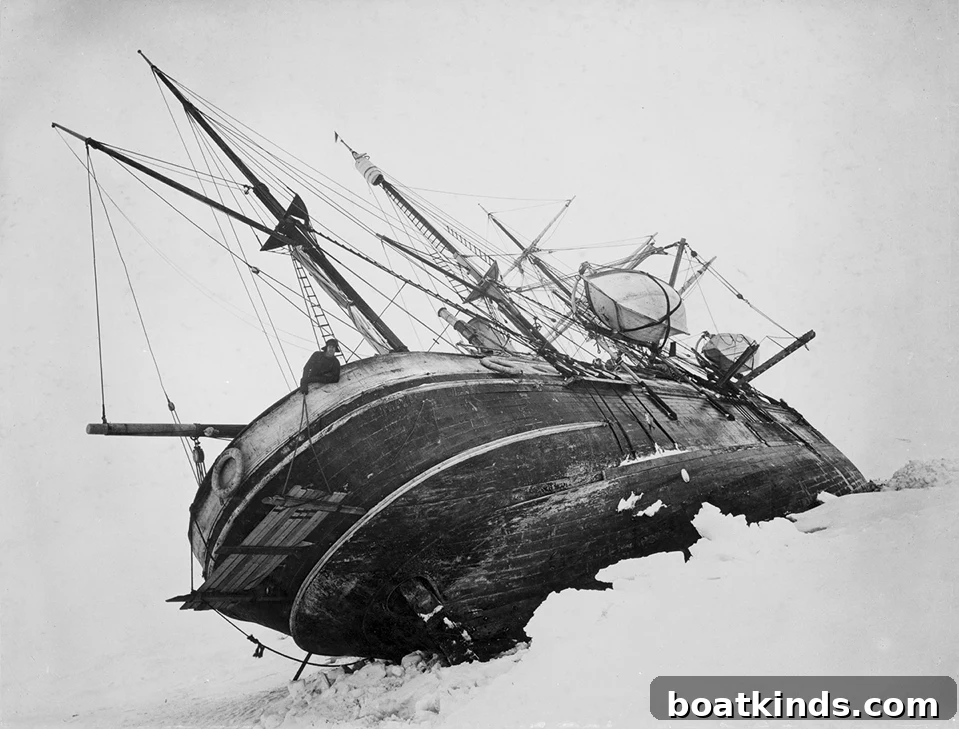
Searching for Shackleton’s Endurance: The Antarctic Wreck and the Endurance22 Expedition
Ernest Shackleton’s ill-fated Imperial Trans-Antarctic Expedition and the crushing of his ship, Endurance, remain among the most compelling survival stories in polar exploration. What began as an attempt to cross the Antarctic continent turned into a legendary struggle for life after the ship was trapped and crushed by pack ice in the Weddell Sea. The voyage and subsequent rescue efforts have since become a defining chapter in the history of exploration.
The Historic Ordeal
When Endurance sank beneath the ice, Shackleton and his men were forced into a prolonged fight for survival. Separated from the world and largely forgotten due to the outbreak of World War I, the expedition improvised a daring self-rescue. Shackleton led his men across drifting ice floes and, in one of the most famous feats of small-boat seamanship and navigation, he and five crew members sailed approximately 800 miles across the Southern Ocean in an open boat from Elephant Island to reach the whaling station at South Georgia Island. After multiple attempts, Shackleton returned to Elephant Island and rescued the remaining crew; miraculously, every man survived the ordeal.
The Lost Ship on the Seabed
For more than a century the wreck of Endurance has lain far below the surface of the Weddell Sea, at an estimated depth of about 10,000 feet. The remote, ice-choked waters and extreme conditions have long made any search and survey operations difficult and hazardous. Still, the historic and cultural significance of the wreck—both as a time capsule of early 20th-century polar exploration and as a symbol of human resilience—has driven continued interest in locating and documenting it.
The Endurance22 Expedition
On February 5, an international expedition called Endurance22 departed from Cape Town, South Africa, embarking on a focused two-week mission to locate and survey the wreck of Endurance. The expedition uses the 440-foot icebreaker S.A. Agulhas II as its base of operations. That vessel is outfitted with modern deep-sea survey equipment, including autonomous underwater vehicles (AUVs) designed to operate at great depths, as well as two helicopters to support operations where ice conditions prevent direct ship access.
The combination of icebreaking capability, aerial reconnaissance from helicopters, and AUV-mounted sensors allows the team to navigate and map the Weddell Sea’s treacherous ice and search the seabed with a level of precision that was previously impossible. Helicopters provide a practical contingency to transport personnel and equipment onto ice floes above targeted search areas if the icebreaker cannot reach them directly, expanding the expedition’s operational flexibility.
Why the Search Matters
Finding and documenting Endurance carries multiple layers of value. First, it would provide a tangible connection to a pivotal moment in polar exploration, preserving physical evidence of Shackleton’s expedition for historians and the public. Second, careful survey and documentation of the wreck can advance maritime archaeology and deepen understanding of how wooden ships behave on the deep seafloor in polar environments. Third, the mission highlights the challenges and capabilities of modern polar science and deep-sea technology—demonstrating how contemporary methods can be applied to conserve and study cultural heritage in extreme environments.
Conservation and Responsible Survey
Teams involved in the search emphasize responsible, non-intrusive survey methods. With the wreck lying in international waters beneath fragile sea ice, the preferred approach is to document and record the site thoroughly while minimizing any disturbance. High-resolution imaging from AUVs, photogrammetry, and remote sensing are standard tools to create detailed records without physically touching the remains.
Public Interest and Ongoing Coverage
The Endurance22 expedition has attracted wide public and media attention due to the enduring fame of Shackleton’s story and the dramatic technical challenges involved in locating the wreck. Reports and features on the search have appeared in major outlets, reflecting both the scientific ambition and the public fascination with polar exploration. Coverage has highlighted the expedition’s mix of historical research, maritime archaeology, and cutting-edge technology.
What Comes Next
If the expedition successfully locates the wreck, the initial priority will be to document and preserve an accurate record of the site. Any future decisions about recovery, conservation, or display would be guided by international conventions, scientific best practices, and the perspectives of heritage professionals. Whether the team finds the wreck or not, the Endurance22 effort stands as a modern effort to reunite a remarkable human story with its physical remains—and to do so with respect for the fragile environment where it lies.
For readers interested in the broader context, contemporary coverage and detailed reports on the effort to find Endurance are available from major news organizations and specialist publications that follow polar exploration and maritime archaeology.