
Fleming 55: The Yacht That Redefined Long-Range Cruising
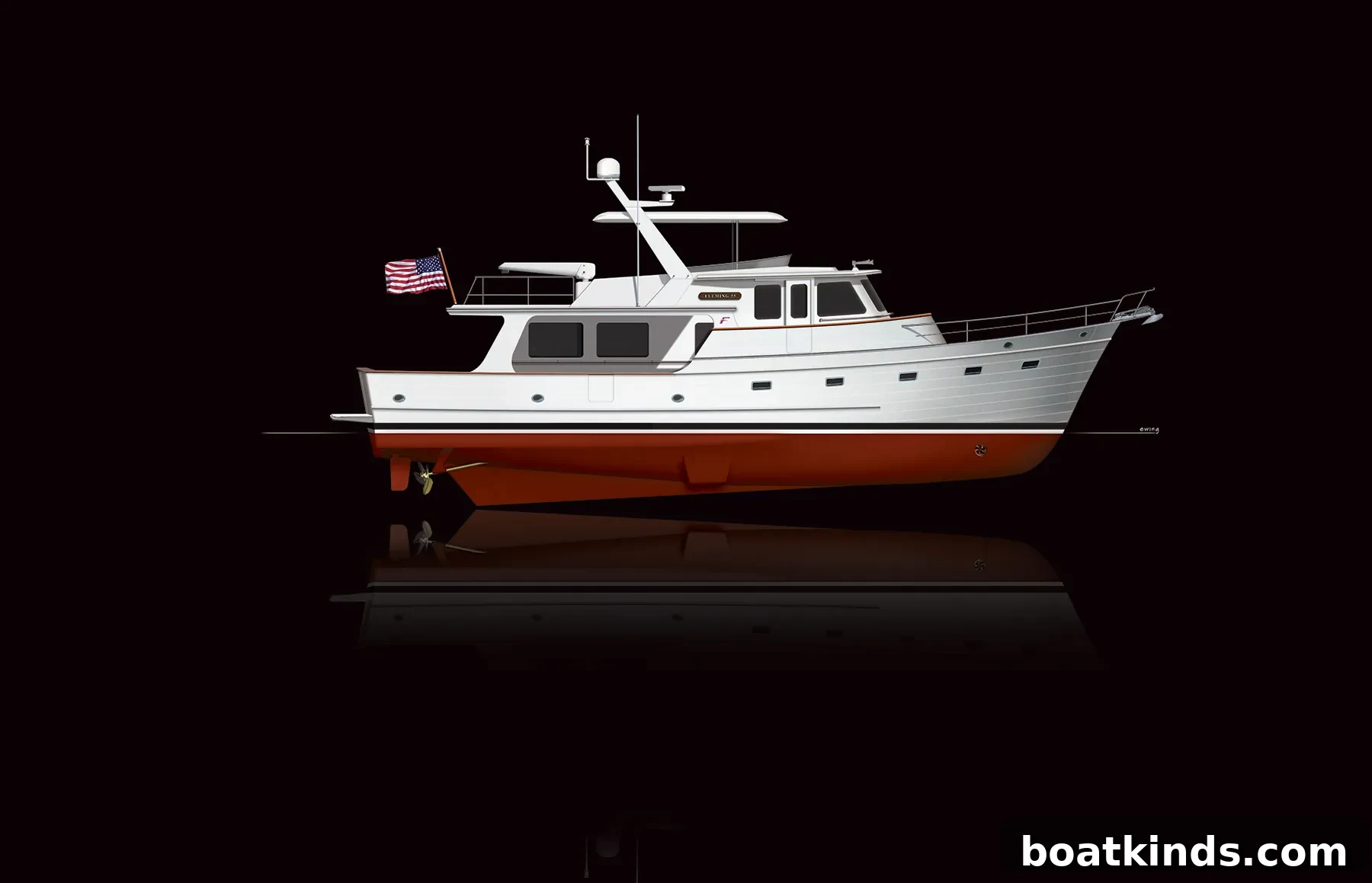
The first Fleming to arrive in the United States was unloaded in Long Beach, California, in November 1986. That initial boat measured 50 feet and was built from the same hull mold later used for the Fleming 55. Early on, a dam was inserted into the mold to shorten the hull because it was believed then that a couple could not comfortably operate a boat over 50 feet. That assumption did not last.
Designed and developed by Tony Fleming, a trained aeronautical engineer and former technical director at American Marine—the company behind Grand Banks trawlers—the Fleming 55 was conceived as a purposeful, long-range cruising yacht for two people with the occasional guests. Constructed at the Tung Hwa shipyard in Taiwan, the Fleming 55 combined rugged seakeeping with thoughtfully arranged living spaces. Fleming drew on nearly 25 years of boatbuilding experience in the Far East to produce a yacht optimized for open-water passages, comfort, and reliability.
The Fleming 55’s hull is a true expression of its mission. It features a semi-displacement form with a fine entry and a high, flared bow to handle significant seas, transitioning to rounded bilge sections and then to hard chines toward the stern. The long keel was designed to protect the running gear from grounding and to contribute to predictable tracking on long passages. A low center of gravity and a modified deep-V deadrise at the transom further enhance underway comfort and stability. With a beam of 16 feet, a draft of 5 feet, and a fully loaded displacement of 80,178 pounds, the design provides substantial interior volume, long-range fuel capacity, and the ability to mount twin diesels for both efficiency and redundancy. Early alterations to the mold were later removed, and the boats matured into what is commonly referred to as a 60-foot, 9-inch LOA when bow pulpit and swim platform are included.
Practical, safety-oriented features are woven into the Fleming 55’s profile. A Portuguese bridge provides a protective walkway forward of the pilothouse, while the raised, enclosed pilothouse and an additional flybridge helm offer multiple command positions for different conditions. The boat deck was designed to stow the dinghy off the transom, preserving deck space and keeping operations simple. Wide side decks with deep bulwarks allow safe movement on deck in rough weather, reflecting Fleming’s focus on single- or two-person operation without sacrificing seagoing capability.
Rather than chasing fashion, Fleming pursued continuous improvement. From the very first hull, the company made thousands of small but meaningful refinements to materials, systems, and equipment while preserving the yacht’s classic lines and purpose-driven layout. This iterative approach—fine-tuning details over decades—helped the Fleming 55 develop a reputation for durability, practicality, and comfort among owners who cruise long distances and expect dependable systems.
Tony Fleming eventually chose to live aboard one of his own creations and cruise the world, handing daily operations to trusted colleagues while continuing to contribute design ideas. He remained committed to building the best boat possible, even as competitors introduced lower-priced alternatives. The enduring success of the series is reflected in the production run and in hull number 275, a milestone of one of the most successful production cruising yachts in history. That boat, and the many that preceded it, stands as proof of a concept that began on paper in 1985 and evolved through decades of practical use and careful refinement.
—John Wooldridge
This article was originally published in the July 2023 issue.