Pursuit Boats and Chapman School of Seamanship: Practical Safety Training for New Owners
Two years ago Pursuit Boats partnered with the Chapman School of Seamanship in Stuart, Florida, to offer a focused safety and boat-handling course for new Pursuit owners. The program blends classroom instruction with on-the-water practice and has earned praise from both novice and experienced boaters who say the course refreshes essential skills and highlights safety practices that are easily overlooked.
The two-day curriculum includes one day of classroom instruction followed by a full day aboard a Pursuit on the water. Classroom topics cover the basic rules of the road, navigation fundamentals, speed checks, required safety equipment, and decision-making in common scenarios. Instructor Capt. Mike Kmiotek notes that docking is often the single biggest source of anxiety for both new and seasoned owners. “It’s easy to drive a boat out in open water,” Kmiotek says, “but when you come home, you want the confidence to dock successfully.”
The course emphasizes practical, repeatable techniques. Students learn controlled approaches, use of lines and fenders, and how to handle the boat when power is reduced or unavailable. The Chapman instructors demonstrate methods that reduce stress and increase control in confined spaces, and then give students the chance to practice those skills under supervision.
Karen Laliberte and her husband John Niles bought a Pursuit DC 246 with a 300-hp outboard two years ago without prior boating experience. After the Chapman School course, the couple focused on reinforcing what they had learned. Karen was particularly concerned about docking, so she followed Capt. Kmiotek’s advice and practiced repeatedly at their summer home in Boothbay, Maine. “We would just drive out and then dock and then go to the neighbor’s dock to try again,” she recalls. “We were constantly practicing everything we learned.” She started by learning to use spring lines and practicing without power, and now feels confident enough to handle docking on her own.
Instructors stress the value of multiple people knowing how to operate the boat. Karen points to a real-life example: friends on a boat experienced a medical emergency and those aboard were not prepared to take the helm. After that event they attended a Coast Guard class. “You need more than one person who can confidently operate the boat,” Karen says. “If something happens to the primary operator, others must be ready to step in.”
Capt. Kmiotek also advises crews to rotate roles. “If somebody’s usually driving and someone else usually handles lines, switch it up once in a while,” he recommends. Doing so builds respect for each role, improves communication, and strengthens overall crew awareness—skills that matter whenever conditions change suddenly.
On the second day of the Chapman course, students board Pursuit models that match their own engine configurations—single or twin outboards—so they can learn handling specific to their boat. Because steering and control vary between single-engine and twin-engine setups, Kmiotek will split the class when necessary to provide focused instruction for each group.
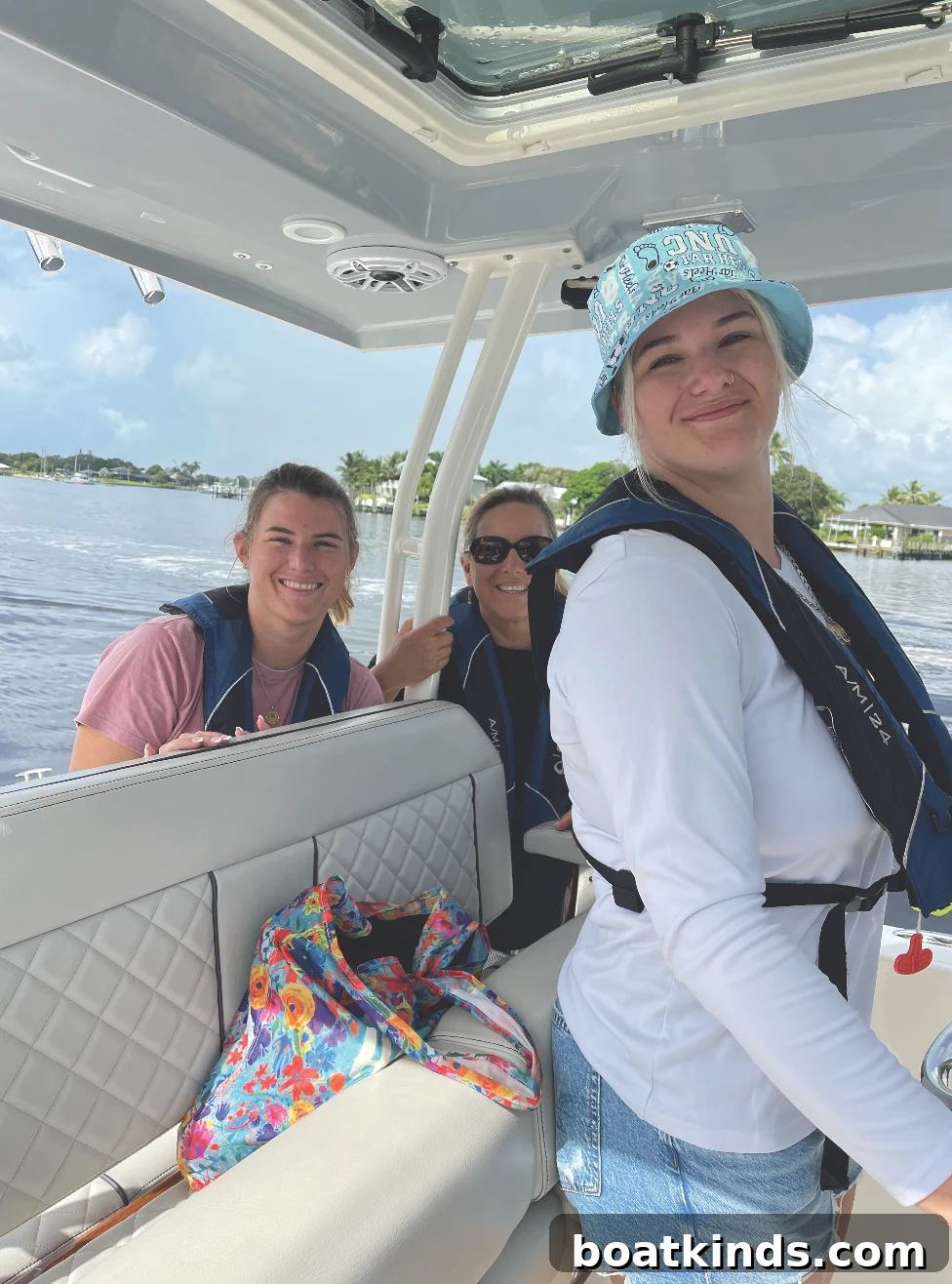
Lifelong boaters Dustin Garland and his father Charles, from Long Island, New York, attended the Chapman course after buying a 30-foot Pursuit 295 Dual Console with twin 300-hp Yamahas. For them, the chief takeaways were crew awareness and practical safety. “You have to be aware of your boat, your environment and the people on board,” Dustin says. “That awareness carries over to everyday life—if you’re not comfortable driving, don’t drive.”
An alert crew can spot changing conditions—currents, channels, other vessels, wakes, chop, and even the occasional jet skier—before they become problems. The Garlands appreciated hands-on instruction in navigating choppy inlets and mastering joystick and throttle control for fine maneuvers. Charles notes the course’s value for owners of larger, more powerful boats: “Just because you can afford a big, beautiful boat doesn’t mean you automatically can handle it. Chapman’s course takes you under its wing and reminds you that without basic knowledge and skill you can cause serious damage.”
Charles describes the program as an excellent foundation for both entry-level and experienced boaters. “You can never know too much, but you can definitely know too little,” he says. “If you’re confident in your capabilities on the water and your understanding of the rules of the road, you’ll have more fun and stay safer.”
Overall, the Chapman School partnership gives Pursuit owners a concise, practical pathway to greater competence and confidence. Through classroom learning, supervised practice, role rotation, and focused coaching on docking and handling, participants leave better prepared to enjoy their boats responsibly. For many owners, the course proves to be a valuable investment in safety, crew coordination, and long-term enjoyment of time on the water.
This article was originally published in the July 2024 issue.