
Gardner 6LXB: A Classic Marine Diesel — Reliability, History and Real-World Performance
I was at the helm of my 47-foot wooden cruiser Puffin, the Gardner 6LXB humming below, when a familiar voice came over the VHF with a Pan Pan. Robert on Paragon, one of the boats following us across Dixon Entrance, reported he was halfway across the sound and dead in the water. Dixon Entrance straddles the Canada–U.S. border and is one of the few open-ocean crossings on the Inside Passage — a place where losing power can quickly become serious.
I reversed course, told the crew to prepare a towline and checked Paragon’s AIS position on the GPS. Robert explained he’d had an electrical problem and that his diesel had stopped unexpectedly. Conditions were moderate that day, but the Entrance is known for weather that can change fast. By the time Robert reported his engine had restarted, the run to reach him had been tense.
When we arrived he assured us he didn’t need a tow: he’d accidentally brushed an electrical switch for his Cummins QSB 4.5L and caused a shutdown. We ghosted him the remaining 45 miles to Ketchikan. The episode underscored a key difference between modern diesels and the classic engines built decades ago: today’s diesels depend heavily on electrical systems and computer controls. Remove electrical power from modern engine electronics and the engine will stop. The old rule of thumb — if there’s fuel, air and raw cooling water, the diesel will keep running — simply doesn’t apply to many contemporary engines.
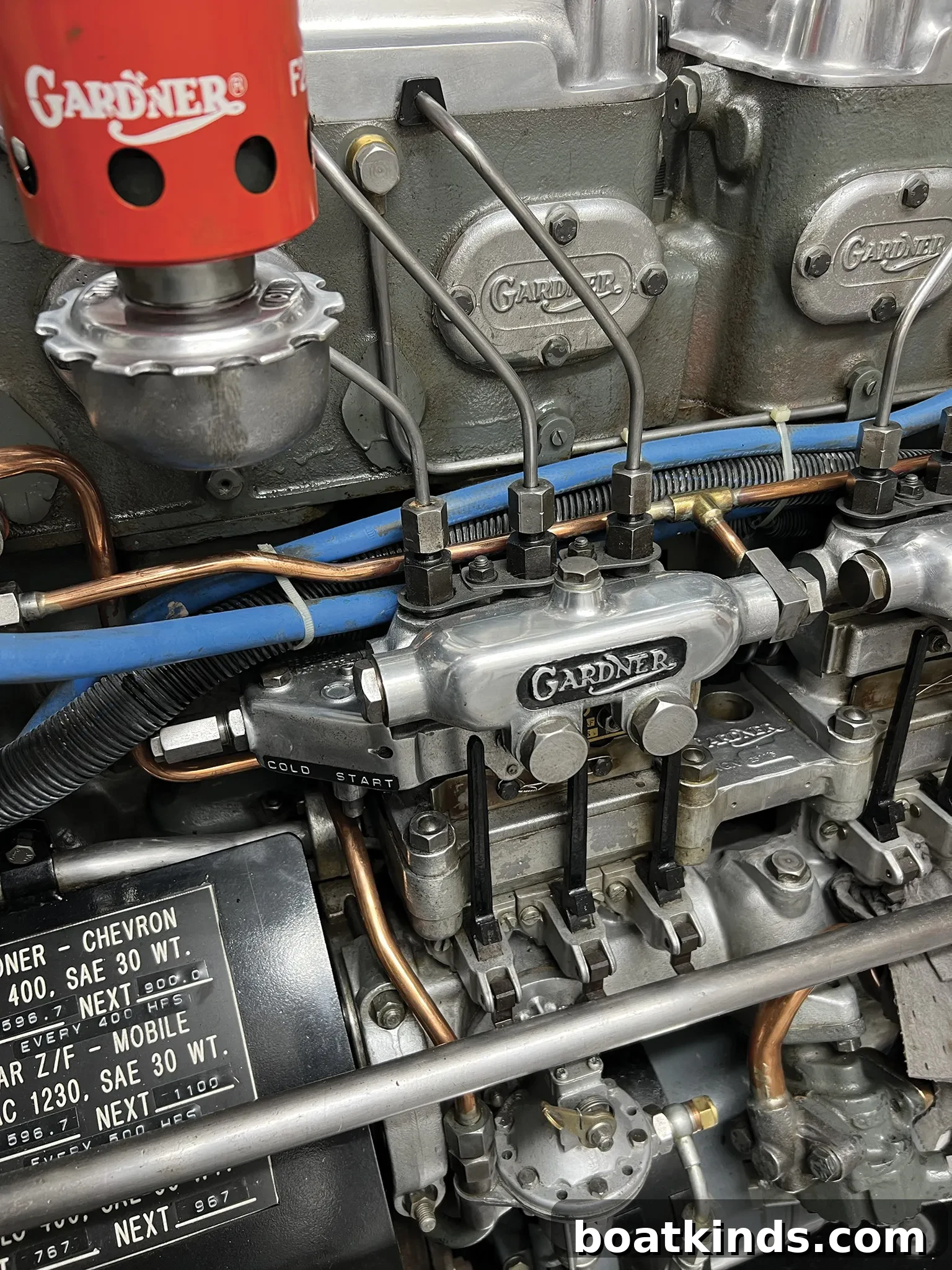
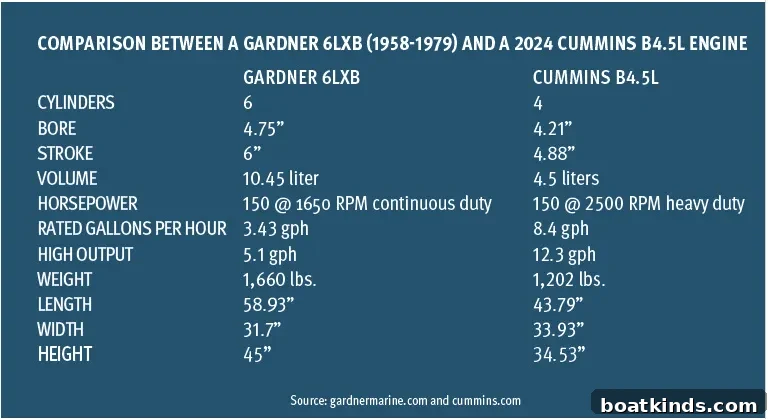
My boat was built in 1966 and is powered by a Gardner, an engine fundamentally different from modern, electronics-dependent diesels. To the uninitiated the first impression of a Gardner is its size — it’s physically large for the horsepower it delivers. Compared with a modern diesel of similar output, the Gardner 6LXB is noticeably longer (around five feet overall), taller and roughly 30 percent heavier at about 1,660 pounds. There’s nothing hidden or shrouded: the 10.45-liter 6LXB has two stacks of three cylinders, the fuel pump looks like a small multi-cylinder steam engine, and vital components are accessible and obvious. Gardners are simple, neat, and for many enthusiasts, beautiful. Some owners polish parts to a high shine and say one could “eat off the engine.” For anyone who enjoys hands-on maintenance, servicing a Gardner is a pleasure.
Gardner engines represent a pinnacle of mechanical marine engine construction and the 6LXB is widely regarded as one of the most reliable diesel engines ever built. They earned the respect of fishermen and yachtsmen who relied on their longevity and predictability.
Manufactured in England starting in the early 20th century, Gardner engines found uses across a wide range of vehicles and vessels — from Bentleys and Rolls-Royces to trucks, buses and boats. They were not mass-produced in the modern sense; many were assembled by a single craftsman in a process sometimes called craft production, which contributed to consistent quality and long life.
Historically notable applications include privately owned “little ships” that helped evacuate troops from Dunkirk during Operation Dynamo in 1940 and the Royal Navy’s X and XE class midget submarines powered by Gardner 4LK engines in World War II. After the war, larger Gardner engines were installed in locomotives and prominent yachts, with vessels like Condor and Condor of Bermuda fitted with the 240-hp 8LXB.
Gardner changed ownership a few times — Hawker Siddeley acquired the company in 1977 and Perkins Engines purchased it in 1986. The rise of turbocharged automotive-based marinized engines and tighter emissions regulations made it difficult for Gardner to adapt without a major redesign. By the mid-1990s production had ceased, as the industry moved toward lighter, higher-horsepower engines that met new regulatory demands.
Despite the end of production, Gardner’s reputation for longevity keeps many of these engines in service on commercial fishing vessels and yachts. They’re known to accumulate tens of thousands — sometimes hundreds of thousands — of operating hours with minimal fuss. Parts remain available for most models, though many components must be sourced from the U.K. or Ireland. Gardner Marine Diesels in Canterbury, England, continues to rebuild and service these engines using original tooling and procedures.
Several practical features set Gardners apart. Each cylinder has a decompression lever that enables hand-cranking if necessary, and the fuel shutoff can be used to test individual injector performance by noting changes in engine pitch as fuel is momentarily cut to each cylinder. Gardners are intentionally derated from absolute maximum horsepower, typically producing between about 127 hp at 1500 rpm and 175 hp at 1800 rpm, running at relatively low temperatures and rpm. That low-stress operating envelope contributes to their longevity compared with many higher-revving modern diesels.
This summer my 6LXB ran for more than 500 hours, reliably turning my 88,000-pound boat at an average 7.4 knots while burning just under 3 gallons per hour — a level of fuel efficiency that compared favorably with modern diesels on long passages. Aside from an oil change at the 400-hour mark, the engine performed without incident.
L. Gardner and Sons Ltd. introduced the first direct injection diesel in 1929 and began producing the LX series in 1958. More than 73,000 LXB engines were built before production ended in 1979. The majority remain operational, quietly powering a wide variety of vessels around the world.
In an era of disposable goods and heavily electronic systems, the Gardner 6LXB stands out for its mechanical simplicity, smooth operation and enduring reliability. For Puffin, and for many boatowners who prize dependability and hands-on maintainability, a Gardner is as good as it gets.