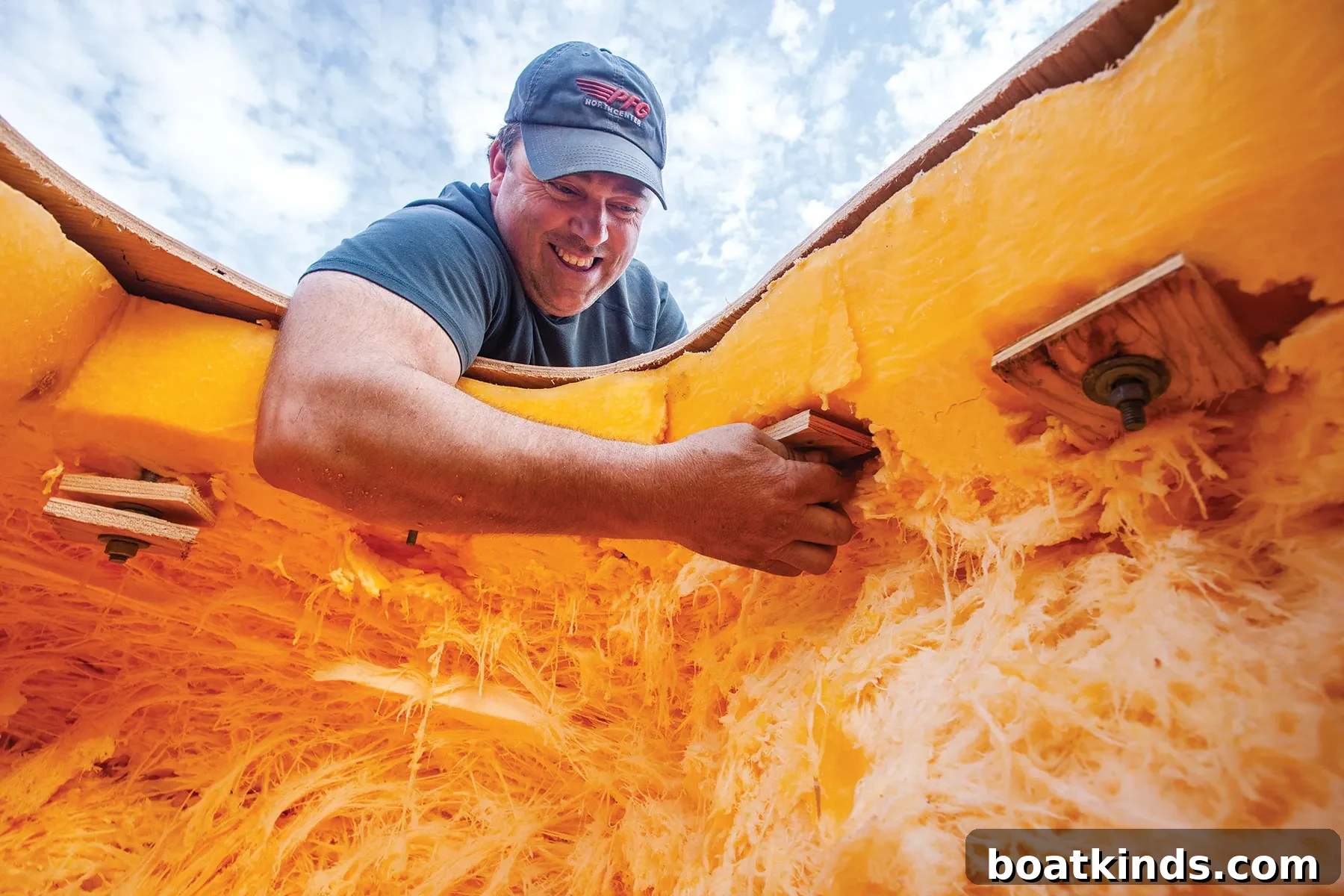
Edwin Pierpont is surprised to discover that an 8-inch blade on his Sawzall will cut right through the deck of his latest build. He had expected the deck to be thicker, but the cut goes cleanly and he isn’t worried—the deck is more than sturdy enough. Edwin works as an outside machinist at Bath Iron Works in Bath, Maine, where he helps build Navy destroyers. On this October day, though, he’s building a very different kind of craft in the parking lot at Pinkham’s Plantation, a nursery in Damariscotta. He spent the summer and early fall tending this hull on his property in Jefferson. The finished pumpkin hull weighs 1,960 pounds and, in two days when his friends launch it, it will be the largest powered craft of its kind ever launched in Maine—and possibly the largest in the world.
Edwin took the Friday off from his regular job to make sure the boat would be ready for Sunday’s big event. After cutting the cockpit through the deck, he climbs into the hull to clear out the bilge, which is messy and full of sticky pulp. He scoops the residue into five-gallon buckets and sets them aside.
Sorting the bits falls to Richard Powell, a Bath Iron Works retiree, who sits under the tent with a colander in his lap. Richard explains that growing pumpkins for boats is less about aesthetics than genetics. “These are good genetics for boatbuilding,” he says as he palms a handful of seeds. “They make for a good hull shape.”
Edwin and Richard are part of a group of giant pumpkin growers and pumpkin-boat builders. Each spring they distribute roughly 700 seeds around the community, encouraging locals to grow fruit big enough to become a pumpkin boat. Edwin has been growing giant pumpkins since 2007 and is recognized as one of Maine’s top growers and builders. In 2021 he grew Maine’s largest pumpkin on record: 2,121.5 pounds. Buzz Pinkham, owner of the nursery and a chief instigator of the pumpkin boat race, marvels at the pace of growth. “The vines can grow a foot a day, and pumpkins can gain 40 to 50 pounds per day,” he says.
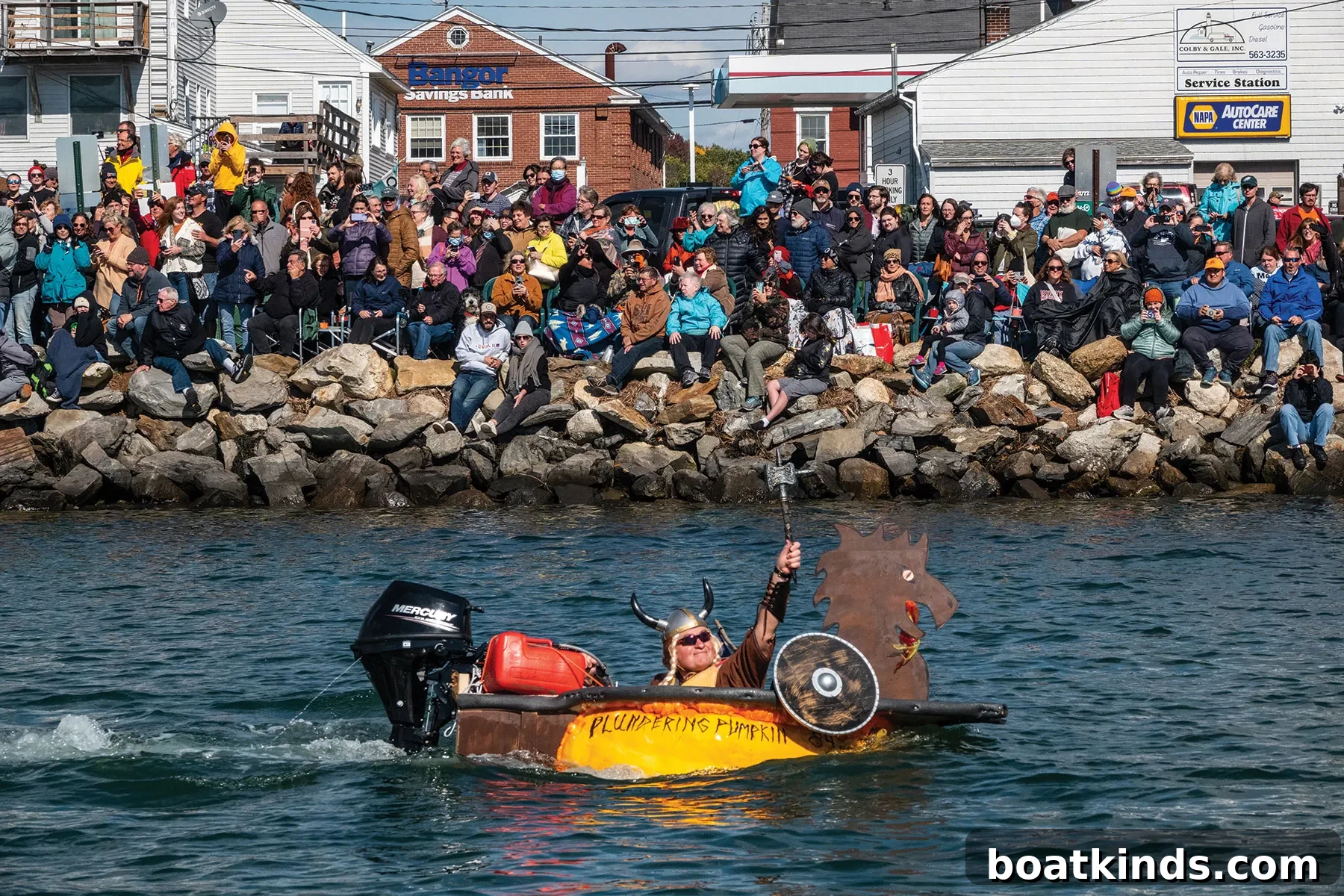
Bill Clark, the lead pumpkin-boat builder and another Bath Iron Works employee, works with Russell “The Viking” Orms to convert Richard’s 842-pound pumpkin into Plundering Pumpkin. The Viking is a big man—well over six feet tall—and his presence raises questions about whether his gourd will support him. He just smiles and says, “That just adds to the excitement.”
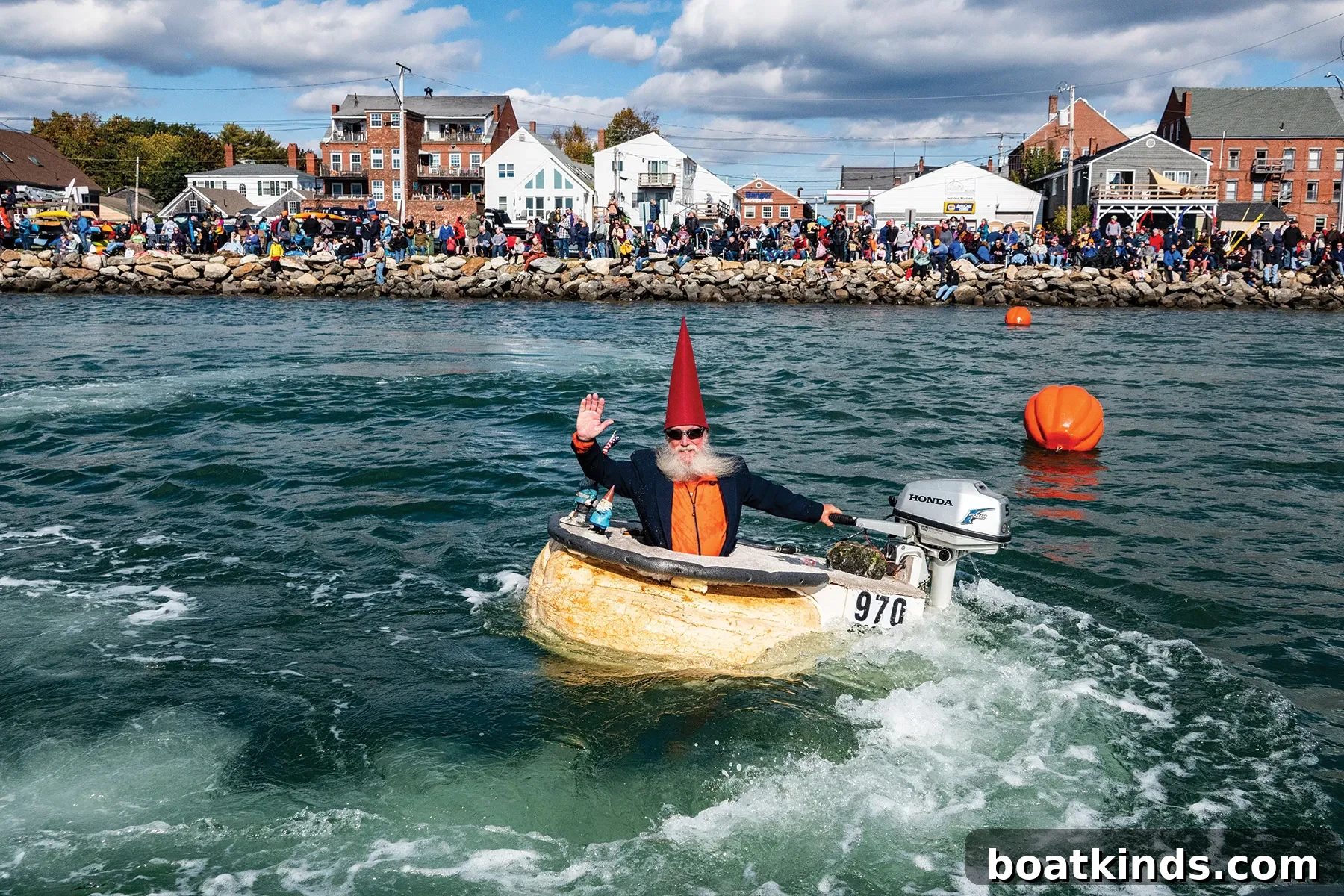
Another crew member, Tom “The Gnome” Lishness, mounts a plywood deck onto his 970-pound pumpkin. The builders affectionately call the plywood deck the “toilet ring” design, a local term that describes its shape. Tom’s displacement gives him a comfortable margin for staying afloat; he’s a little over five feet tall and the pumpkin displaces nearly 1,000 pounds. Bill, who has been building pumpkin boats for 15 years, rib-jokes with Tom about enlarging the cockpit: “Why? You don’t think you can get your fat ass in there?” The banter reflects the longstanding friendships and playful spirit behind the project.
The motorized pumpkin story dates back to 2005, when Bill and Buzz first attached an outboard to a pumpkin. After Bill showed Buzz a photo of a motorized gourd, Buzz convinced him they should try it. The next summer Bill grew a pumpkin, they flipped it, and the hull looked unmistakably like a boat to them. They mounted a small 3-hp Yamaha outboard and launched the 754 Clark at the Damariscotta boat ramp. Buzz rode it first, and Tom remembered being startled by the engine’s torque, but they were instantly hooked.
Convincing the town to host a pumpkin festival took time. “It’s not easy to persuade a community to celebrate giant pumpkins and motorize them,” Buzz says. They finally launched the first events in 2006 with two boats. Since 2007, the Damariscotta Pumpkinfest & Regatta has grown into a weekend festival on Indigenous Peoples Day weekend, following the pumpkin weigh-in. The celebration now includes a parade, a Pumpkin Queen, a crowd-pleasing array of over 100 artist-decorated giant pumpkins, and draws roughly 15,000 visitors per day. Along the way the organizers have added crane drops, a pumpkin cannon, hilltop derbies and, most importantly, the pumpkin boat races and demonstrations.
On Sunday morning, hours before the demonstrations, Bill and volunteers prepare the pumpkins at the town dock. Each hull is modified for safety and performance: the floor is carpeted to distribute weight, interiors are sprayed with disinfectant to slow rot, plywood edges are covered with pipe insulation to prevent splinters, and transoms are reinforced with lumber and foam to carry outboards. The Gnome’s craft is christened 970 Moby, sporting three little gnomes affixed to the bow; The Viking’s boat gains shields and a dragon figurehead.
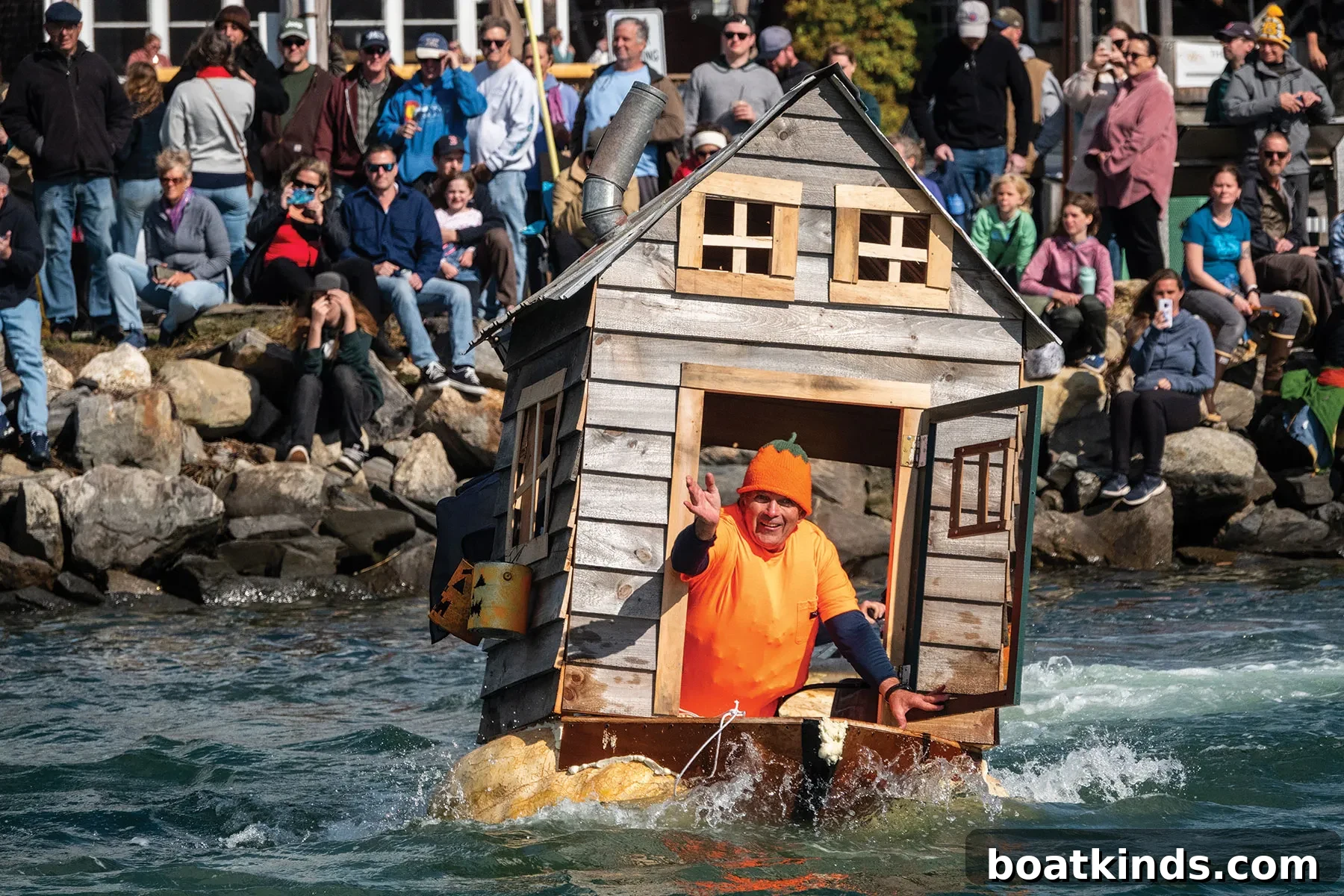
Edwin’s 1,960-pound giant undergoes the most dramatic makeover. The cast of Discovery Channel’s Maine Cabin Masters, who are participating in the paddle events, transform the behemoth into The Cabin Cruiser, complete with a metal roof, windows, a functioning screen door and a stovepipe chimney. Though the pumpkin floats upright at the dock, some express concern that its cabin could trap a driver if it capsized. Buzz shrugs those worries away: “He can get out the screen door,” he says, confident that whoever takes the helm will be able to escape if needed.
Volunteers in waders steady the hulls while Bill mounts outboards of various vintages. The local fire department staffs a rescue boat and a volunteer enters the water in a dry suit—primarily to recover props and motors should they fall in. Bill initially fits a 9.9-hp short-tail Mercury to 970 Moby, but the short shaft proves too short. The motor is swapped for a Honda 5-hp long-tail four-stroke better suited to the pumpkin’s draft.
By midday the docks, decks and boats are packed with spectators. Two announcers deliver running commentary laced with humor; a trio of local teenagers sings the national anthem while a bagpiper accompanies pumpkin pilots onto the dock. The Pumpkin Queen blesses the fleet and a character dressed as Goldilocks recites a playful ode to pumpkins.
Buzz had planned to pilot 840 Pinkham for the powered races, but he slips aboard The Cabin Cruiser for a test run. Shortly after the paddle races conclude, organizers announce that powered racing will be canceled; rather than run a full competition, the crew stages a high-speed demonstration. The Gnome, The Viking, Buzz and another paddler, Todd Sandstrum, take the powered pumpkins around the course at surprising speed. Problems surface with Plundering Pumpkin—as The Viking speeds up, the hull loses freeboard and water begins to creep in. After a couple of nerve-wracking runs he returns to the dock and the crew bails the hull out.
The other pumpkins fare better. The Gnome’s 970 Moby rockets around the course, stalls once, then restarts as the crowd roars. He demonstrates impressive maneuverability—spinning in place and cutting close to the spectator line—while managing freeboard at lower speeds. Todd, sporting an orange plastic mohawk atop his head aboard the 840 Pinkham, zips through the harbor without incident.
Buzz delights the crowd in The Cabin Cruiser. Everyone had thought Edwin’s one-ton hull too unstable to motor, but Buzz discovers the craft is surprisingly steady. Dressed in a pumpkin costume and hidden inside the cabin, he frequently releases the tiller and pops out the screen door to wave, letting the enormous gourd steer itself through the spectator fleet.
Edwin himself is absent from the dock. Two days earlier he had told friends he’d be “in the patch on Sunday,” tending next year’s crop—an apt reminder that growing record pumpkins requires as much attention after a harvest as before it.
This article was originally published in the January 2023 issue.