
U.S. Department of the Interior, National Park Service, Historic American Engineering Record
Lowell’s Boat Shop: The Birthplace of the New England Dory
Lowell’s Boat Shop in Amesbury, Massachusetts, has crafted seaworthy wooden boats for more than two centuries. Founded in 1793 by Simeon Lowell, it stands as the oldest continually operating wooden boat shop in the United States, and it remains a defining presence in New England’s maritime history.
Origins and Early Innovations
Simeon Lowell is credited with developing the Surf Dory, a bold and practical design distinguished by its simple, flat, football-shaped bottom. This approach made the dory less expensive to build than vessels requiring complex hand-carved keels, while delivering exceptional stability. The Surf Dory’s hull form handled the Merrimack River’s currents and open coastal conditions well, and the Coast Guard relied on the design for lifesaving missions for nearly a century.
Under Simeon’s grandson Hiram Lowell, the shop continued to evolve. Hiram refined the Banks Dory, a straight-sided, high-walled design well suited to hand-lining from a parent ship and to the demands of offshore fishing. He also pioneered an assembly-line approach within the shop, enabling production of more than 2,000 boats in a single year. That production system has been noted as an influence on later mass-production practices, including those associated with Henry Ford.
Design Evolution: From Dory to Skiff
As the shop passed through successive generations of the Lowell family, designs continued to adapt to changing needs and technologies. Around the turn of the 20th century, the emergence of heavy, single-cylinder engines created new challenges for fine-sterned dories, which tended to squat under the added weight at the stern. The Amesbury Skiff evolved in response.
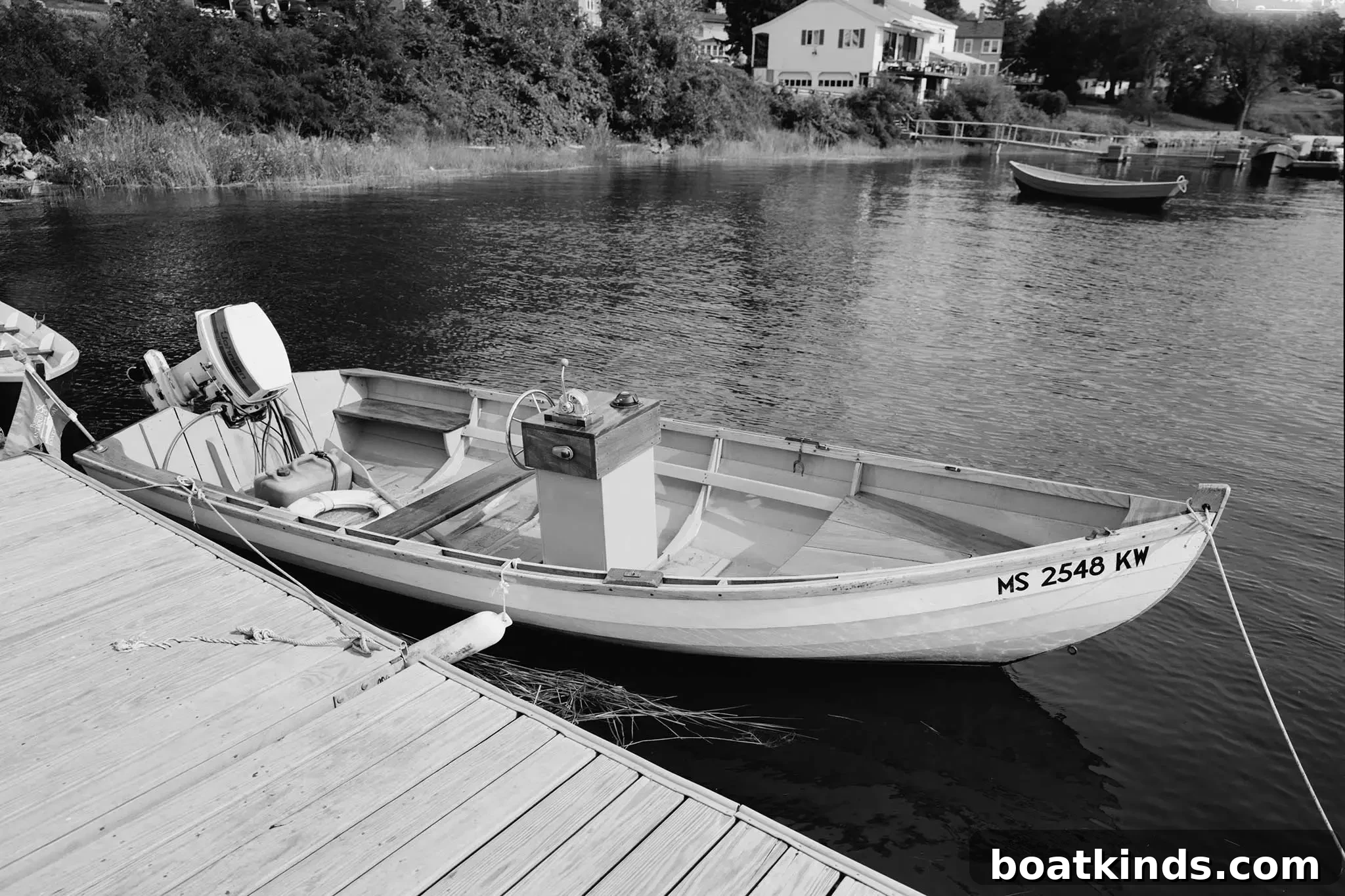
Closely related to the Surf Dory, the Amesbury Skiff retained the flared, rounded sides and flat bottom forward, but its stern was broadened. Instead of narrowing to a traditional tombstone transom, the skiff’s hull remains beamy through the transom, with the flat bottom extending to a wide stern. This change restored balance and buoyancy under the load of inboard propulsion and later adaptations for outboard engines.
Construction and Handling Characteristics
The Amesbury Skiff is lapstrake-planked and flat-bottomed, combining a dory’s seaworthiness with the practicality demanded by power applications. From midships to the bow the shape mirrors the Surf Dory—rounded and flared for stability—while the flat, broad transom at the stern provides a dry, well-supported ride. The result is a boat that is easy to handle, dry in choppy conditions, and capable of planing when powered appropriately.
These skiffs proved versatile: originally designed for inboard engines, many were later modified for outboards. Their stability and predictable handling made them useful for livery services, coastal and inland fishing, rescue work, and family cruising, and they remain a practical choice for recreational boaters.
Continuity and Preservation
Lowell’s Boat Shop has remained a working boatyard, preserving traditional wooden boatbuilding skills across generations. Ownership passed out of the Lowell family in the 1980s to the Odell family, and then to the Newburyport Maritime Society in the 1990s. The shop was recognized for its historical significance with listing on the National Register of Historic Places in 1988 and designation as a National Historic Landmark in 1990. In 2006, Lowell’s Maritime Foundation, an independent nonprofit, purchased the property and has since guided the yard into its third century of wooden boatbuilding.
Legacy and Availability
Lowell’s continues to build dories and skiffs according to the family’s tradition. The Amesbury Skiff remains in the shop’s lineup, offered in models ranging from 12 to 20 feet. These boats preserve the practical innovations that made Lowell’s designs central to New England’s working waterfronts while offering modern boaters a connection to two centuries of craftsmanship.
This article was originally published in the August 2026 issue.