
HMS Endurance: Shackleton’s Ship Found Intact on Weddell Sea Floor
In 1914, polar explorer Sir Ernest Shackleton set out from the United Kingdom on the Imperial Trans-Antarctic Expedition aboard HMS Endurance. The ship and her crew reached the edge of Antarctica the following year, but thick pack ice in the Weddell Sea trapped the vessel and forced the men to abandon her. Although every member of the expedition survived, Endurance eventually succumbed to the crushing ice and sank, disappearing beneath the Southern Ocean for more than a century.
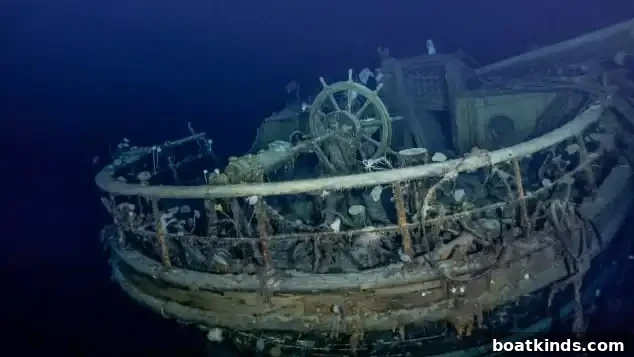
Now, 115 years after she sank, Endurance has been located on the seabed, lying upright and remarkably well preserved at a depth of 9,842 feet in the Weddell Sea. The discovery was led by the Falklands Maritime Heritage Trust in partnership with the content platform History Hit, and marks one of the most significant polar shipwreck finds in recent history.
Mensun Bound, the mission’s director of exploration, described the condition of the wreck: “This is by far the finest wooden shipwreck I have ever seen. It is upright, well proud of the seabed, intact, and in a brilliant state of preservation.” Those words emphasize both the rarity of finding a wooden vessel in such condition at this depth and the exceptional historical value of the site.
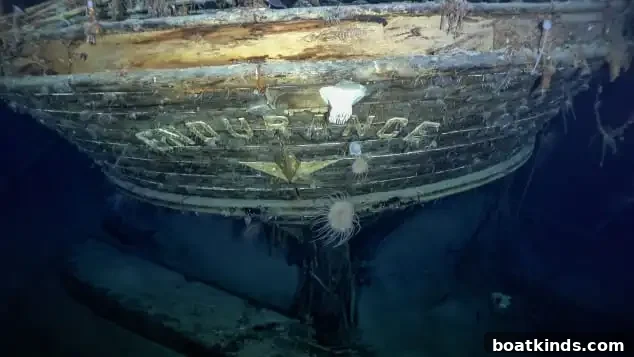
The search effort, conducted as Endurance22, sailed from Cape Town aboard the research vessel S.A. Agulhas II. The expedition team included scientists, historians, and filmmakers who documented the operation for an upcoming National Geographic documentary. Using Saab-built Sabertooth remotely operated search vehicles, the team was able to scan the seafloor and capture detailed imagery once they reached the area where Endurance was believed to lie. Video footage clearly shows the ship’s name etched on the stern, confirming the identification.
Those images and the careful documentation produced by Endurance22 provide an unprecedented record of Shackleton’s vessel. The discovery allows historians and maritime archaeologists to study the ship’s construction, condition, and the way it has endured more than a century beneath the cold Antarctic waters, all without disturbing the site itself.
In accordance with the Antarctic Treaty — an agreement originally signed by 12 countries in 1959 that governs activities on the continent and surrounding waters — the expedition team will not raise the wreck or remove artifacts. Instead, the ship will be studied in situ: mapped, photographed, and recorded to preserve its context and protect it for future generations. This approach follows established principles of maritime heritage stewardship and respects the fragile environment of the Weddell Sea.
The recovery of Endurance offers both a poignant reminder of the extreme challenges faced by early polar explorers and a unique scientific opportunity. The site stands as a time capsule from the Heroic Age of Antarctic Exploration, providing researchers with fresh data about ship preservation in deep, cold waters and offering the public an emotionally powerful connection to Shackleton’s story through the upcoming documentary and published findings.
While the ship will remain where she sank, the extensive survey work and imagery collected during Endurance22 will enable ongoing study and public engagement. Careful analysis of the footage and maps will inform conservation strategies and historical interpretation without compromising the wreck’s integrity. For historians, maritime archaeologists, and anyone captivated by polar history, the rediscovery of HMS Endurance is a rare and invaluable event.