
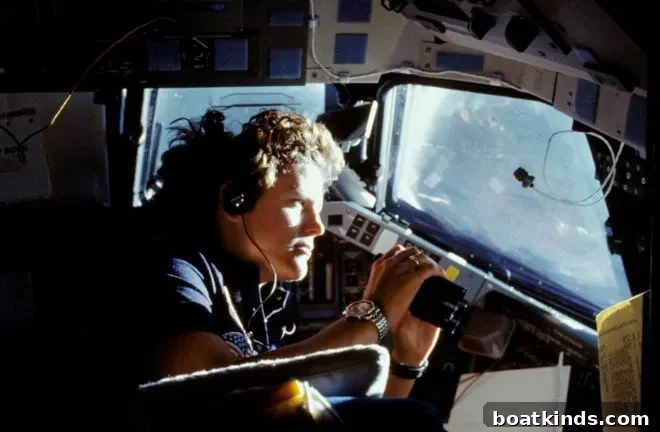
Kathy Sullivan Becomes First Woman to Reach the Ocean’s Deepest Point
Kathy Sullivan, who first made history in 1984 as the first woman to walk in space, has added another landmark achievement to her career. In a recent dive to the Challenger Deep—the deepest known spot on Earth—Sullivan became the first woman to reach the bottom of the ocean’s most remote trench.
What and Where Is the Challenger Deep?
The Challenger Deep is a part of the Mariana Trench and represents the deepest known section of the seabed. Located in the western Pacific Ocean, it lies nearly seven miles below the surface. The first recorded descent to the Challenger Deep was completed in 1960 by US Navy Lieutenant Don Walsh and Swiss oceanographer Jacques Piccard, and only a handful of explorers have reached it since that initial expedition.
The Recent Dive
On the recent expedition, Sullivan boarded a two-person submersible alongside former naval officer Victor Vescovo. The pair descended to more than 35,800 feet beneath the sea surface. The entire round-trip—from descent to the seafloor and back to the surface—took between four and five hours. Operating a submersible at such extreme depths requires careful preparation and robust engineering to withstand the crushing pressures and near-freezing temperatures found in the hadal zone.
Why This Moment Matters
Sullivan’s achievement is important on multiple levels. It is a milestone for human exploration, demonstrating the continued capability to reach and study the most remote environments on our planet. It also represents progress for representation in science and exploration: until this mission, no woman had been recorded as reaching the deepest known point of the ocean. Sullivan’s record-breaking career—spanning achievements both in space and beneath the sea—highlights the broad possibilities for scientists and explorers regardless of gender.
Scientific and Cultural Significance
Exploring the Challenger Deep is more than a symbolic feat. Each descent contributes to our scientific understanding of extreme environments, marine geology, and deep-sea biology. Samples and observations from these depths can inform studies on how life adapts to high pressure, low temperature, and complete darkness. Expeditions to such locations also drive technological innovation in submersible design, sonar mapping, and remote-sensing instruments.
A Call for Continued Exploration and Inclusion
Sullivan has expressed her hope that nations, research institutions, and individuals will continue to expand humanity’s knowledge of the planet. Her message also emphasizes the need for greater diversity and female representation in science, technology, engineering, and exploration fields. Her career—spanning both a pioneering spacewalk and this historic ocean descent—serves as an example of how sustained curiosity and commitment can break long-standing barriers.
Looking Ahead
The Challenger Deep remains one of the least-explored places on Earth. Future missions will likely build on this expedition’s data and experience to deepen scientific insight and improve the tools used to reach the ocean’s extremes. As exploration continues, the legacy of explorers like Kathy Sullivan will help inspire new generations to pursue careers in marine science, aerospace, and related disciplines.
Her recent dive stands as a reminder that exploration takes many forms—above and below the surface—and that advancing knowledge often comes hand in hand with expanding who is welcomed into the field.