
Known for simple, intuitive products Vesper doubles down on what they do best for an innovative new product.
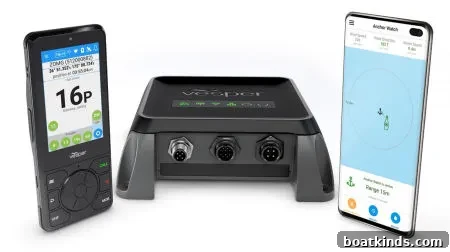
Vesper has built a strong reputation in marine electronics for delivering high-performance, thoughtfully designed products that are easy to use. Their new Cortex platform continues that tradition by combining VHF radio, AIS transponder, and advanced boat monitoring into a single, modular system. Announced at the NMEA conference in Norfolk, VA, Cortex is designed to simplify onboard communications and safety while expanding remote monitoring and control capabilities for boat owners.
Cortex is modular: the M1 base unit provides AIS and monitoring capabilities, while the H1 and H1p handsets add full VHF audio functionality. The system also includes a mobile app for display and control. You can start with just an M1 for AIS and monitoring, then add handsets as needed to enable VHF audio and multi-station communication across the boat.
VHF
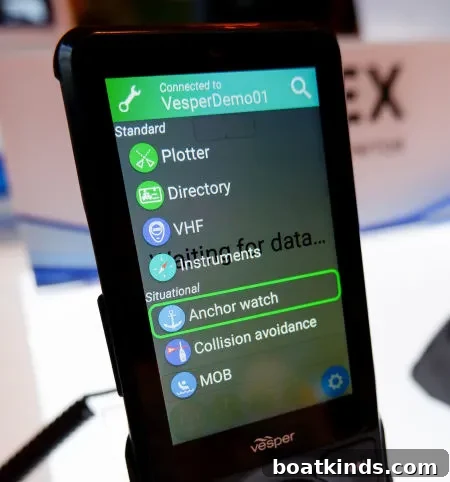
Vesper calls Cortex “VHF Re-imagined,” and the handset interface shows why. The design focuses on the most frequently used features and puts them right on the screen for quick access. For example, when viewing AIS target details you can tap a visible on-screen button to initiate a DSC station-to-station call, avoiding the multiple menu steps many traditional radios require.

VHF audio requires at least one H1 or H1p handset connected to the M1 base. Vesper notes regulatory requirements prevent using a phone or tablet running the Cortex app as a legal VHF handset, so the dedicated handsets provide compliant audio, DSC, and speaker functionality. Cortex uses an 8-channel VHF architecture. At launch two channels serve VHF audio, one handles DSC, and two are reserved for AIS, leaving three channels available for future features and scanning modes. Each channel is dedicated to a single function to prevent audio lag regardless of enabled features. Currently Cortex supports dual watch (monitoring channel 16 plus one additional channel), with expanded scanning modes planned in future updates.
AIS
Cortex includes an AIS B/SO transponder and retains Vesper’s proven collision avoidance, anchor watch, and man-overboard (MOB) alerts. The B/SO transponder provides more frequent updates for faster vessels and improved transmission performance in congested waters. AIS targets can be viewed in bird’s-eye, plotter, or list formats in the app or on an H1 handset, and you can access detailed target data with a tap.
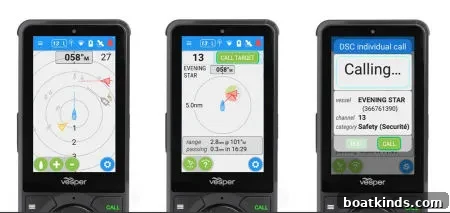
All AIS and vessel data are output over the M1’s NMEA 2000 connection, so your existing multi-function displays (MFDs) and apps can use the full AIS feed. The tight integration of AIS and VHF makes tasks like station-to-station DSC calling straightforward: select a visible AIS target and use the on-screen “Call Target” control to initiate communication.
Monitoring
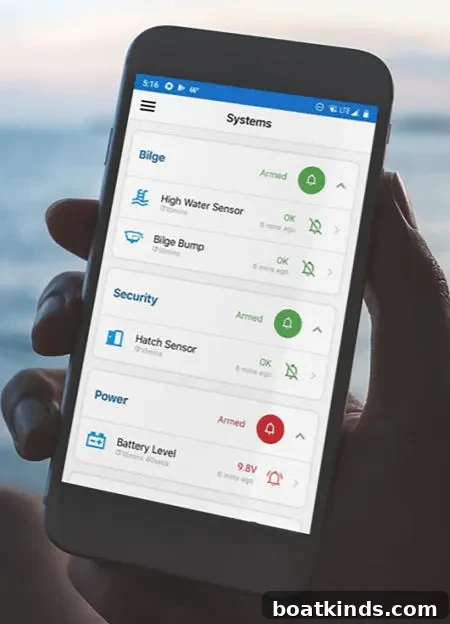
Vesper has a long track record of turning sensor data into useful safety and convenience features, and Cortex expands that approach with a full-featured boat monitoring and control system. Cortex leverages the M1’s GPS, sensors, and cellular connectivity to deliver off-boat alerts and remote control when you’re away from the vessel.
The monitoring system covers anchor watch, GPS position, battery voltage, bilge level, temperature, shore power status, security sensors, bilge pump control, heading, wind, depth, and barometric pressure. It can also switch loads—lights, refrigeration, or other devices—via relays, allowing remote control of onboard systems. The built-in cellular radio enables anchor alarm and other critical notifications to reach you anywhere with cell coverage, not just when you’re aboard.
Base unit
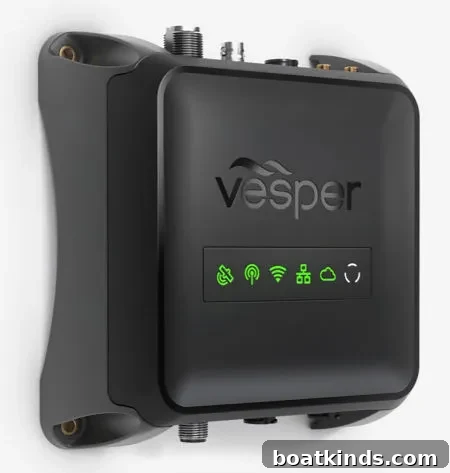
The compact, water-resistant M1 base unit is the heart of Cortex. Despite its small footprint it packs Wi-Fi and cellular radios, an 8-channel VHF radio supporting AIS, VHF and DSC, NMEA 2000 connectivity, GPS input, an analog I/O port (with five channels dedicated to monitoring), and built-in sensors for heading, barometric pressure, and battery voltage. The M1 also includes a no-loss VHF antenna splitter, allowing a single antenna to serve the Cortex plus one additional VHF radio—handy for integrating Cortex alongside an existing radio during phased upgrades.
Handset
VHF audio and speaker alerts require at least one H1 or H1p handset. The H1p is the portable version with a rechargeable battery; the standard H1 is designed for fixed installation. Up to ten handsets can be paired to a single M1 base. All handsets communicate with the M1 using 2.4 GHz Wi‑Fi. Each handset features an optically bonded full touchscreen protected by Gorilla Glass, designed to be readable at off angles and usable with wet or gloved hands. The handset snaps into a charging cradle for the cordless units and offers a battery life of more than twelve hours under typical use.
Alerting
Vesper’s alerting system has been a standout feature across their product line, and Cortex expands both the range and delivery of alerts. Alerts for anchor drag, dangerous AIS targets, and MOB events are now spoken through the 85 dB speaker built into each H1 handset and displayed on screen. If you subscribe to the paid monitoring plan, real‑time alerts and remote control commands are pushed to your phone as well. A free twice-daily sensor status update is included with every Cortex device; paid monitoring provides updates every five minutes and enables instant alarm notifications and remote device control.
From hands-on demos, Cortex feels well thought out: the handset balances comfortably in the hand, the user interface is clear and intuitive, and the system is designed for single‑handed operation. While some features such as advanced hailing, weather alerts, or expanded scanning modes remain on the roadmap, Cortex’s built-in antenna splitter makes it easy to use alongside an existing radio until additional functions roll out.
Pricing varies by configuration. A bundle with one handset and the M1 base—providing AIS, monitoring, and VHF functionality—is priced at $1,800. The M1 base by itself is $1,300 for AIS and monitoring only. Additional handsets cost $600 each and can be added at any time to enable VHF audio across the system. Paid monitoring is available for $10 per month when billed annually, or $20 per month on a month-to-month basis.