
FPM-050 Fuel Polishing Module: Remove Water and Protect Your Diesel Fuel
Condensation in diesel fuel tanks is a common source of trouble. When water collects in fuel, it creates an environment where bacteria and other contaminants can grow, leading to fuel breakdown, clogged filters, corrosion and poor engine performance. Regular fuel maintenance is essential to protect engines and fuel systems from these issues.
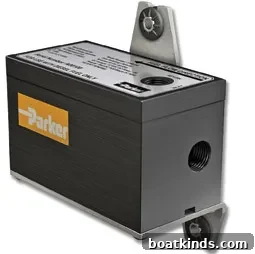
What the FPM-050 Does
The FPM-050 Fuel Polishing Module from Parker Energy Systems is designed to remove emulsified water and suspended contaminants from diesel fuel. By extracting water and polishing the fuel, the unit helps prevent corrosion inside tanks and fuel lines, preserves the effectiveness of primary fuel filters, and reduces the need for periodic chemical treatments and additives.
Key Features
The FPM-050 is a compact recirculation system featuring a solid-state pump and an integrated Racor filter. It is capable of polishing up to 50 gallons of fuel per day, making it well suited for small to medium tanks and regular fuel maintenance loops. The module draws approximately 150 mA when operated at 12 VDC, so it can be powered by standard 12-volt systems and is compatible with solar power sources for off-grid or low-power applications.
An automatic bypass valve is included to simplify operation; the bypass eliminates the need for manual switching during maintenance or if flow conditions change. The manufacturer states the FPM-050 is compatible with diesel, biodiesel and kerosene fuels, broadening its usefulness across a range of equipment and vessels.
Installation and Use
The FPM-050 can be retrofitted to an existing diesel fuel system. It can be installed in line with the main fuel filter/water separator so it works as part of the primary fuel treatment train, or it can be configured as a dedicated fuel maintenance loop that continuously polishes tank fuel. Either configuration helps maintain cleaner, drier fuel in storage tanks and can extend the service interval of primary filters.
Benefits of Fuel Polishing
Regular fuel polishing with a unit like the FPM-050 offers several practical benefits: it limits microbial contamination and sludge formation by removing water, reduces corrosion risk to tanks and metal components, helps maintain consistent fuel quality, and supports reliable engine starts and operation. Because the module reduces the amount of emulsified water and suspended particles, it also decreases reliance on chemical fuel treatments and frequent filter replacements.
Technical and Purchase Information
Capacity: up to 50 gallons per day (recirculation)
Power: 150 mA at 12 VDC (solar-compatible)
Pump type: solid-state
Filter: built-in Racor filter
Compatibility: diesel, biodiesel, kerosene
Automatic bypass valve included
The FPM-050 retails for $587. For further information, inquiries or purchasing details contact Parker Energy Systems, New Britain, Conn., Phone (877) 217-4501; www.parkerfuelpolishing.com.
Who Should Consider the FPM-050
Owners of boats, backup generators, agriculture or light industrial equipment with on-board fuel storage can benefit from a compact, low-power polishing system. The unit is particularly useful for vessels or equipment stored for extended periods, installations with limited maintenance access, or systems where condensation and water accumulation are recurring problems. Because of its low current draw and solar compatibility, the FPM-050 is also well suited to remote or off-grid applications where continuous or periodic polishing is desired without significant power requirements.
By addressing emulsified water and suspended contaminants at the tank level, fuel polishing helps maintain fuel quality and reliability, reducing the likelihood of costly repairs and downtime that result from contaminated diesel.
This article originally appeared in the October 2009 issue.