
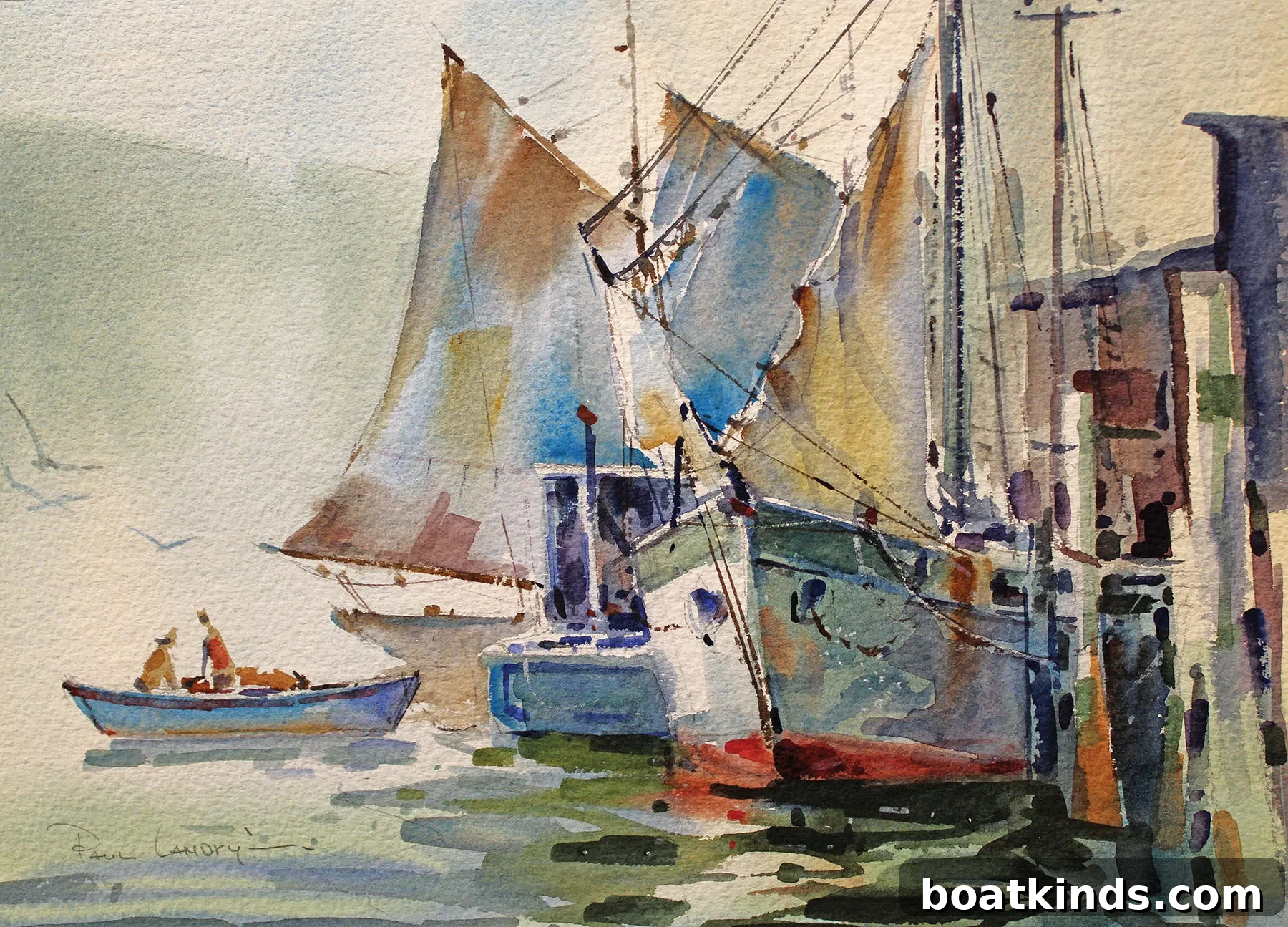
Paul Landry: “At the Dock” and a Life Painted by the Sea
With a watercolor palette of blues and greens, tempered by reds and browns, Paul Landry’s painting “At the Dock” draws the viewer into a quiet, familiar maritime moment. This 9-by-12 watercolor depicts a small scene from the waterfront of his native Halifax: gulls gliding through an indistinct sky, schooners with patched sails, and two men maneuvering a dory across calm water. The composition is spare yet evocative, combining bold brushwork with subtle washes to suggest atmosphere more than detail.
Roots on the Halifax Waterfront
Landry was born in Halifax, Nova Scotia, in 1931 and grew up surrounded by the rhythms of harbor life. As the grandson of French and Scottish schooner captains, he spent his youth on the wharves, working alongside fishermen, hauling traps and mending nets. Those early experiences gave him an intimate knowledge of the sea and the coastal communities that supported it—an understanding he later translated into his art. Observing daily routines, ship repairs, and the changing moods of weather and tide, he learned to see the small facts that make a maritime scene feel lived-in and authentic.
A Career Formed by Sight and Skill
Landry’s formal training began with work as a photo engraver at age 17, a job that sharpened his eye for composition and detail. He later studied at the Nova Scotia College of Art and Design and at the Art Students League of New York, where he refined his technique and expanded his visual vocabulary. Even as he developed his craft, Landry remained committed to subjects rooted in everyday coastal life—boats, boatyards, village houses, and the people who maintained them.
Technique and Themes
Working primarily in watercolor and oil-wash, Landry favored a restrained palette that could convey both the clarity and the melancholy of maritime light. His brushstrokes range from economical and suggestive to decisive and textured, always attentive to the way water and sky interact. He frequently used reference photographs, but his paintings are not photographic records; they are composed memories, distilled impressions that emphasize mood, rhythm, and the human relationship to the sea.
Recurring motifs in his work include dories hauled in winter, small boatshops hunkered under snow, gardens beside sea captain’s houses, and the everyday labor of coastal communities. These subjects reflect a fascination with the people who live and work at the water’s edge and with the environments that shape their daily lives. “I believe you have to know your subject to paint it well,” Landry observed, and that intimate knowledge is visible throughout his oeuvre.
Preserving a Vanishing World
Landry witnessed what he called the “last days” of fleets like the Grand Banks, capturing a world in transition as traditional fishing practices and working vessels gave way to modern changes. His paintings act as both personal memory and cultural record, preserving the look and feel of maritime life for viewers who may never have seen those scenes in person. While economical in means, his works are rich in suggestion and atmosphere, inviting the viewer to imagine sounds, smells, and the tactile work of rope and sail.
Legacy
Paul Landry continued to return to the sea and its surrounding villages for subject matter throughout his life. He described the coast and its people as an “unending source of inspiration” that called both to his heart and to his hand. Landry passed away in 2018, but his paintings remain as quiet testimonies to a life shaped by the harbor: a close observation of people, craft, and weather, rendered with technical skill and abiding affection.
This article originally appeared in the September 2020 issue.