
Marine lithium battery systems have advanced rapidly in recent years. If you need greater onboard capacity to support growing electrical demands, want to lower long-term operating costs, or reduce weight aboard your vessel, converting to a lithium battery system can be a sensible upgrade.
Lithium-ion describes a family of battery chemistries; in the marine world, Lithium Iron Phosphate (LiFePO4 or LFP) is the prevailing choice. LiFePO4 has become popular because of its strong safety profile, long cycle life, and overall cost-effectiveness over the life of the battery. When designed and installed correctly, a lithium system can be as safe or safer than traditional lead-acid systems.
Lithium battery conversion is a broad subject that often leaves boat owners unsure of where to begin. This article focuses on the benefits of lithium compared with lead-acid and explains the differences between internal and external battery management systems (BMS). A later piece can cover the detailed design and installation process.
Why Lithium batteries?
Lead-acid batteries are proven and familiar, but they have notable limitations compared with modern lithium systems. The arrival of LiFePO4 batteries in the marine market has helped meet the higher continuous electrical demands of today’s cruisers and liveaboards.
One of lithium’s main advantages is capacity and cycle life. LiFePO4 batteries are commonly rated for an 80% recommended depth of discharge (DoD) and can last up to around 4,000 cycles. By contrast, lead-acid batteries are typically limited to about a 50% DoD and roughly 1,200 cycles. Although lithium batteries usually cost more up front, their longer usable life and higher usable capacity often make them less expensive over the long term.
Lead-acid chemistry also suffers from sulfation if left at low state-of-charge for extended periods, which reduces capacity and shortens life. Charge acceptance is another limitation: lead-acid batteries accept charge more slowly as they near full capacity, making high-output alternators and large solar arrays less effective than they are with lithium batteries.
Before converting, check with your insurance provider to confirm coverage remains valid after a retrofit. Many insurers will permit lithium retrofits but may require professional installation to mitigate perceived risks. Properly configured battery management systems are an essential part of that safety picture.
So, what is a BMS?
A battery management system (BMS) is critical for lithium battery safety and reliable performance. The BMS protects cells from unsafe temperatures, overcharge, and over-discharge. Lithium batteries are typically offered with either internal or external BMS configurations, each with its own advantages and trade-offs.
Internal BMS Batteries
Internal BMS batteries are often promoted as “drop-in” replacements for lead-acid batteries because they simplify installation. Each battery contains its own BMS, which reduces the need for separate external control devices. That built-in simplicity makes them appealing for many DIY and retrofit applications.
An important upside to internal BMS-equipped batteries is resilience in a multi-battery bank. If an individual battery fails, a correctly wired system using positive and negative bus bars will typically isolate the failed unit and allow the rest of the bank to continue operating. This can be an advantage over some external BMS configurations that, if not properly designed, might take the entire bank offline when a fault occurs.
The main drawback is serviceability: if a cell or the internal BMS fails, the entire battery usually must be replaced. Some internal BMS batteries also lack external communication ports, which can limit monitoring and integration with alternators, chargers, or system monitors. That lack of communication can create challenges for alternator protection and may make meeting certain safety standards or alarm requirements more difficult.
Internal BMS batteries are sometimes restricted in how they can be wired in series or parallel, which limits their use in larger-capacity house banks or higher-voltage systems. These limitations vary by brand, so it’s important to consult the manufacturer’s specifications before purchasing. Despite these constraints, internal BMS models are improving quickly, and many reputable brands now offer robust options.
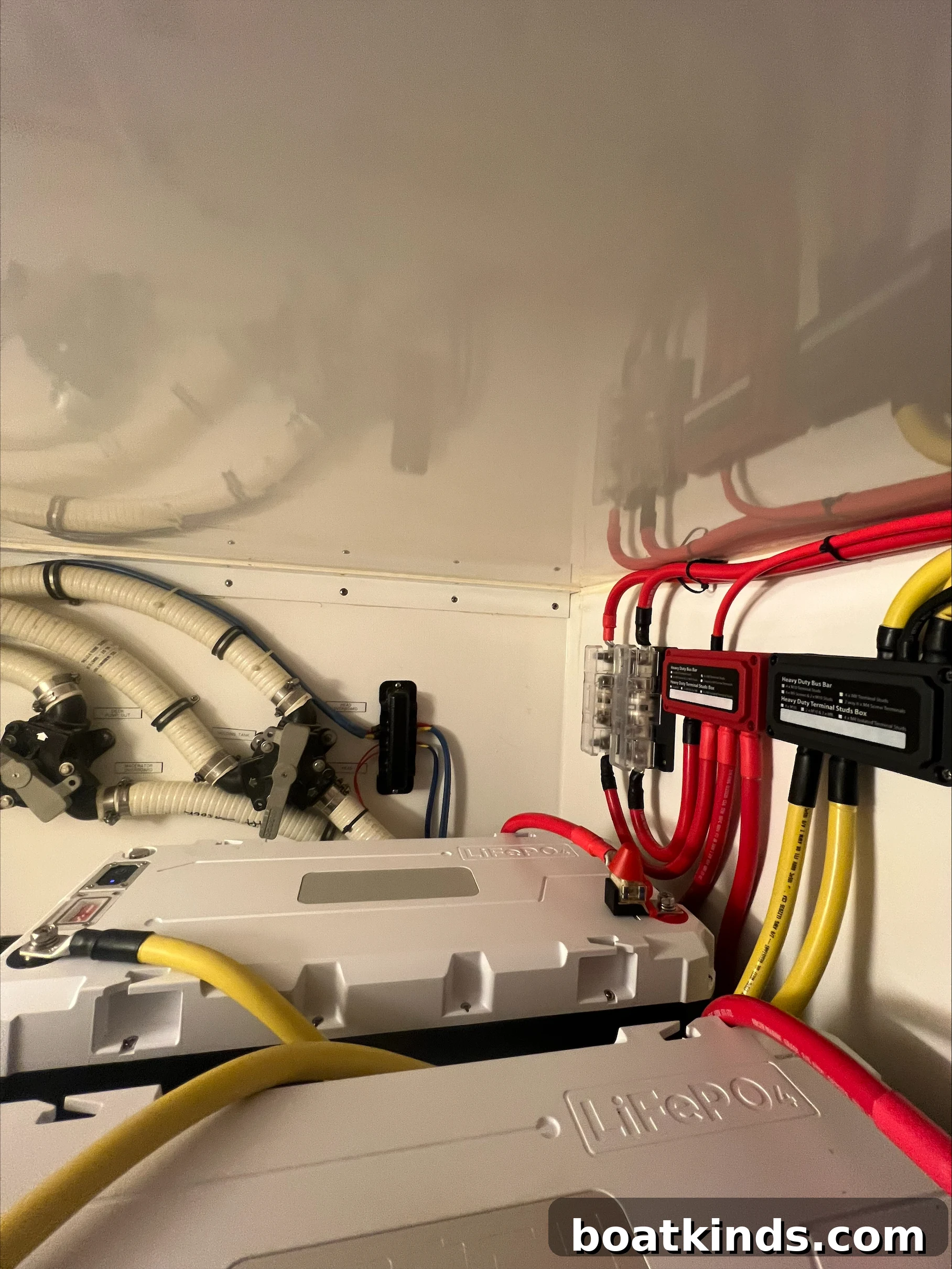
External BMS Batteries
External BMS systems are more complex but also more flexible. Because the BMS is separate from individual battery modules, it can independently control the charging and load sides. That allows the BMS to disconnect the charging source in an overcharge event while keeping house loads active, or to disconnect loads while preserving the charging connection in an over-discharge condition. This separation improves operational resilience.
External BMS configurations are generally easier and less expensive to repair: a failed module or controller can often be replaced without discarding entire batteries. They also typically allow more flexible wiring for larger amp-hour banks or higher-voltage systems—provided all manufacturer guidelines are strictly followed.
The trade-offs include added installation complexity and higher system-level cost for wiring, controls, and labor. External BMS installations require careful design, accurate wiring, and sometimes a detailed drawing to ensure correct operation and safety.
Which is right for your boat?
There is no single correct answer. External BMS systems tend to be favored by professionals for their flexibility and scalability on larger or customized installs. Internal BMS batteries are becoming more capable, often including communication features such as Bluetooth, improved charge/discharge tolerance, and more competitive pricing, which make them increasingly attractive for many owners.
Deciding between internal and external BMS approaches starts with a clear assessment of your electrical needs, desired expandability, space constraints, and whether you require professional installation. Once those requirements are established, you can move into system design and layout with confidence.
Mike Garretson owns Sea & Land Yacht Works in Wakefield, Rhode Island. This article was originally published in the August 2024 issue.