
Intrepid Powerboats marks its 40th anniversary this year, celebrated for pioneering advances in center-console design and performance. The company has introduced numerous industry firsts while continually refining construction, fit and finish, and its single-step hull technology. Ken Clinton, who has been with Intrepid for 32 years and served as president for the past 14, has played a central role in shaping both product direction and company culture. Below, Clinton discusses the evolution of center-console boats, the innovations that drove larger designs, and where the segment is heading.
SOUNDINGS: You grew up in the Northeast and your first marine job was building submarines in Connecticut. How did you move into recreational boatbuilding?
KEN CLINTON: I’m from Danielson, near Groton, Connecticut. My first job was as a machinist at General Dynamics, building submarines. After a vacation to St. Petersburg, Florida—arriving to sunshine and green grass while my hometown still had snow—I decided I didn’t want to wait until retirement for that kind of weather. I quit, moved south and started looking for work in the boat business.
My first role in Florida was with Triumph Yachts, installing inboard gas engines and running gear. I quickly began organizing installations and building jigs to improve efficiency, which led to a supervisor role. The luxury tax of the late 1980s hit the industry hard, and Genmar closed Triumph, shifting managers to Wellcraft. When a large St. Petersburg plant became available, Yoshiro Kitami—owner of Intrepid and Super Hawaii—took over the facility and merged the brands. I was hired by Intrepid and continued my career there.
SOUNDINGS: You worked your way up through manufacturing to the top. How did that experience shape your leadership?
KEN CLINTON: I began on the assembly line and quickly moved into lead and supervisory roles, then plant manager, VP of manufacturing, COO and, for the last 14 years, president. Having done almost every job gives me a deep respect for our team and practical insight when I meet customers. I can discuss design details with buyers and immediately understand what’s feasible in production—what will work and what won’t.
SOUNDINGS: Intrepid is known as a true semi-custom builder, pushing center-console boundaries. How does your hands-on background influence the boats you build?
KEN CLINTON: Every Intrepid is built to order. We typically produce about 110 boats a year, and our production slots are booked 12 to 18 months out. Many companies call themselves semi-custom but offer only superficial choices like paint color. At Intrepid, I sit with each customer to create a detailed build sheet tailored to how they intend to use the boat—family cruising, diving, tournament fishing, etc. Customers regularly request significant modifications: relocating a head, enlarging a cabin, or adding a side dive door long before those features were common. That customization is less efficient than repeat production, but it’s the reason customers come to us—experienced boaters who know what they want and expect we can deliver it.
SOUNDINGS: Intrepid has long favored center consoles. What drove the move to larger, faster center-console models?
KEN CLINTON: In the early days, outboards were modest by today’s standards—200 horsepower was considered large. To get a 37- or 40-foot hull to perform with limited power, we had to develop very efficient hulls. Our proprietary single-step bottom helped create that efficiency, but many ideas came directly from customer feedback. For example, one customer wanted to fish from a center console but needed an onboard head that his wife would accept; we designed the first in-console head, which is now standard.
We also built the first large center console—a 47-footer—after a customer asked for a center console on our 47-foot cabin sport yacht hull. Initially a one-off project, that stick-built prototype drew interest after we posted photos on social media in 2010, and strong demand led to the 475 Panacea. Creating that boat revealed technical challenges, primarily how to power such a large center-console hull.
SOUNDINGS: What engineering hurdles did you face, and how did you solve them?
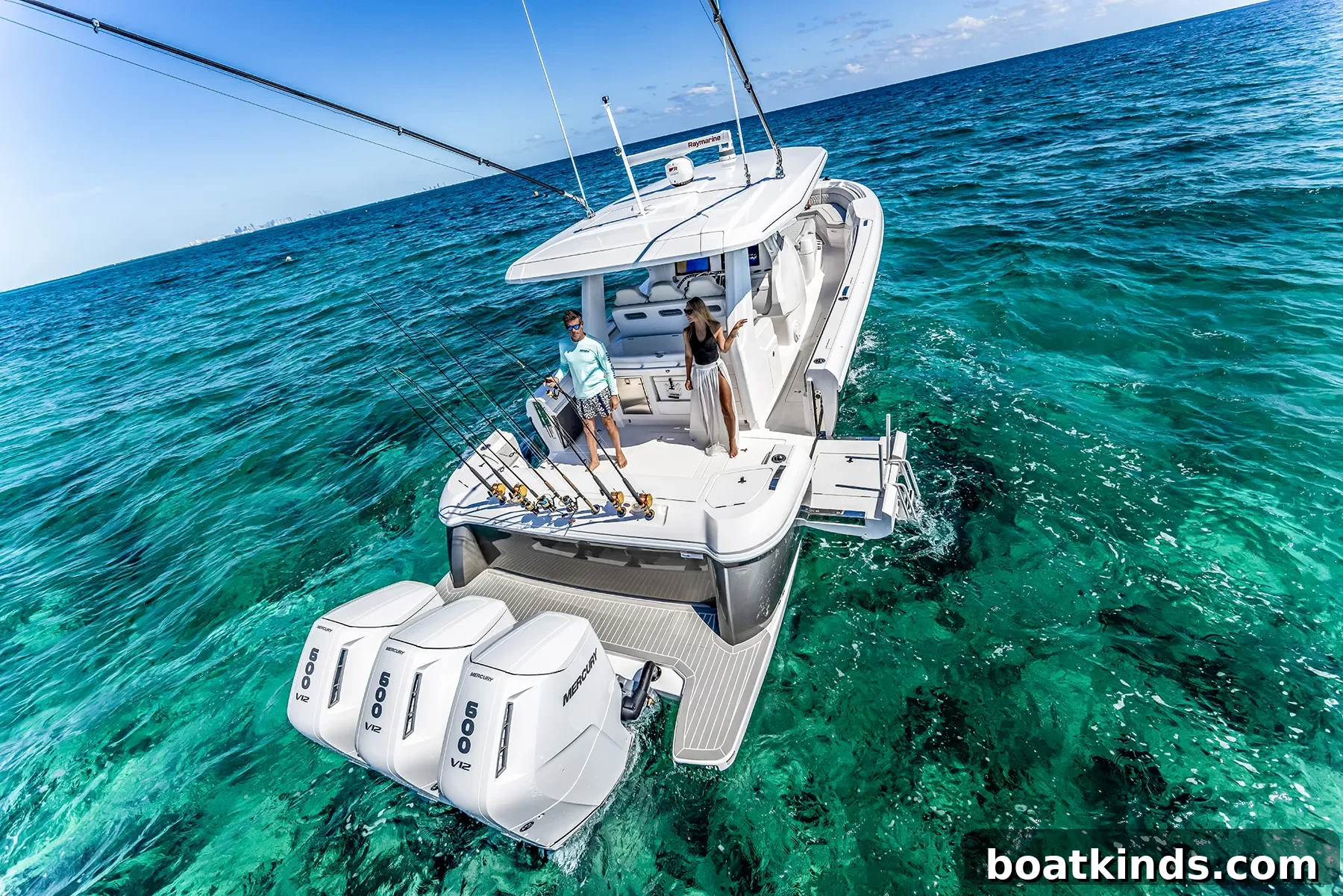
KEN CLINTON: The biggest issue was power. At the time, the largest production outboards were 350 hp and standard shafts were too short. Manufacturers like Mercury and Yamaha initially declined to make longer shafts or higher-horsepower production outboards. We worked with Latham to build shaft extensions, and later partnered with Seven Marine to install very high-horsepower outboards on the 475 Panacea at the 2011 Miami Boat Show. That move proved the market existed and helped spur the industry to produce longer shafts and higher-horsepower outboards. Pushing those boundaries enabled the growth of larger center consoles across the industry.
SOUNDINGS: Where do you see the center-console market heading?
KEN CLINTON: The rise of powerful outboards has fundamentally changed center-console design by freeing space inside the hull and enabling larger, more capable boats. Intrepid is planning a new production facility in Clearwater, Florida, designed to build outboard-powered boats up to at least 65 feet. Efficient hulls combined with modern engine technology make that feasible. What was once a 30-foot core market has grown to 40 feet and beyond; joystick control and other systems have reduced the learning curve for owners, removing much of the intimidation previously associated with larger boats. I expect growth to continue.
SOUNDINGS: Does this mean inboards are obsolete?
KEN CLINTON: For many sizes, yes—especially in the center-console segment. For very large yachts, 75 feet and above, inboard diesels still make sense. But for most recreational boats, outboards are easier to service and replace, free up interior space, and avoid putting a heavy propulsion system into a wet bilge. With manufacturers like Mercury fully committed to high-performance outboards, the industry is shifting decisively in that direction.
SOUNDINGS: You’ve introduced a new flagship. Tell us about it.
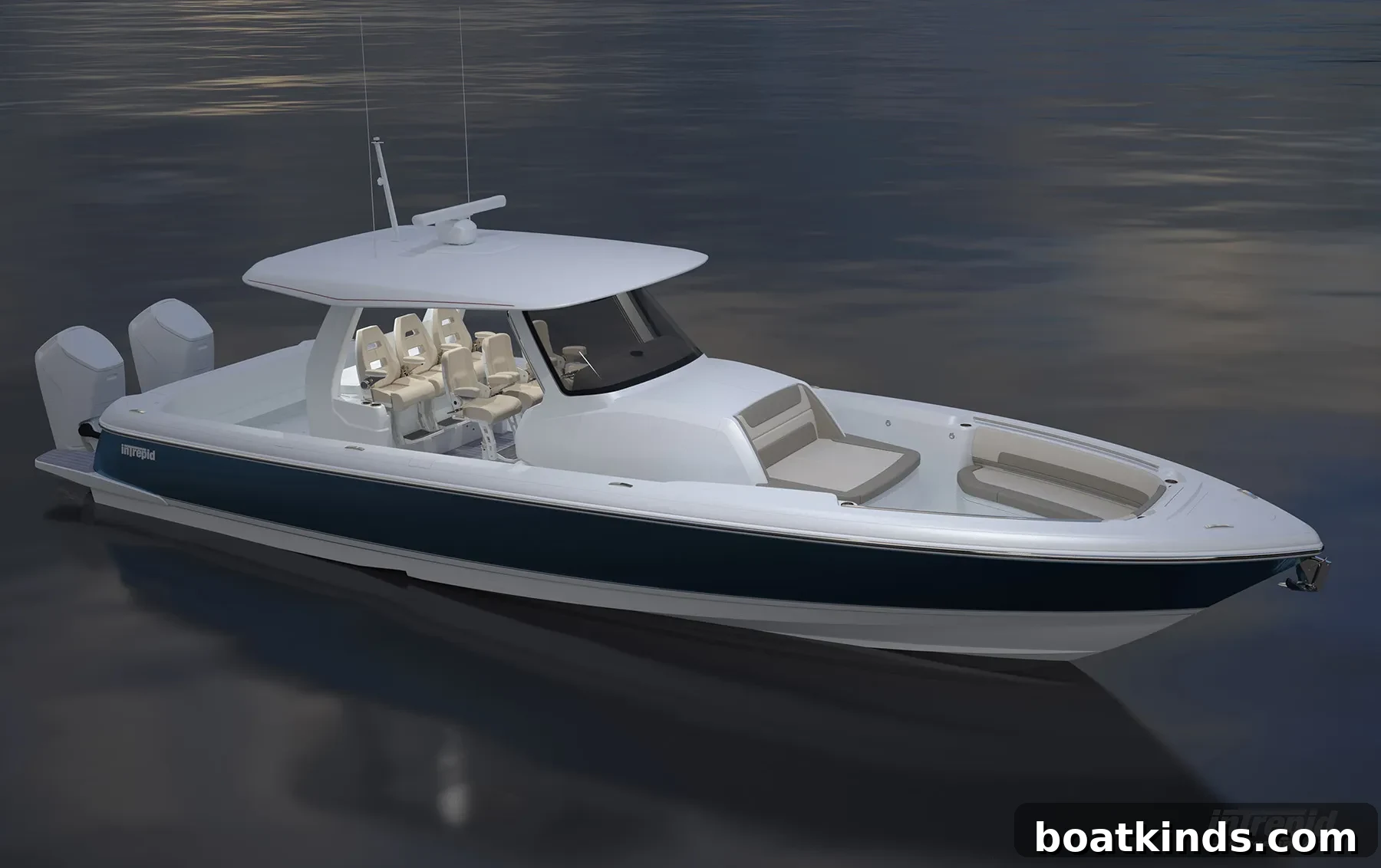
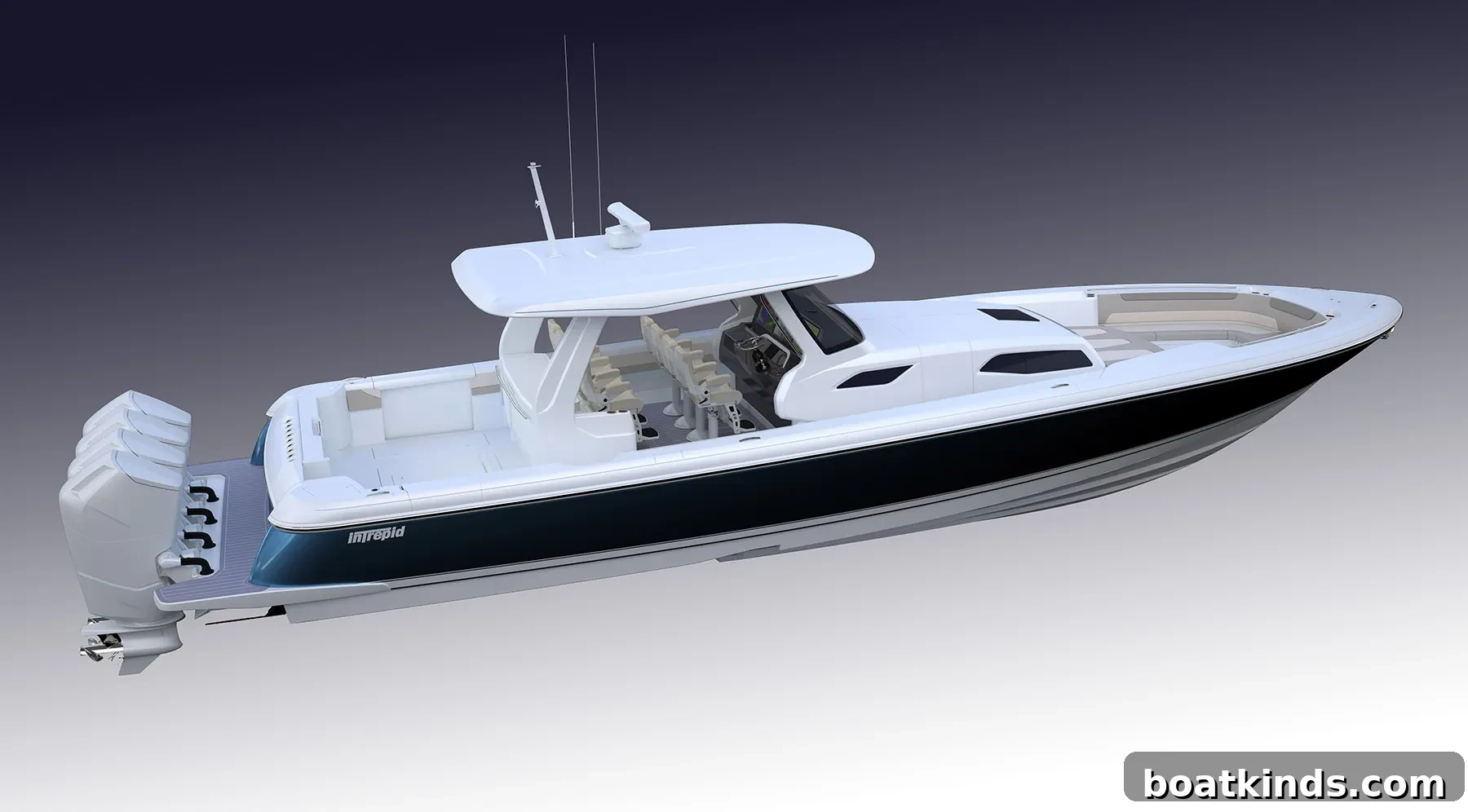
KEN CLINTON: The 51 Panacea is our new flagship—a 51-foot center console with a spacious cabin that includes a full galley, berth, wraparound settee, and a separate head and shower. It has a 14-foot-10-inch beam and during sea trials, the 38,000-pound boat reached 71 mph with quad 600-hp Mercury outboards—an indicator of the hull’s efficiency. Even with two engines trimmed out and 900 gallons of fuel plus six people aboard, it still got on plane and exceeded 40 mph. Initial demand is strong: we already have multiple orders placed.
This article was originally published in the May 2023 issue.