
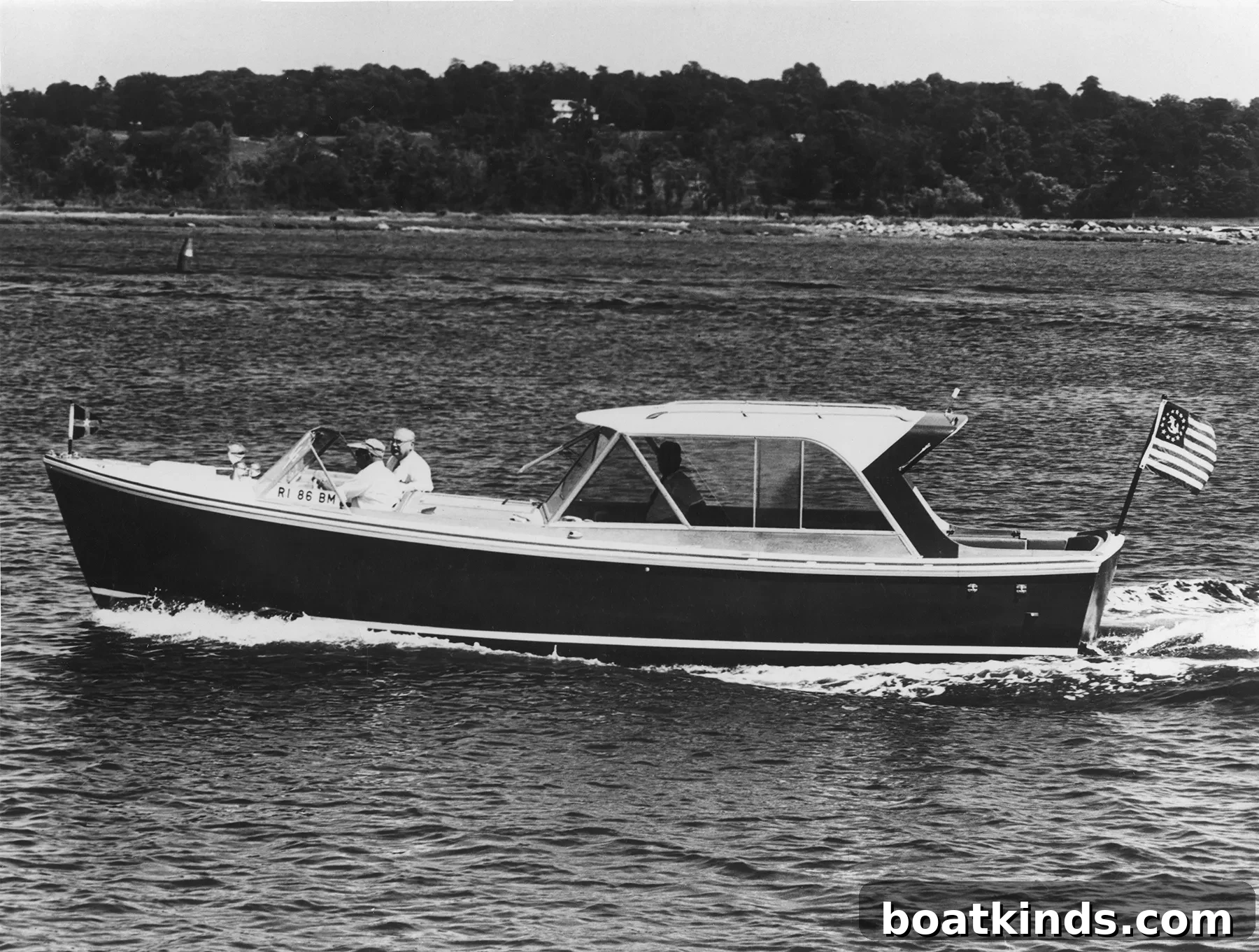
Restoring “Merriweather”: A Rare Dyer Commuter Returns Home
I’ve asked readers of Soundings to send in their stories about boats and memorable on-water experiences, and among the letters and notes I received recently was one about an uncommon classic: a Dyer 29 known as Merriweather. The story combines maritime history, a dedicated restorer, and a small but passionate local boatbuilder—elements that resonate with anyone who cares about preserving nautical heritage.
From Camp Topridge to a Field in Upstate New York
Jan Moniz, a U.S. Coast Guard–licensed captain based in Warren, Rhode Island, owns and operates a charter business on the Warren River and has long admired Dyer Boats. She previously owned a 16-footer and later a fully restored 20-footer completed by The Anchorage Inc., the original builder of Dyer Boats in Warren. In 2017 she learned of a much larger, rare Dyer—a fiberglass 29—that had been abandoned for years in a field in Wilmington, New York.
Tad Jones, president of The Anchorage, discovered the boat and reached out to Moniz. What grabbed her attention was provenance: the vessel had belonged to Marjorie Merriweather Post, the American businesswoman and philanthropist who owned General Foods Corporation. Built in 1963, this Dyer was one of the few constructed in a commuter style and carried guests to and from Camp Topridge, the Adirondack estate owned by Mrs. Post.
A Storied Past and Periods of Neglect
According to Moniz, when Post died in 1973 she bequeathed Camp Topridge and its contents, including the boat, to the state of New York. At some point the boat was adapted by state troopers for use on the lakes, and in subsequent years it passed into private hands. Eventually it was abandoned and left to deteriorate in a field near Wilmington. The image above captures part of that long wait before renewed attention and care.
Why Save Merriweather?
Moniz decided to finance the rescue and restoration of Merriweather. Her motivation is personal as well as historical: she admires that the boat was once owned and used by a woman who ran her own business and who played a role in American cultural history. To Moniz, preserving this vessel is part of keeping maritime stories alive—stories of design, ownership, and the ways boats connect people to place.
The Restoration Effort
Merriweather was hauled out of the woods and transported back to Warren, where The Anchorage Inc. is leading the restoration with Tad Jones as the project lead. The rebuild will address the boat’s structural needs and return as much of its original character as possible. Restoring a classic fiberglass commuter involves careful attention to the hull, deck, fittings, and period-correct interior details, as well as ensuring the vessel meets modern safety and operational standards for use as a charter or showpiece.
Moniz intends to honor the boat’s story while making it seaworthy for contemporary use. For many owners and restorers, that balance—respecting historical authenticity while incorporating necessary updates—is integral to successful preservation.
Community, History, and Boats
This project resonates with readers who appreciate maritime history and classic boat design. Moniz put it succinctly: “Anyone who loves history and boats would most likely agree that Merriweather is worth saving.” Her effort highlights how individual stewardship can rescue a vessel from oblivion and restore a tangible link to a past era of boating and hospitality at places like Camp Topridge.
Soundings will document the makeover in a future issue, tracking the restoration steps and sharing updates on how Merriweather is returned to life. For now, the story stands as an example of how local craftsmen, engaged owners, and respect for provenance come together to preserve important pieces of nautical heritage.
This article was originally published in the November 2023 issue.