
At 70, Gary Paulsen Still Intends to Take on the Sea’s Ultimate Challenge
Gary Paulsen has acquired a new boat that fits him: a rugged, compact cutter built to face — and perhaps embrace — the fierce weather of Cape Horn. After six years away from sailing, the celebrated author and Iditarod racer is drawn back to the sea by a long-standing ambition.
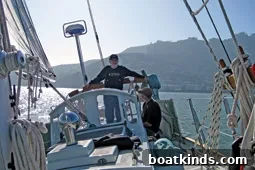
For years Paulsen returned to Alaska’s mush and the life of sled dogs, treating the sea as something he’d left behind. But the ocean’s pull never fully left him. He keeps about 50 dogs at his property north of Willow, Alaska, and while their clamorous presence fills his days, the sea — its smell, its surge and its dangers — remained an ember he could not ignore.
In his 2003 memoir Caught by the Sea, Paulsen recounts surviving an enormous Pacific blow leeward of Catalina Island that nearly killed him in 22 minutes. That night he began plotting a different challenge: someday he would attempt the sailor’s great passage — to round Cape Horn.
Last winter, while training for the Iditarod, he bought another boat. “Two things, unfinished,” he told Soundings by email: an unsettled run at the Iditarod and “the Horn.” He says his life has been a continuous fight against weather, places and people — struggles that he prefers to finish rather than leave unresolved.
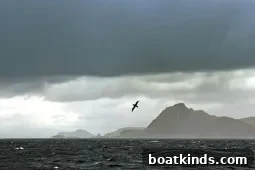
Paulsen’s life is an ongoing story of adventure. He earned Newbery Honors three times — for Dogsong, Hatchet and The Winter Room — and many other literary awards. His success has supported large-scale pursuits: dogsled racing and extended periods at sea.
Sharks, the Sea, and a Lasting Impression
Paulsen was seven the first time he saw the ocean. On a troop ship bound for the Philippines to meet his father, he watched a military plane ditch nearby; survivors swam as sharks converged. The episode terrified and transfixed him. He says the sharks and the sea became metaphors for the harshness and beauty that shaped his life.
He recalls loving the sea immediately — not despite its danger, but alongside it. The ocean’s scale and mystery lodged in his imagination and later surfaced in his writing as vividly as the memories of his early childhood.
Paulsen speaks bluntly about his parents, whose drinking and behavior left him with a chaotic childhood. He ran away by age 12 and found refuge with relatives and on family farms in northern Minnesota. Those places, and the wild landscapes beyond them, would become the foundation for his later work and his comfort in the natural world.
The Natural World and Early Independence
Paulsen learned to live off the land: bowling-alley pin-setting, selling newspapers, hunting and trapping. He developed an affinity for the woods, which he describes as honest and unforgiving in a way that taught him to be resourceful. When troubled, he still turns to the forest for clarity and grounding.
A chance in the public library changed his life: the librarian allowed him to take books home. He adopted a lifelong habit he tells children about often: “Read like a wolf eats.”
A Nobody Starts Writing
After his Army service and a stint in electronics, Paulsen moved to Hollywood and began pursuing writing. A brief encounter with sailing on a mountain lake inspired him to buy his first boat, a 22-foot Schock, and to teach himself to sail. He later moved back to Minnesota, lived in a lakeside cabin, and continued writing. His early work had mixed success; one book failed but another, Mr. Tucket, did well enough to encourage a move to New Mexico.
Struggles with alcohol and difficult publishing experiences interrupted his progress. He stepped away from writing for a time, returning to trapping and living with dogs — an occupation that eventually led him back to literature through stories of hard, solitary life.
The Spotlight and Sled Dogs
Paulsen discovered dog sledding by necessity and then by passion. Someone gave him a few dogs and a sled, and he began hunting and trapping with them. Those dogs became transportation, work, joy and, later, a major theme in his books. His Iditarod runs in the 1980s inspired award-winning work such as Dogsong, which brought him wider recognition.
Publishers and critics admired his terse, vivid prose. “He uses words as a painter uses paints,” one observer said of Dogsong. Paulsen credits steady hard work and some luck for his literary success.
The Boat Thing
Health concerns in the late 1980s forced Paulsen to slow his dog racing. He turned back to sailing in the early 1990s, buying progressively larger and more capable boats. His passages ranged from coastal cruises to voyages into the Gulf of Alaska and the South Pacific. A terrifying blow near Catalina only intensified his fascination with the sea.
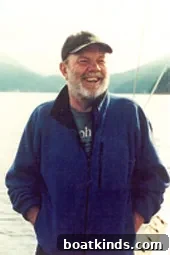
He learned to sail single-handedly. At one point he owned Scallywag, a Bristol Channel Cutter with no engine. Sailing without a motor felt primitive and elemental to him, similar to running dog teams: both require intimate knowledge, presence and self-reliance. He described those experiences as almost spiritual — a kind of merging with nature.
Though he once left a boat in Hawaii and returned to dog mushing, the impulse to sail remained. The sea and the dogs represent competing but complimentary passions: when he’s on one, he misses the other.
To the Dogs
At his Willow, Alaska home, Paulsen’s fifty mixed-breed sled dogs are central to his life. They are not purebred show dogs; they are working animals with distinct personalities. He prepares the teams meticulously, feeding and massaging each dog before harnessing them to the sled. The dangers of Alaska — moose that can attack, thin ice, and occasional bears — make the dogs indispensable. In that landscape, a well-handled team means survival, just as a well-found vessel does at sea.
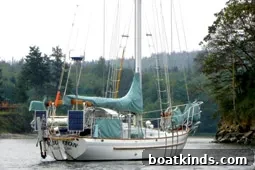
For Paulsen, both the dogs and the sea represent unfinished business. He entered the Iditarod again in 1985 but did not succeed, and later medical warnings forced a hiatus. Sailing and single-handed voyages offered an alternative, yet the dream of Cape Horn persisted. Recently he found a Cape George 31 — a stout fiberglass cutter with a full keel — and discovered it was already in the hands of an old sailing friend, ready for the very run down Chile toward the Horn.
“The great dilemma,” Paulsen says, “is that when I’m on a boat, I miss the dogs, and when I’m with the dogs, I miss the boat.” His life remains a balance between those two elemental callings: the northern winter and the Southern Ocean. At 70, with a boat that looks the part and the resolve to finish what he began, Paulsen intends to answer the sea’s challenge and finally test himself against Cape Horn.
This article originally appeared in the January 2010 issue.