
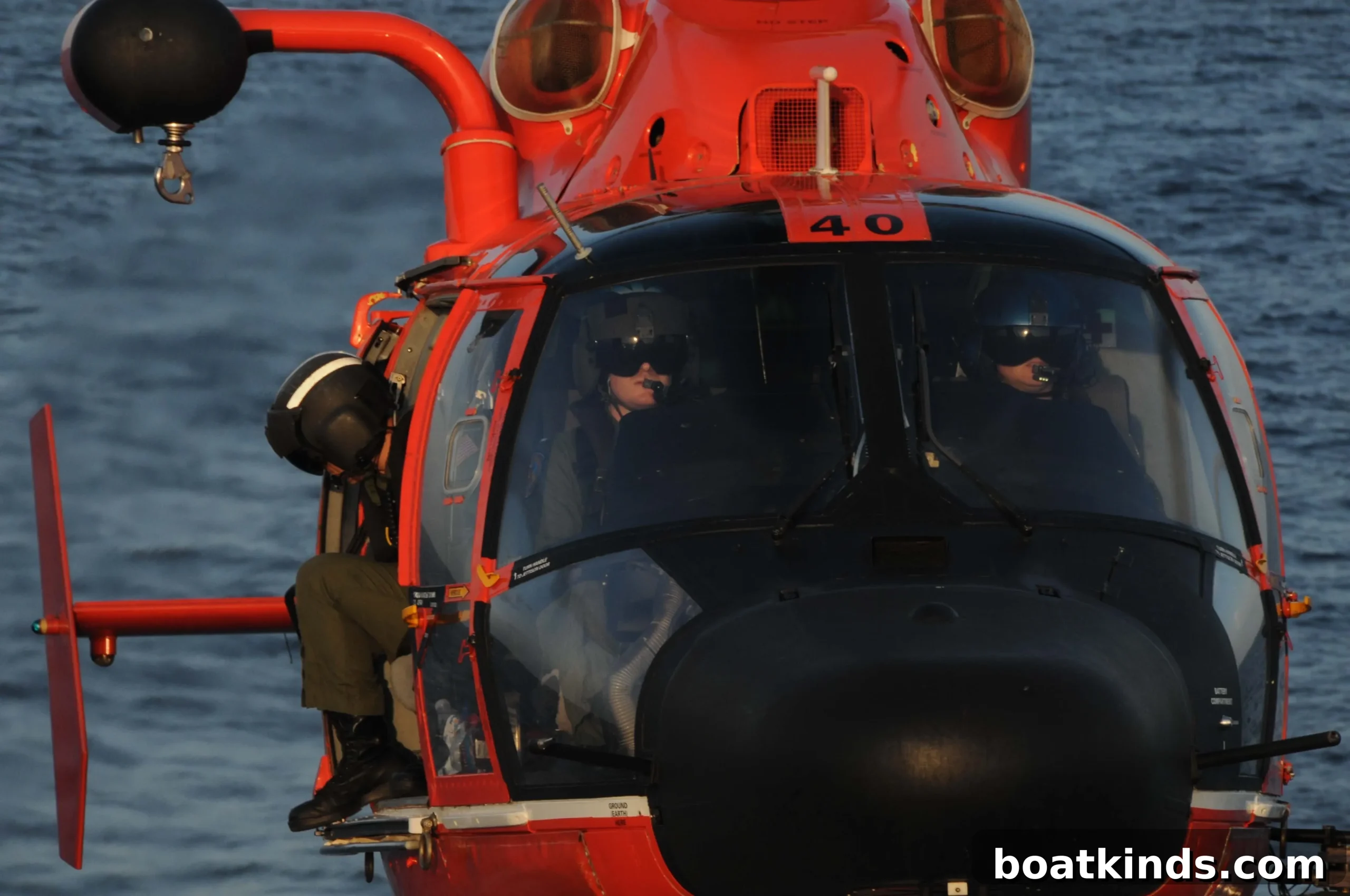
It is a call that always comes sooner than grieving families expect. Relatives cling to the hope of one last flight, one more search pattern, and the Coast Guard sector commander — the person who must ultimately decide when to suspend operations — has to be the bearer of the worst news: nothing was found and the search is being suspended. Choosing to suspend a search is one of the most painful responsibilities in search and rescue.
When the Coast Guard suspends a search for a missing boater, the result is more than heartbreak. Families often react with shock, anger, and confusion. Anger is a natural response, but confusion can be reduced through clear explanation. The hard reality is that most people lost at sea are never recovered. The Coast Guard approaches every suspension decision with that sobering fact in mind, and they do not stop looking lightly or early.
Probability of Survival Decision Aid (PSDA)
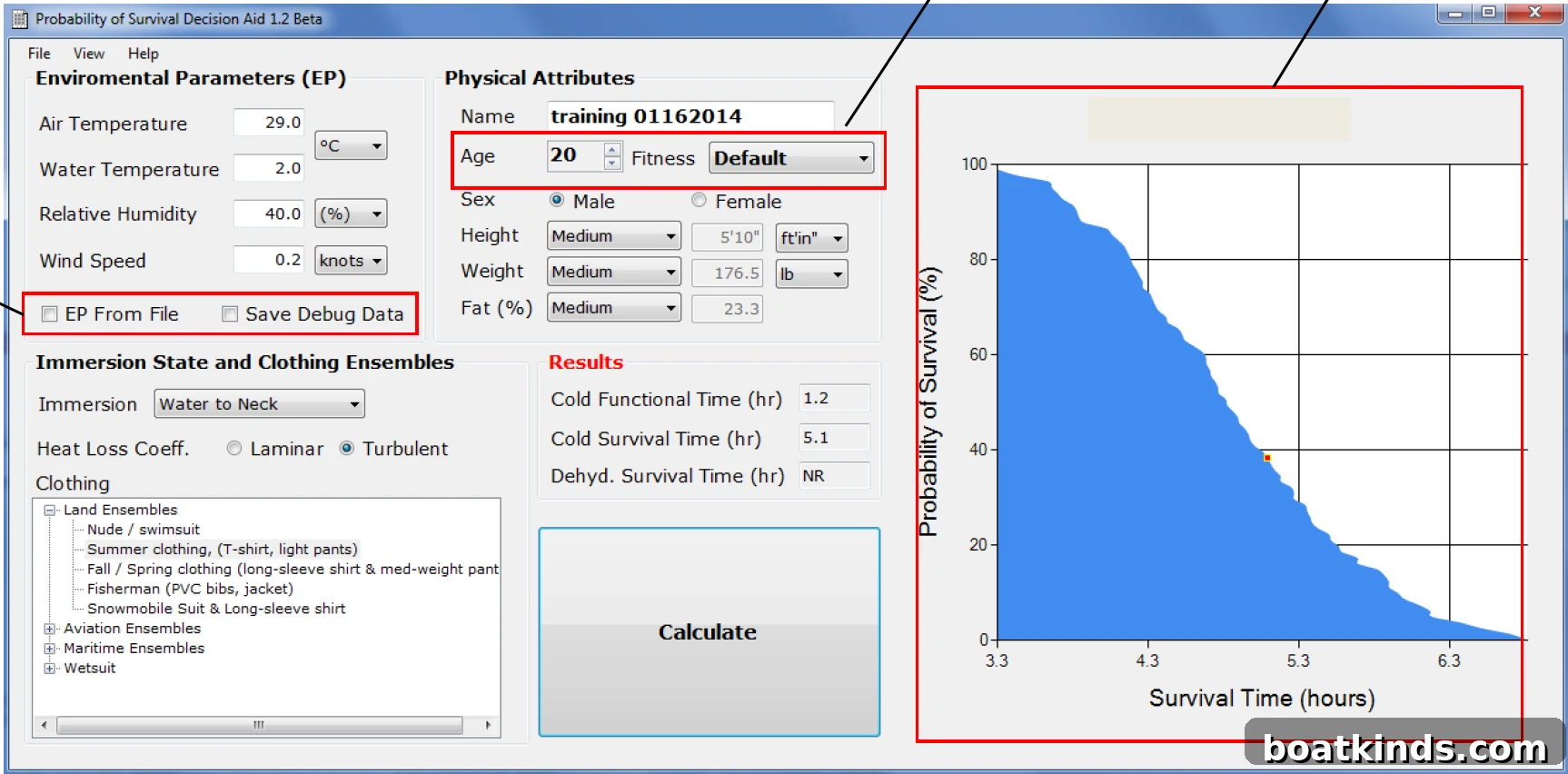
Although it may seem surprising, the Army has produced much of the scientific work used to estimate how long someone can survive in the water. Researchers at the Biophysics and Biomedical Modeling Division of the Army Research Institute of Environmental Medicine developed the Probability of Survival Decision Aid (PSDA), a model-driven computer tool that combines environmental conditions and individual characteristics to predict likely survival times.
The PSDA focuses on hypothermia and dehydration as the principal threats to a person in the water. If a person can remain afloat — on a raft, in a life jacket, on wreckage, or aboard a boat long enough — then staying warm and staying hydrated are the two key determinants of survival. The model is continually refined: its interface, parameters, and underlying data sets are updated with new research and case histories each year.
Compared to real-world outcomes, the PSDA’s predictions tend to be accurate or slightly optimistic, which means the model gives people in distress the benefit of the doubt. That conservative bias is intentional: it helps search planners extend operations to times that maximize the chance of finding survivors.
What You Are Wearing, Where You Are
During the earliest phase of a search, Coast Guard teams gather detailed information about the incident and the missing person. Investigators record variables such as air and water temperature, wind and humidity, sea state, the person’s age, height, weight, fitness level, and most importantly, what they were wearing when they were last seen. All of these inputs feed into the PSDA model.
The PSDA computes three key time estimates, each expressed in hours: cold function time, cold survival time, and dehydration survival time. Cold function time estimates how long a person should be able to move effectively — for example to wave, swim, or use a radio. Cold survival time estimates how long the body can remain alive in the given conditions, and dehydration survival time estimates how long the person can survive without sufficient fluid intake.
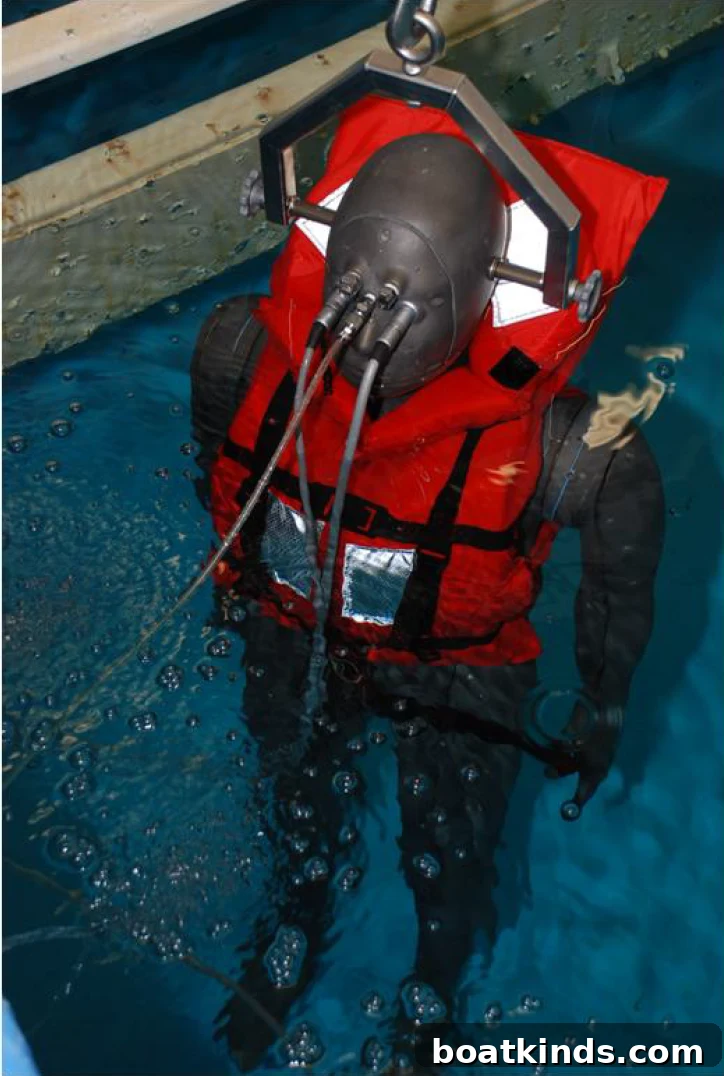
The Navy contributes detailed gear-performance data to these calculations, obtained through controlled testing with an anthropomorphic mannequin called “Nemo.” Nemo can mimic sweating and other physiological responses; researchers place him in cold water wearing different clothing and life jackets to measure how each combination affects heat loss. Those laboratory and field data, combined with historical case outcomes, strengthen the PSDA’s survival estimates.
No Assumptions
One of the PSDA’s most notable features — and a guiding principle for Coast Guard search decisions — is that it avoids assuming the most likely immediate cause of death: drowning. In many incidents, cold incapacitation leading to drowning is the typical fatal sequence. Yet the PSDA deliberately assumes the missing person remains afloat or has gained flotation, even if they were initially without a life jacket. This conservative assumption accounts for possibilities such as finding floating debris, grabbing a life ring, being rescued by a passing vessel, or having managed to stay on wreckage.
That benefit-of-the-doubt approach means the Coast Guard extends searches to honor every realistic chance of survival. Search planners therefore combine scientific modeling with exhaustive operational tactics: persistent coverage of last-known positions, expanding search patterns, multi-objective coordination with air and surface assets, and continuous reassessment as new information arrives.
Delivering the news that a search is over is among the toughest tasks a rescuer faces. Calling in negative results after the final sortie, returning to base, and telling family members that the search will be suspended are emotionally draining responsibilities. Yet those decisions are never made lightly. Each suspension follows a careful, documented analysis of environmental data, survivor probabilities, and available resources.
For those interested in a thorough technical exploration of the PSDA and its scientific basis, published research papers discuss the model methodology, validation against incident histories, and recommended operational use. These technical references are available through official defense research archives and explain how survival probabilities are computed and applied to real-world search-and-rescue planning.